
SCHADS Award Increase 2026
Learn about the SCHADS Award 2026 wage increase, updated pay rates, payroll compliance requirements, and upcoming classification changes affecting NDIS and home care providers.


From the first full pay period starting on or after 1 July 2026, modern award minimum wages will increase by 4.75% following the Fair Work Commission's Annual Wage Review 2026.
For providers covered by the Social, Community, Home Care and Disability Services Industry Award, commonly known as the SCHADS Award, this change will affect payroll, rostering costs, budgets and compliance planning.
For NDIS, home care and community care providers, this is not just a rate update. It is a good time to review employee classifications, shift rules, payroll settings and future award changes.
What is the SCHADS Award?
The SCHADS Award sets minimum pay and employment conditions for many workers in social and community services, home care and disability services.
For care providers, this may include:
- Disability support workers
- Home care workers
- Personal care workers
- Community support workers
- Team leaders and coordinators
- Some administrative and support roles
However, not every care worker is automatically covered by SCHADS. Some roles may fall under other awards, such as the Aged Care Award, Nurses Award or Health Professionals and Support Services Award. Providers should always check the worker’s actual duties, classification and work setting.
What is changing from July 2026?
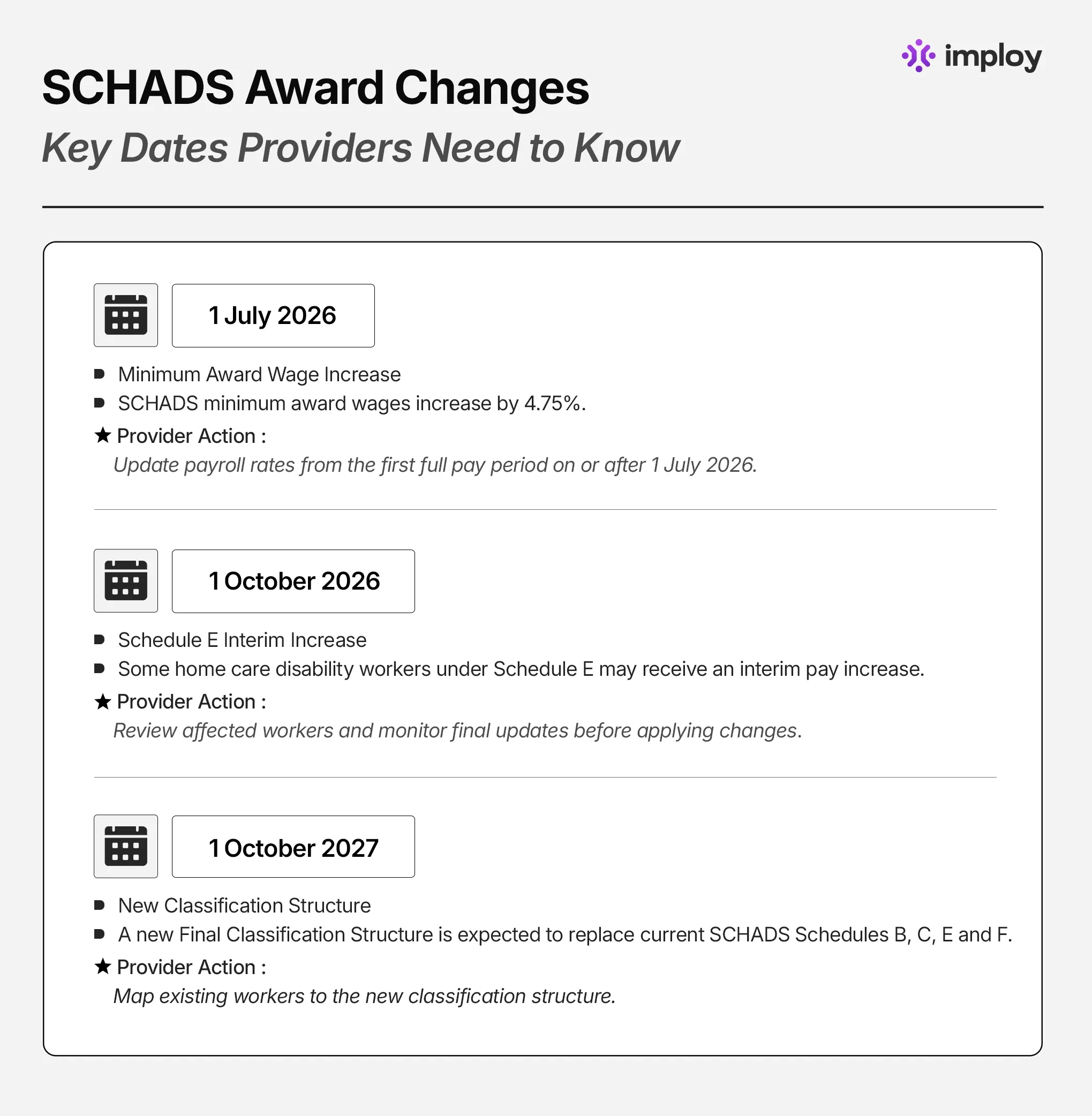
The key change is that modern award minimum wages will increase by 4.75% from the first full pay period starting on or after 1 July 2026.
This means SCHADS minimum rates will need to be updated for employees covered by the award. Providers should not simply apply the increase from midnight on 1 July without checking their pay cycle. The correct start date depends on the first full pay period that begins on or after 1 July 2026.
For example:
The main point is that providers need to check their payroll calendar carefully. Applying the new rates too late can create underpayment risks. Applying them incorrectly can also cause payroll confusion and unnecessary back-pay adjustments.
Why the July 2026 SCHADS increase matters for providers?
For NDIS and home care providers, wage increases affect more than base hourly rates.
A support worker’s final pay may include several components, such as:
- Base hourly rate
- Casual loading
- Evening penalties
- Saturday and Sunday penalties
- Public holiday penalties
- Overtime
- Broken shift payments
- Sleepover payments
- Kilometre or travel-related allowances
- First aid or other applicable allowances
When the base award rate increases, providers need to check whether related penalty rates, loadings and overtime calculations are also affected.
This is especially important for providers with complex rosters, including:
- Split shifts
- Short shifts
- 24/7 support
- SIL or group home rosters
- Sleepover shifts
- Community access shifts
- Last-minute roster changes
- Mixed NDIS and home care workforces
A small payroll setup error can become expensive when repeated across hundreds or thousands of shifts. Using care management software such as Imploy can help providers keep rostering, payroll, compliance and workforce processes more consistent as SCHADS changes continue into 2026 and 2027.
Who should review their payroll settings?
Any provider employing workers under SCHADS should review their payroll settings before July 2026.
This includes:
- NDIS registered providers
- Unregistered NDIS providers
- Home care package providers
- Support at Home providers
- Community care organisations
- SIL providers
- Respite providers
- Support coordination businesses with employees
- Providers delivering both aged care and disability support
Providers should also review employees who work across different service types. For example, one employee may deliver personal care in a private home, community access support under the NDIS and domestic assistance for an older client. The correct award interpretation can depend on the actual duties, not just the funding source.
SCHADS areas providers should check before July 2026
Before the increase applies, providers should review the key areas that affect pay, rostering and compliance.
1. Employee classifications
Check that each employee has the correct SCHADS classification, level and pay point. Classification should be based on actual duties, qualifications, experience, supervision level and responsibilities, not just job title.
2. Base hourly rates
Update base rates once the new SCHADS pay rates are available. Review full-time, part-time, casual, junior, trainee and higher duties rates where relevant.
3. Casual loading
Make sure casual loading is calculated correctly after the base rate changes. Updating only the base rate may not be enough if casual formulas are set up separately.
4. Weekend and public holiday penalties
Review Saturday, Sunday and public holiday rates. Providers should also check shifts that run overnight or cross from one day into another.
5. Broken shifts
Check whether the system correctly identifies broken shifts, including multiple work periods in one day, gaps between shifts and any required broken shift payments.
6. Minimum engagement periods
Review short shifts to ensure they meet SCHADS minimum engagement rules. If a shift is shorter than the minimum, the worker may still need to be paid for the required minimum time.
7. Overtime
Check overtime rules for daily hours, weekly or fortnightly hours, roster changes, travel time and shift extensions. This is important when filling vacant shifts at short notice.
8. Sleepovers and 24-hour care
Review sleepover, active overnight and 24-hour care arrangements. These shift types can have different pay outcomes, especially if the worker is interrupted during a sleepover.
More SCHADS changes are coming after July 2026
The July 2026 wage increase is not the only SCHADS change providers need to monitor.
The Fair Work Commission has also handed down a major SCHADS decision relating to gender-based undervaluation. A new Final Classification Structure is expected to replace several current SCHADS classification schedules from 1 October 2027.
NCOSS has also summarised that Schedule E home care disability workers are expected to receive an interim pay rise from 1 October 2026, although it describes this as preliminary and something providers should continue to monitor.
This means providers should think about three separate stages:
Final thoughts
The SCHADS Award increase from July 2026 is a major reminder that providers need to stay prepared, not reactive.
For NDIS, home care and community care providers, the increase affects more than hourly rates. It can impact rostering, payroll, finance, compliance, budgeting and workforce planning.
Providers should use this period to review employee classifications, payroll settings, shift rules and future SCHADS changes. With more changes expected in 2026 and 2027, now is the right time to build stronger systems and reduce the risk of underpayments.
FAQs
1. When does the SCHADS Award wage increase take effect in 2026?
The 4.75% increase to modern award minimum wages applies from the first full pay period starting on or after 1 July 2026. The exact implementation date depends on your payroll cycle, so providers should check their pay period schedules carefully.
2. Do casual employees receive the SCHADS Award increase?
Yes. Casual employees covered by the SCHADS Award will receive updated minimum rates. Because casual loading is calculated on top of the base rate, both the base pay and casual rates may increase.
3. What should providers check before implementing the new rates?
Providers should review employee classifications, pay rates, casual loading calculations, overtime settings, penalty rates, broken shift payments, sleepover arrangements, allowances, and payroll system configurations before the increase takes effect.
4. What happens if a provider applies the new SCHADS rates incorrectly?
Incorrect implementation can result in underpayments, payroll errors, back-pay obligations, compliance risks, and potential Fair Work disputes. Regular payroll audits can help identify and correct issues early.
5. Are there additional SCHADS Award changes expected after July 2026?
Yes. The Fair Work Commission's gender-based undervaluation decision is expected to result in further SCHADS changes, including a proposed interim increase for some Schedule E home care disability workers from October 2026 and a new classification structure from October 2027.