

Best NDIS Rostering Software for Large Providers
Looking for NDIS rostering software for large providers? Compare top platforms, features, pricing, and scalability in this expert guide.

For large NDIS disability support providers, choosing the right rostering software can transform workforce management, reduce compliance risk and dramatically cut administrative overhead. Rostering is the backbone of day-to-day operations in care delivery - especially when you’re coordinating hundreds of staff, multiple locations, complex shift patterns and strict regulatory requirements like SCHADS Award compliance.
In this guide, we’ll explore four of the best rostering software platforms suited for large providers - from solutions built specifically for Australian NDIS compliance to enterprise-grade workforce platforms with broader scheduling power.
Why Proper Rostering Is Important for NDIS Providers?
For NDIS providers, rostering is not just an administrative task - it directly impacts compliance, participant outcomes, financial sustainability, and workforce satisfaction.
Here’s why getting rostering right matters:
1. Compliance with SCHADS Award
Incorrect shift allocations can result in underpayments, overpayments, or award breaches. Automated award interpretation reduces risk and protects providers during audits.
2. Funding & Claim Accuracy
Each NDIS service has specific line items and pricing rules. Proper rostering ensures the right staff deliver the right service under the correct funding category.
3. Participant Continuity of Care
Consistent rostering improves relationship-based care and reduces participant complaints or dissatisfaction.
4. Workforce Retention
Clear schedules, fair allocation of hours, accurate pay, and minimal last-minute changes help reduce burnout and turnover.
5. Cost Control & Profitability
Travel time, overtime, penalties and idle gaps can quickly erode margins. Smart rostering helps optimise workforce utilisation and reduce unnecessary labour costs.
6. Reduces Admin Time and Errors
Manual rostering increases the risk of double-booking, availability clashes, and missed updates. Digital rostering automates checks and reduces costly mistakes.
What to Look for in a Rostering Software?
Not all rostering systems are built for large NDIS providers. When evaluating platforms, consider the following:
1. SCHADS Award Interpretation
The system should automatically calculate:
- Overtime
- Penalty rates
- Broken shifts
- Minimum engagement rules
Manual award calculations are not sustainable at scale.
2. Qualification & Compliance Matching
The software should prevent unqualified staff from being assigned to participants requiring specific certifications or clearances.
3. Multi-Site & High-Volume Capability
Large providers need:
- Bulk roster editing
- Template scheduling
- Recurring shifts
- Mass notifications
4. Payroll & Accounting Integration
Two-way sync with payroll systems (such as Xero or other accounting platforms) reduces duplicate data entry and billing errors.
5. Mobile Workforce App
Support workers should be able to:
- View shifts
- Accept changes
- Clock in/out
- Record notes
- Submit travel claims
6. Real-Time Reporting & Analytics
You should have visibility over:
- Labour costs
- Overtime exposure
- Staff utilisation
- Service delivery gaps
7. Scalability
The platform must handle growth - new participants, new service lines, new regions without performance or complexity issues.
Top 4 Best Rostering Software for Large NDIS Providers
1. Imploy - Best All-in-One Platform for Large NDIS Providers
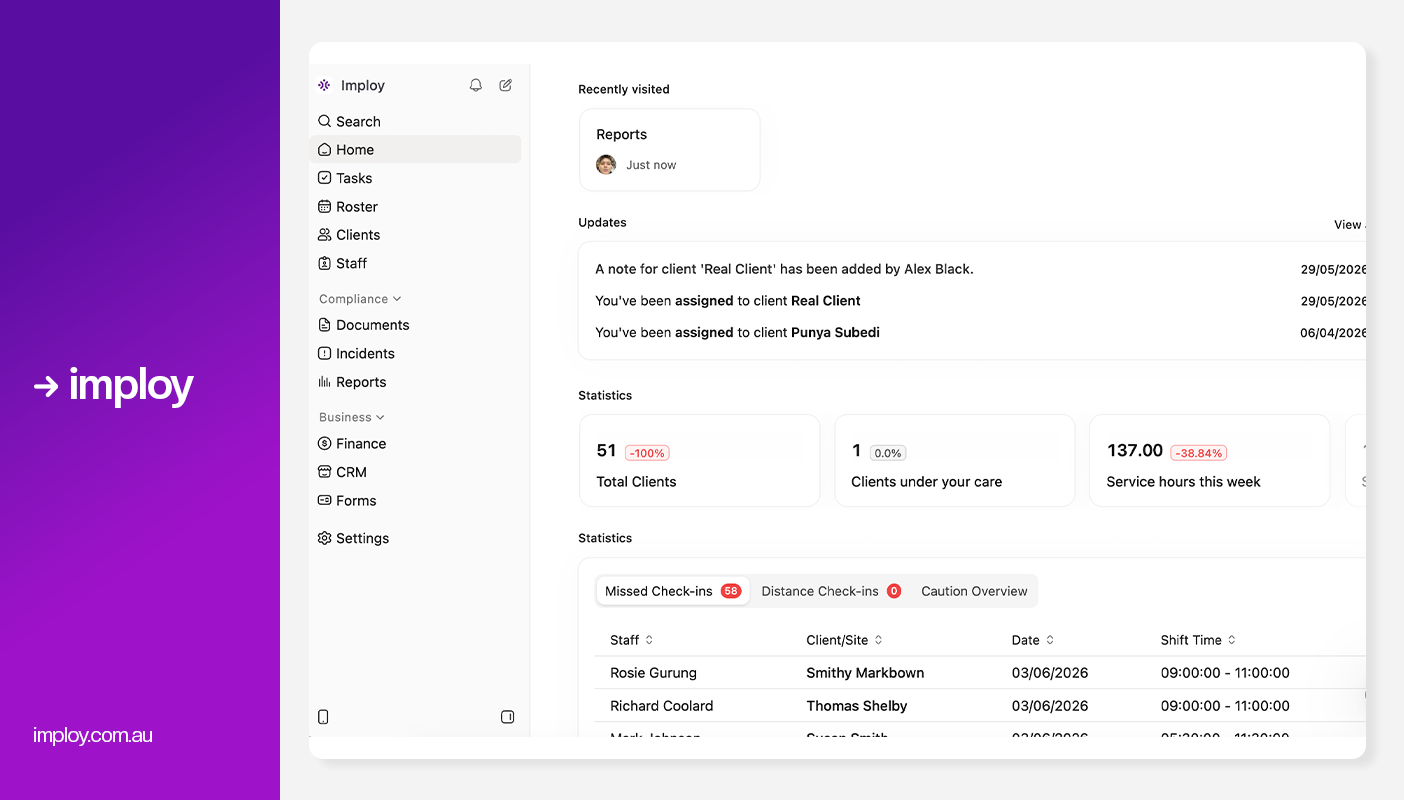
Imploy is an Australian-built workforce management platform designed specifically for disability and aged care providers. It stands out by combining scheduling with payroll, mobile access, compliance tools, and billing workflows. If you're an NDIS provider who wants compliance confidence, smart automation, and affordable pricing without enterprise complexity, Imploy is the best-rostering software for NDIS providers in the market.
Unlike generic scheduling tools, Imploy is built around NDIS operational workflows - reducing the need for external systems or manual compliance checks.
Best for: Large NDIS providers wanting an end-to-end rostering, payroll and compliance ecosystem.
Key Features:
- Smart Rostering: Quickly assign and adjust shifts using a visual drag-and-drop interface, with real-time availability and last-minute flexibility.
- Recurring Rosters with Compliance Checks: Set daily, weekly, fortnightly or monthly shifts with automatic conflict and SCHADS alerts, so recurring rosters stay compliant, consistent, and ready to adjust without starting from scratch.
- Real‑time Updates and Notifications: Push live changes, reminders, and alerts so workers always see the latest roster, reducing missed shifts and keeping everyone aligned on where they need to be and when.
- Payroll & Invoicing: Integrated with Xero, Quickbooks, timesheet processing, and payroll management.
- Care Management: Centralised system to store client records, update care plans, and track progress over time.
- Client Budgets & Funding: Track budgets in real time, align services to the right funding categories, and reduce claim errors with transparent, compliant spending controls.
- E-Signature Integration: Authorise client documents directly within Imploy using built-in eSignatures - eliminating the need for third-party subscriptions and streamlining approvals.
- Compliance Tools: Automatic alerts for expiring documentation, incident logging, and staff screening to maintain regulatory compliance.
- Real-Time Reporting: Interactive dashboards to monitor service delivery, track budget usage, and analyse funding in real time.
- Mobile app for staff and providers: Imploy’s mobile app gives support workers access to upcoming shifts, client information, clock-in/out, shift notes and active-hour recording while working in the field.
- Flexible Shift Types: Imploy supports flexible shift types, including sleepover and group shifts, making it easier to manage overnight support, multiple staff and shared client sessions within the same roster.
- Split Billing: Imploy simplifies split billing by allowing shifts to cover multiple service types, with separate billables and timesheets automatically created for each segment.
- Share Forms by Email: Imploy makes it easier to collect information by letting providers email forms directly to participants, staff or other recipients, with options to prefill details and track completion.
- AI Features:
- Smart Shift Matching: Uses AI to assign the most suitable support worker based on the client’s needs, staff location, availability, skills, and previous interactions -helping reduce travel time and boost consistency.
- Intelligent Note Enhancement: Refines rough shift notes into clear, well-structured summaries by improving tone, grammar, and extracting key insights -enhancing compliance and communication.
- AI Powered Risk Identification: Uses AI to analyze shift notes for key phrases, rating risk from 0 to 10, with plans to allow converting high-risk notes into incidents.
- AI Chatbot (Enterprise only, on request): Provides role-based access to company data, including shifts, client information, and financial data, available exclusively for enterprise customers upon request.
Pros:
- Smart rostering with real-time updates.
- Replaces 4-5 other tools with one unified system.
- Advanced AI features.
- Affordable and scalable for teams of all sizes.
- Dedicated mobile app for support workers.
- Free entry-level plan for small teams.
Cons:
- Feature-rich - some training needed for smaller teams.
- Premium Plan: $20 per user/month - includes SCHADS Awards, Bulk Client Invoicing AI Scheduler, Human Resources Module, Accounts Module, Unlimited Users
- Enterprise Plan: Provided on request from the Sales Team
2. FlowLogic
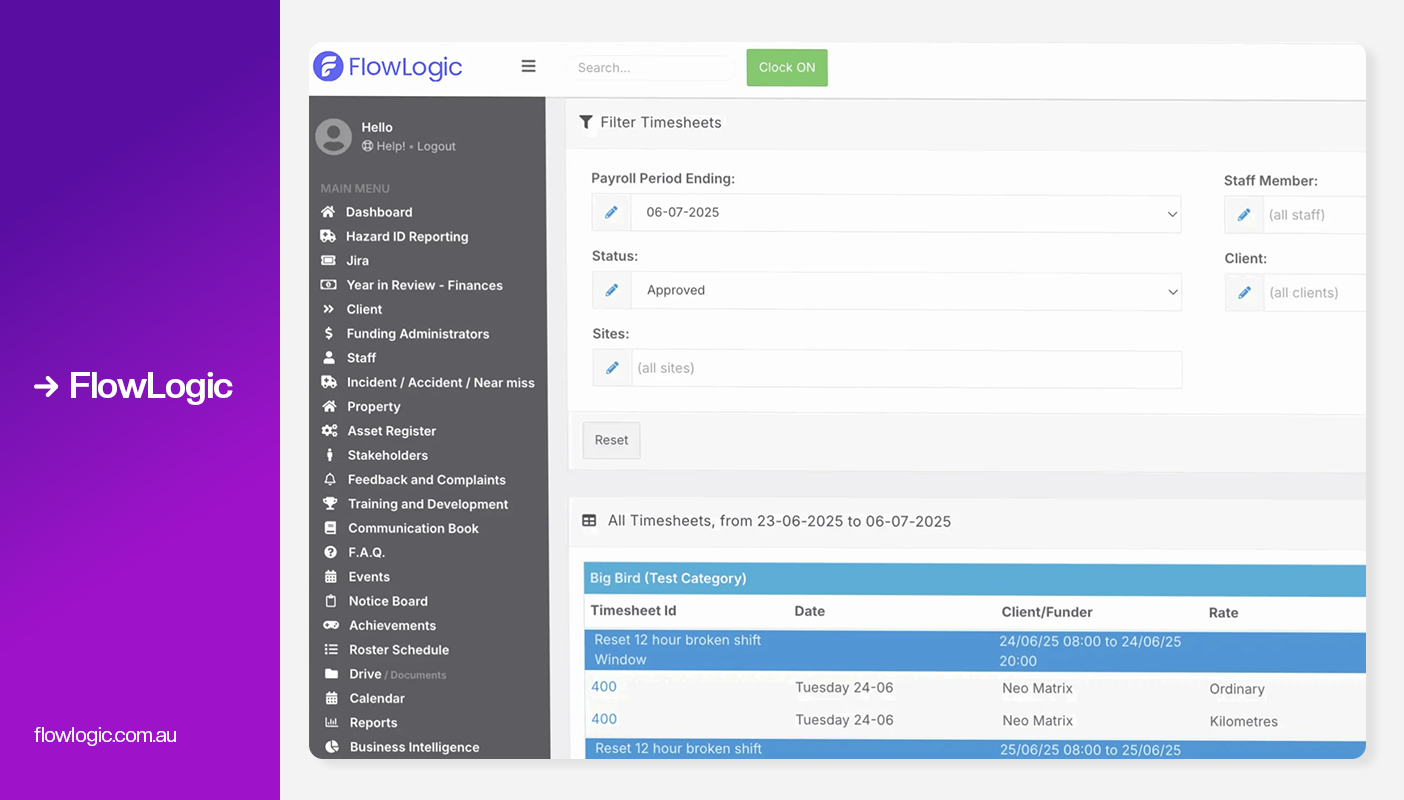
FlowLogic is an all-in-one, cloud-based NDIS software platform built specifically for disability and aged care providers. Its functionality spans scheduling and rostering to compliance, participant management, billing, reporting, document workflows and more, making it a strong contender for large providers looking to unify operations.
Best for: Large providers with heavy compliance and reporting requirements.
Key Features:
- Smart NDIS Rostering: Intelligent scheduling tools match staff availability, qualifications, and participant preferences to create compliant and efficient rosters.
- Participant & Case Management: Centralised participant profiles store service plans, case notes, risk assessments, goals, and communication records in one secure system.
- Compliance & Quality Management: Built-in compliance tracking supports NDIS Quality and Safeguards requirements with audit trails, incident management, and policy control.
- Automated NDIS Billing: The platform streamlines invoicing, bulk claims, funding tracking, and pricing guide updates to reduce administrative errors.
- Real-Time Reporting & Analytics: Customisable dashboards and forecasting tools provide operational insights across finance, workforce, and service delivery.
Pros:
- Designed specifically for NDIS compliance and audits.
- Covers support coordination workflows.
- Includes strong document and tracking tools.
Cons:
- Less visually intuitive interface.
- No AI features.
- No transparency on pricing.
Pricing:
- Available on request from the vendor.
3. RomeoHR
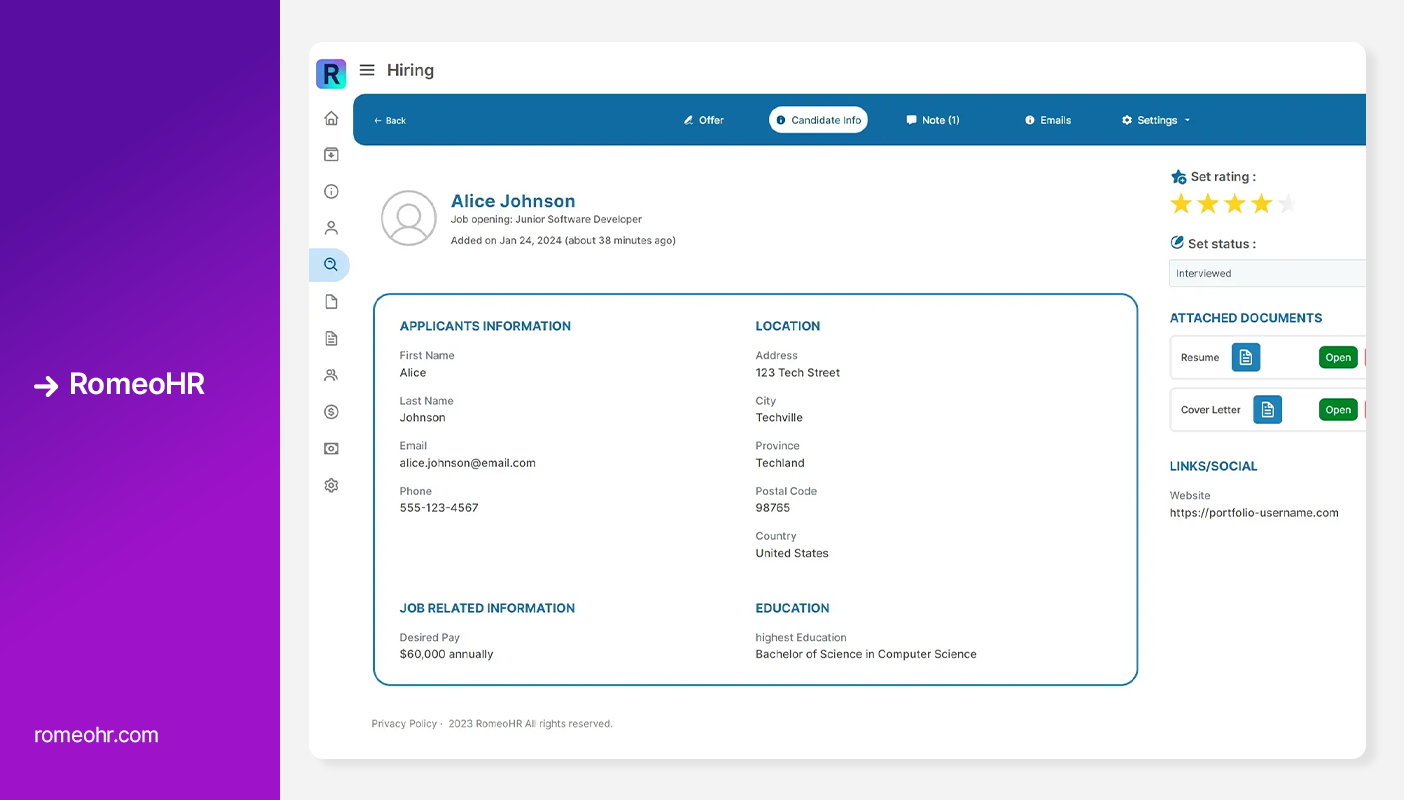
RomeoHR is an Australian-based workforce management platform designed specifically for NDIS and SCHADS-compliant care providers. It combines rostering, time & attendance, payroll, invoicing, HR and compliance into a centralised system, helping providers reduce admin, improve accuracy and stay audit-ready.
Best for: Growing to large providers that want intelligent automation to reduce administrative burden.
Key Features:
- AI-Assisted Rostering: Helps generate smart rosters based on participant needs, staff skills, availability, travel distances and other care-specific criteria.
- Time & Attendance Tracking: Geo-verified clock-in/out and attendance capture feed directly into timesheets for accurate records.
- SCHADS-Award Payroll Engine: Fully automated award interpretation calculates penalties, overtime, sleepovers and allowances for compliant pay runs.
- Invoicing & Claims: Auto-generate NDIA-ready invoices from approved timesheets to reduce claim errors and improve cash flow.
- Participant & Client Management: Centralised profiles, goals, preferences, risks and notes support consistent care delivery and documentation.
Pros
- Comprehensive All-in-One System
- Designed for NDIS & SCHADS Compliance
- AI-Driven Rostering Features
- Mobile-First Worker Experience
Cons
- Pricing Not Publicly Listed
- Limited AI features
- Implementation & Training Required
- No direct PRODA integration
Pricing:
- Provided by provider on request.
4. Skedulo
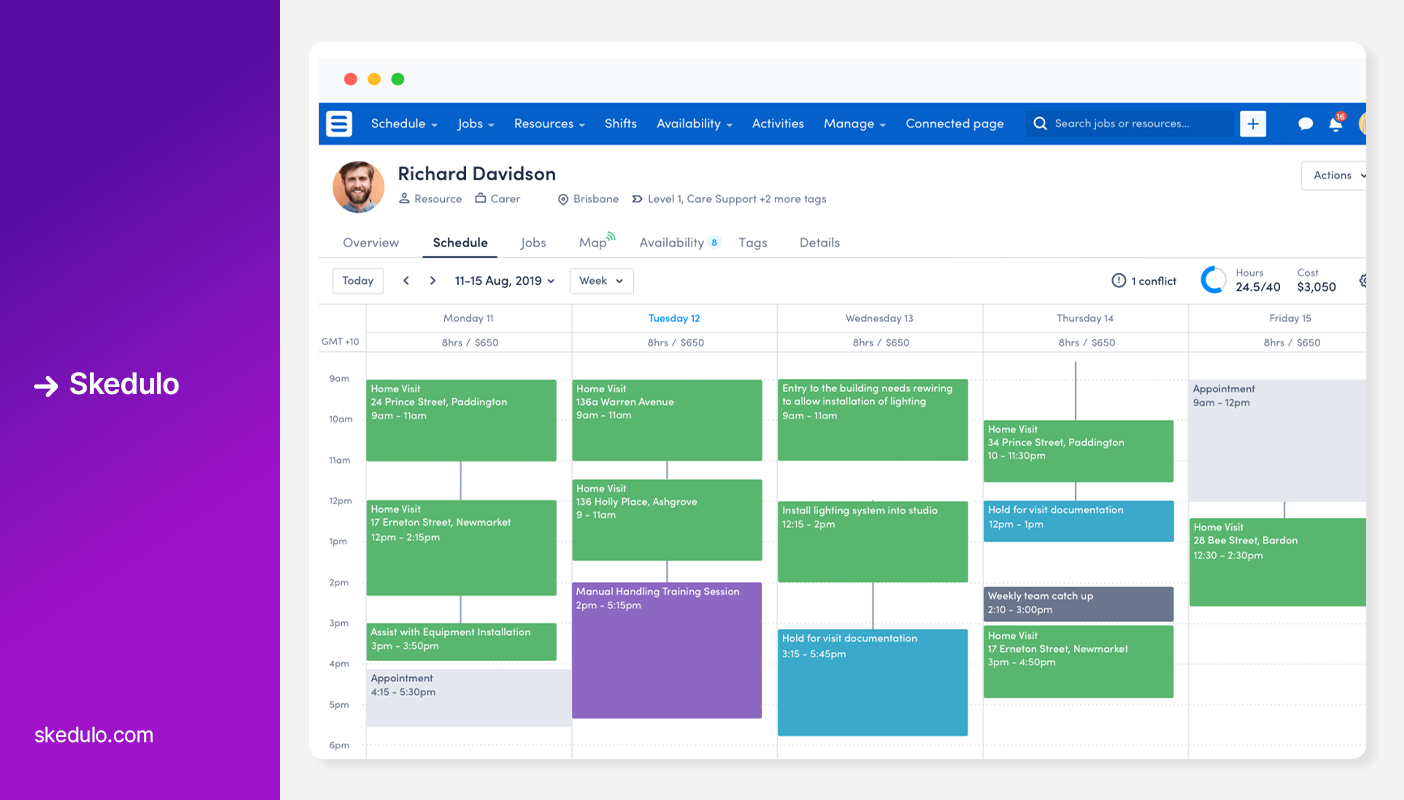
Skedulo is an enterprise-grade mobile workforce and scheduling platform designed to help organisations manage complex rostering, dispatch and field-based work at scale. It uses intelligent scheduling, real-time tracking and integrations with enterprise systems to optimise workforce productivity and visibility for large and distributed teams.
Best for: Enterprise-scale providers with complex integration requirements.
Key Features:
- Intelligent Scheduling & Automation: Automated rules-based scheduling helps assign the right workers to the right jobs based on skills, availability and business logic.
- Mobile Workforce Management: Field workers can view jobs, update status, capture notes and communicate via Android and iOS apps.
- Real-Time Job Tracking & Dispatch: Schedulers can monitor job progress and workforce status in real time to improve responsiveness.
- Route & Travel Optimisation: Scheduling logic can prioritise efficient travel routes to reduce travel time and operational costs.
- Workforce Analytics & Dashboards: Reporting tools provide insights into utilisation, scheduling efficiency and other key performance metrics.
Pros:
- Designed for Complex & Large-Scale Scheduling
- Mobile-First for Field Workers
- Strong Integration Capability
- Advanced Routing
Cons:
- No pricing transparency
- Not Built Specifically for NDIS
- Complex for Simple Use Cases
- No direct PRODA integration
Pricing:
- Provided by provider on request.
Comparison Table
Why Imploy Is the Best Alternative?
If you are an NDIS provider looking for an all-in-one, purpose-built system, Imploy stands out as the strongest alternative to FlowLogic, RomeoHR, and Skedulo. Here's why:
1. Built Specifically for NDIS
Imploy is designed from the ground up for NDIS and SCHADS compliance, not adapted from a generic workforce platform.
2. AI That Actually Helps Providers
Unlike others that either have no AI or only basic scheduling optimisation, Imploy includes smart shift matching, AI note enhancement, risk identification, and an AI chatbot to save admin time.
3. Compliance + Rostering + Payroll in One Place
Many platforms require multiple integrations to handle payroll and compliance. Imploy keeps rostering, participant records, compliance tracking, and payroll exports together in one system.
4. Transparent and Affordable Pricing
Imploy offers free access for small teams (up to 5 users) and clear per-user pricing after that. Most competitors require demos and custom quotes, which can be expensive and less transparent.
5. Designed for Growing Providers
Whether you’re a new provider or scaling your operations, Imploy supports growth without needing enterprise-level contracts.
6. Simple to Use
The system is designed for support coordinators, rostering managers, and admin teams - not just IT departments.
In short, if you're an NDIS provider who wants compliance confidence, smart automation, and affordable pricing without enterprise complexity, Imploy is the best-rostering software for NDIS providers in the market.
Final Thoughts
For large NDIS providers, software must go beyond basic rostering. It needs to support complex compliance requirements, multi-site operations, workforce scalability, and financial oversight.
Enterprise platforms may offer strong scheduling engines, but not all are built specifically for NDIS. The real advantage comes from choosing a system that combines deep compliance capability with automation, payroll integration, and operational visibility.
For large providers wanting a purpose-built NDIS platform with AI-driven efficiency - without relying on multiple disconnected systems, Imploy presents a strong, scalable alternative.
FAQs
1. What should large NDIS providers look for in rostering software?
Key factors include NDIS and SCHADS compliance, AI-assisted rostering, multi-site scheduling, payroll integration, participant record management, mobile access, and real-time reporting.
2. Can Imploy handle multi-site operations?
Yes. Imploy supports multiple locations, large teams, and recurring shifts, making it ideal for providers with several service sites.
3. How scalable is Imploy for growing organisations?
Imploy is designed to grow with your organisation adding new participants, staff, service lines, or regions doesn’t compromise performance or increase complexity.
4. How does Imploy improve efficiency for admin teams?
Imploy automates rostering, generates compliance alerts, provides AI-driven shift suggestions, and includes an AI chatbot - reducing manual workload for large administrative teams.
5. Can Imploy integrate with existing payroll and accounting systems?
Yes. Imploy supports integrations and exports to systems like Xero, helping large providers manage payroll and reduce errors without extra administrative overhead.

.webp)