

Disability Individual Support Plan (ISP) with Example
Learn what an Individual Support Plan (ISP) is in disability support, why it’s important, key components, and how to create one. Includes a clear ISP example and how Imploy helps providers streamline support planning and compliance.

Delivering safe, goal-focused, and person-centred support begins with one essential document - the Individual Support Plan (ISP). For NDIS providers, support workers, and allied health teams, a well-crafted ISP ensures that every person receives the right support, at the right time, in the right way.
In this guide, we break down what an ISP is, why it matters, what’s included, and provide a practical Individual Support Plan example you can use. We also explain how Imploy helps streamline ISP creation, updates, and compliance.
What is an Individual Support Plan in Disability Support?
An Individual Support Plan (ISP) is a personalised document that outlines a person’s needs, goals, preferences, risks, and the supports required to help them live safely and independently.
It serves as the foundation for all daily supports, guiding how disability providers and support workers deliver services.
ISP vs NDIS Plan - What’s the Difference?
- NDIS Plan: Funding document created by the NDIA.
- Individual Support Plan: Provider-created document that explains how supports will be delivered based on a person’s needs and goals.
Both work together, but the ISP is the practical, day-to-day guide used by workers.
Why is an Individual Support Plan Important?
A strong ISP helps providers deliver safe, consistent, and meaningful support. It:
- Ensures person-centred and goal-driven care.
- Helps support workers understand daily needs, routines, and preferences.
- Ensures consistent support across all shifts.
- Supports compliance with NDIS Practice Standards.
- Improves communication between participants, families, and providers.
- Tracks progress towards goals.
- Identifies risks and outlines mitigation strategies.
Without a clear ISP, support delivery becomes inconsistent, and non-compliant.
Key Components of a Disability Individual Support Plan
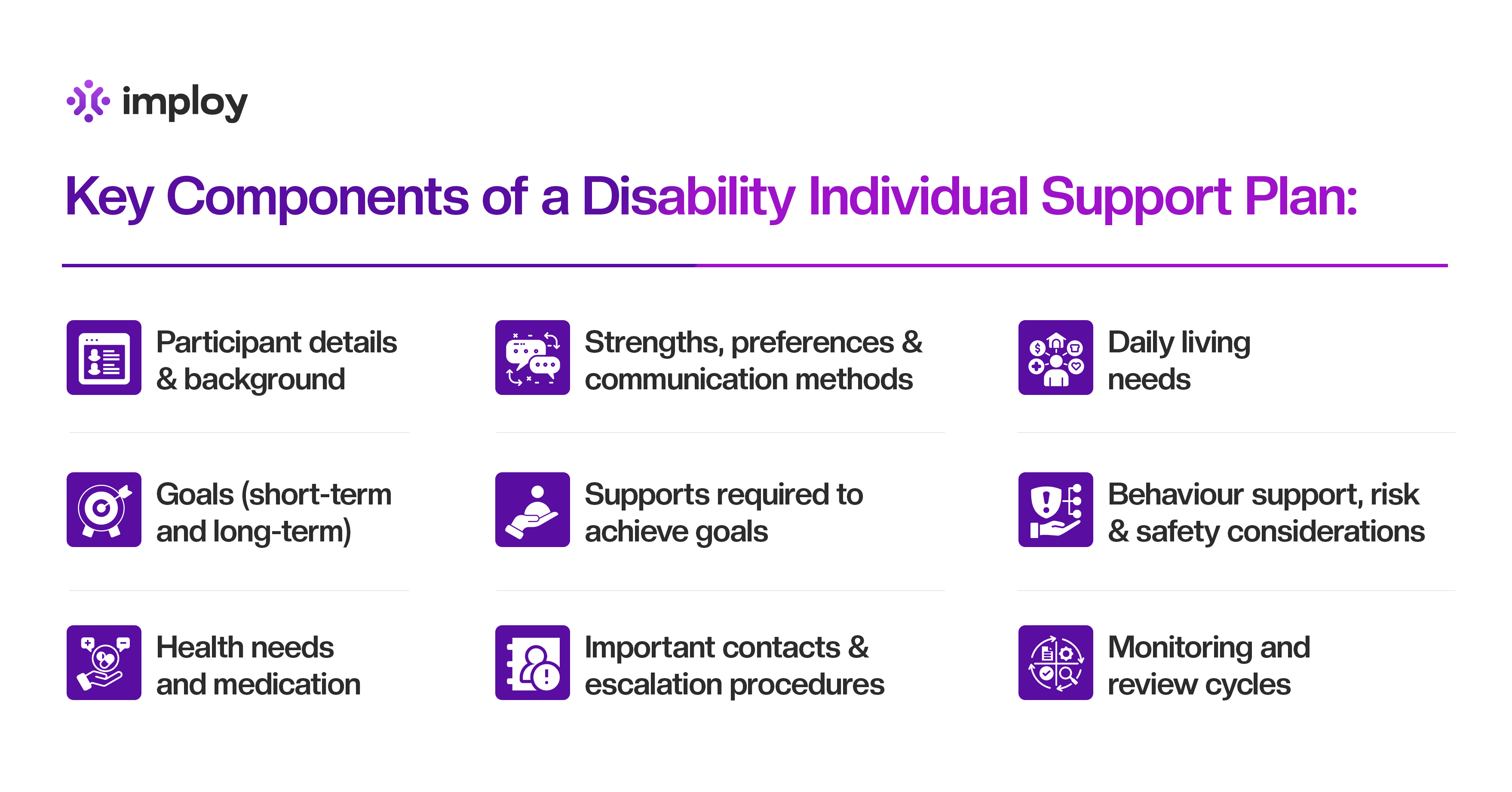
A strong Individual Support Plan includes the following essential elements:
1. Participant Details & Background
Basic personal information, living situation, disability or support needs, cultural considerations, and any relevant history.
2. Strengths, Preferences & Communication Methods
What the participant enjoys, their abilities, routines, preferred support style, and how they communicate (verbal, non-verbal, AAC, gestures, etc.).
3. Daily Living Needs
Supports required for personal care, mobility, meals, household tasks, community access, routines, and social participation.
4. Goals (Short-Term and Long-Term)
Clear and measurable goals that reflect the participant’s priorities - covering independence, skill-building, health, social participation, or community inclusion.
5. Supports Required to Achieve Goals
Specific actions support workers must take, step-by-step instructions, assistive technology used, frequency of support, and expected outcomes.
6. Behaviour Support, Risk Assessment & Safety Considerations
Identified behaviours of concern (if any), triggers, de-escalation strategies, risk levels, safety procedures, and crisis response plans.
7. Health Needs & Medication
Medical conditions, medication schedule, allied health supports, equipment used, and any monitoring requirements.
8. Important Contacts & Escalation Procedures
Key family contacts, emergency contacts, healthcare providers, escalation steps during incidents or health changes.
9. Monitoring & Review Cycles
How progress is tracked, documentation requirements, monthly or quarterly check-ins, and the formal review timeline (e.g., every 6–12 months).
How to Create an Effective ISP?
1. Assess the participant’s needs
Start with a holistic assessment covering daily living, mobility, communication, social participation, behaviour, and health. Gather information from the participant, family, carers, and allied health providers to ensure accuracy and a person-centred approach.
2. Identify strengths and preferences
Record what the participant can do independently, what they enjoy, what motivates them, and how they prefer to receive support. Include communication styles, daily routines, cultural needs, sensory preferences, and any important personal values.
3. Set measurable goals
Create goals that are clear, achievable, and directly related to the participant’s aspirations. Use simple, outcome-focused language and SMART goal principles - Specific, Measurable, Achievable, Relevant, and Time-bound.
4. Match supports to goals
Break down how each goal will be supported in daily practice. Explain the specific actions workers must take, how often supports occur, and how progress will be measured.
5. Develop risk and safety plans
Identify potential risks such as mobility issues, health complications, environmental hazards, or behaviours of concern. Outline preventive strategies, de-escalation steps, and emergency procedures to ensure safe service delivery.
6. Assign responsibilities
Clearly define who is responsible for each part of the ISP - support workers, team leaders, coordinators, and allied health. Clarify instructions for each shift so all workers provide consistent support.
7. Review and update regularly
Monitor progress through notes, shift reports, and communication logs. Update the ISP after incidents, health changes, new goals, or whenever the participant’s needs evolve.
8. Use digital tools
Use systems like Imploy to store, update, and track ISPs. Digital platforms ensure workers always see the latest version, improve communication, reduce errors, and support NDIS Practice Standards compliance.
Individual Support Plan Example
Below is a simple, easy-to-use ISP example for disability support providers.
Participant Overview
- Name: Sarah M
- Age: 32
- Primary Diagnosis: Mild intellectual disability, anxiety.
- Living Situation: Lives independently with drop-in support.
- Communication: Verbal, prefers simple instructions, becomes anxious with sudden changes.
Goals
Goal 1: Increase independence in personal care
- Supports:
- Morning routine assistance.
- Step-by-step prompting for showering and grooming.
- Outcome Measures:
- Sarah completes 3 out of 5 personal care tasks independently within 6 months.
Goal 2: Improve community participation
- Supports:
- Weekly community outing.
- Support to attend art classes.
- Outcome Measures:
- Attends 2 community activities per month.
Daily Support Needs
- Morning hygiene routine.
- Medication reminders.
- Meal planning & simple meal preparation.
- Assistance with budgeting and shopping.
- Community access for appointments and activities.
- Anxiety support during unexpected situations.
Risk & Safety Support
- Risk: Anxiety escalations.
Strategy: Provide reassurance, offer choices, avoid sudden changes. - Risk: Forgetting to lock doors.
Strategy: Worker completes safety check during each visit.
Review Schedule
- Monthly monitoring through progress notes.
- Full ISP review every 6 months or after major changes.
Best Practices for Maintaining an ISP
To keep your ISP effective and compliant:
- Use plain-English, easy-to-read language.
- Make goals measurable (SMART goals).
- Update after incidents or health changes.
- Keep workers trained on how to follow the ISP.
- Review regularly (minimum every 6-12 months).
- Ensure version control and secure storage.
- Link ISP to rosters, support logs, and reporting.
How Imploy Helps Providers With ISPs?
Imploy simplifies ISP creation, storage, and updates so providers save time and stay audit-ready.
With Imploy, you can:
- Use templates for assessments, goals, and risk plans
- Keep all ISPs in one secure, central platform
- Link the ISP to rosters, worker notes, support logs, incidents, and outcomes
- Ensure workers always have the latest version of the plan
- Track progress against goals
- Maintain compliance with NDIS Practice Standards
- Reduce paperwork and admin time
Imploy makes it easier to deliver truly person-centred support while keeping your organisation efficient and compliant.
Final Thoughts
A well-structured Individual Support Plan is essential for delivering safe, consistent, and meaningful disability support. It ensures every participant receives personalised, goal-focused care - and helps providers meet NDIS compliance requirements.
With digital tools like Imploy, you can streamline ISP management, improve communication, reduce admin, and keep every support worker aligned.
Frequently Asked Questions (FAQs)
1. What is an Individual Support Plan (ISP)?
An Individual Support Plan is a personalised document that outlines a participant’s needs, goals, strengths, risks, and the supports required to help them live safely and independently. It guides support workers in delivering consistent, person-centred care.
2. How is an ISP different from an NDIS Plan?
An NDIS Plan is a funding document created by the NDIA. An ISP is a provider-developed support plan that explains how supports will be delivered based on the participant’s needs and goals.
Both work together, but only the ISP guides daily practice.
3. Who creates the Individual Support Plan?
The ISP is usually created by the disability service provider, often by a support coordinator, team leader, or case manager. It is developed in consultation with the participant, their family, carers, and relevant allied health professionals.
4. What information must be included in an ISP?
A good ISP includes participant details, communication needs, daily support needs, goals, support strategies, risk assessments, behaviour supports, health information, and review timelines.
5. Do support workers need to read the ISP?
Yes. Support workers must understand and follow the ISP to ensure consistent, safe, and compliant service delivery. Providers should ensure workers always have access to the latest version.
6. Can the participant contribute to their ISP?
Absolutely. The ISP must be built with the participant, not for them. Their preferences, choices, routines, and goals should shape every part of the plan.
7. What happens if the ISP is outdated or inaccurate?
Outdated ISPs can lead to inconsistent support, safety risks, non-compliance, and potential audit issues. Regular reviews and digital updates are essential for accuracy.
.webp)