

How to Hire NDIS Support Workers: A Step-by-Step Guide
Learn how to hire NDIS support workers with this step-by-step guide. Discover recruitment strategies, compliance requirements, interview tips, onboarding best practices, and a free hiring checklist.

.webp)
Hiring the right NDIS support workers is essential for delivering high-quality, person-centred support. Support workers play a key role in helping participants achieve their goals, maintain independence, and improve their quality of life.
With growing demand and ongoing workforce shortages across the disability sector, finding qualified candidates can be challenging. A structured recruitment process can help providers attract suitable workers, meet compliance requirements, and build a reliable workforce. This guide outlines the key steps to hiring NDIS support workers successfully.
Why Hiring the Right NDIS Support Worker Matters?
Support workers have a direct impact on participant outcomes and experiences. The quality of support they provide can influence participant satisfaction, goal achievement, and overall trust in your organisation.
Hiring the right people can help:
- Deliver high-quality, person-centred support
- Improve participant satisfaction and retention
- Strengthen compliance with NDIS requirements
- Reduce employee turnover
- Build a positive workplace culture
- Enhance your organisation's reputation
Taking the time to recruit carefully can save significant costs associated with rehiring, retraining, and workforce instability.
How to Hire NDIS Support Workers?
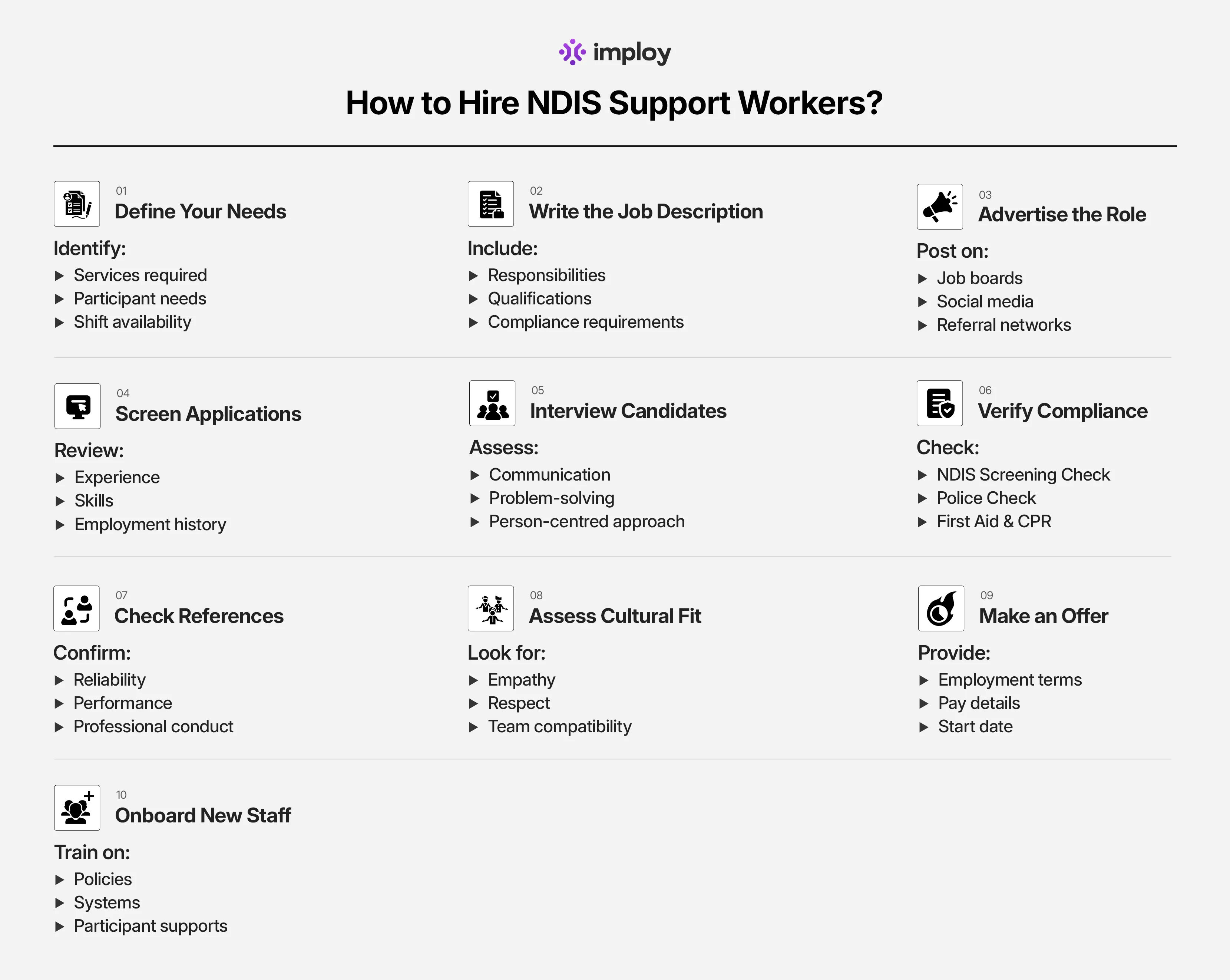
Step 1: Define Your Workforce Requirements
Before advertising a position, clearly identify the type of support worker your organisation needs. Understanding the role requirements helps attract suitable candidates and improves recruitment outcomes.
1. Services Needed
Consider the supports the worker will provide, such as:
- Personal care
- Community participation
- Domestic assistance
- Supported Independent Living (SIL)
- High-intensity supports
- Mental health support
Different support types may require specific qualifications, training, or experience.
2. Participant Needs
Think about the participants the worker will support, including:
- Age group
- Disability type
- Communication needs
- Behaviour support requirements
- Cultural considerations
Matching workers to participant needs can improve service quality and participant satisfaction.
3. Availability
Determine the shifts and working arrangements required, such as:
- Day shifts
- Evening shifts
- Weekend work
- Sleepover shifts
- Overnight support
Being clear about availability requirements helps avoid future rostering challenges.
Step 2: Create a Detailed Job Description
A strong job description helps attract qualified applicants while setting clear expectations about the role.
1. Role Overview
Provide a brief introduction to:
- Your organisation
- Services offered
- Workplace culture
- Purpose of the role
This helps candidates understand whether they are a good fit for your organisation.
2. Responsibilities
Clearly outline key duties, such as:
- Supporting daily living activities
- Assisting with community access
- Promoting participant independence
- Maintaining progress notes
- Following organisational policies
3. Requirements
Include any mandatory qualifications and checks, such as:
- NDIS Worker Screening Check
- First Aid and CPR certification
- Driver's licence
- Working with Children Check (if required)
- Right to work in Australia
A detailed job description can improve application quality and reduce unsuitable candidates.
Step 3: Advertise the Role
Advertise vacancies across multiple channels to reach more candidates.
1. Job Boards
Post on platforms such as:
- Seek
- Indeed
- Jora
- CareerOne
2. Social Media
Promote the role through:
- Facebook groups
- Community networks
3. Referrals
Employee referrals can help you find quality candidates faster and improve cultural fit.
Step 4: Screen Applications
Review applications using a consistent process to identify the most suitable candidates.
1. Experience
Look for experience in disability support, aged care, community services, mental health, or personal care. Transferable skills may also be valuable.
2. Communication
Assess communication skills, including professionalism, empathy, active listening, and the ability to build positive relationships.
3. Employment History
Review previous roles for relevant experience, employment stability, and ongoing professional development.
This can help identify candidates who are likely to succeed in the role.
Step 5: Conduct Interviews
Interviews help determine whether a candidate is the right fit for the role.
1. Behavioural Questions
Ask candidates to share examples of supporting participants, overcoming challenges, or working within a team.
2. Scenarios
Use workplace scenarios to evaluate problem-solving and decision-making skills.
Examples include:
- A participant refuses support
- A participant becomes distressed
- A safety concern arises during a shift
3. Personal Qualities
Look for key traits such as:
- Empathy
- Reliability
- Respect
- Professionalism
These qualities are essential for delivering high-quality support.
Step 6: Verify Compliance Requirements
Before hiring an NDIS support worker, verify that all required checks, qualifications, and documentation are current and valid. This helps protect participants, supports compliance, and reduces organisational risk.
1. NDIS Screening Check
The NDIS Worker Screening Check is a key requirement for many support worker roles. It assesses whether an individual poses a risk to people with disability and is often mandatory for workers in risk-assessed positions.
Ensure candidates hold a valid clearance before they begin providing supports where required.
2. Police Check
Many providers also request a National Police Check as part of their recruitment process. While the NDIS Worker Screening Check considers criminal history, some organisations require a separate Police Check to meet internal policies or participant requirements.
3. Other Checks
Depending on the role, additional requirements may include:
- Working with Children Check
- First Aid certification
- CPR certification
- Driver's licence
- Right to work in Australia
- Vehicle registration and insurance
Step 7: Conduct Reference Checks
Reference checks help verify a candidate's suitability and reliability.
1. Previous Employers
Speak with former supervisors to assess reliability, communication, teamwork, and overall performance.
2. Verify Information
Confirm employment history, responsibilities, and work standards to reduce hiring risks.
This additional step can help prevent costly hiring mistakes.
Step 8: Assess Cultural Fit
Technical skills are important, but cultural fit often determines long-term success.
1. Company Values
Look for candidates who demonstrate respect, compassion, inclusion, and participant-centred care.
2. Team Fit
Consider how well the candidate will work with coordinators, managers, and other team members.
Step 9: Make an Employment Offer
Once you've selected the right candidate, provide a clear employment offer outlining key terms and expectations.
1. Employment Details
Include:
- Position title
- Employment type
- Pay rate
- Working hours
- Start date
2. Employee Benefits
Highlight benefits such as:
- Flexible work arrangements
- Ongoing training
- Career development opportunities
- Supportive workplace culture
A strong offer can help attract and retain quality support workers.
Step 10: Onboard New Employees
Effective onboarding helps new support workers succeed from day one.
1. Policies
Introduce key requirements, including NDIS standards, workplace safety, privacy, and incident management.
2. Training
Provide training on systems, documentation, communication processes, and participant-specific support requirements.
Effective onboarding improves confidence, compliance, and service quality.
Common Hiring Mistakes to Avoid
Even with a structured recruitment process, providers can encounter common challenges.
1. Hiring Too Quickly
Urgent vacancies can lead to rushed decisions. Taking the time to properly assess candidates often leads to better long-term outcomes.
2. Focusing Only on Experience
While experience is important, qualities such as empathy, reliability, and attitude should also be considered.
3. Skipping Reference Checks
Reference checks can reveal valuable information that may not emerge during interviews.
4. Weak Onboarding
Without proper onboarding and training, even strong candidates may struggle to succeed in their role.
How Imploy Helps with Hiring NDIS Support Workers?
Imploy helps NDIS providers streamline workforce management through an all-in-one platform designed for the care sector. With features such as employee onboarding, digital document management, workforce compliance tracking, rostering, timesheets, payroll integration, and SCHADS Award interpretation, providers can reduce administrative workload and focus on delivering quality support.
By centralising workforce operations in a single system, Imploy helps providers:
- Simplify employee onboarding and record management
- Track worker compliance requirements and expiry dates
- Create and manage rosters more efficiently
- Reduce payroll errors and administrative burden
- Improve workforce visibility and operational efficiency
- Support compliance across growing NDIS teams
Whether you're hiring your first support worker or scaling a large workforce, Imploy can help streamline the entire employee lifecycle from recruitment through to ongoing workforce management.
Final Thoughts
Hiring NDIS support workers requires more than simply filling vacancies. Providers must identify workforce needs, assess candidates carefully, verify compliance requirements, and create an onboarding experience that supports long-term success.
By following a structured recruitment process, NDIS providers can attract qualified candidates, reduce turnover, and build a workforce that delivers high-quality, person-centred support. Investing in the right people today can lead to better participant outcomes, stronger compliance, and sustainable business growth in the future.
FAQs
1. What qualifications do NDIS support workers need?
Requirements vary by role, but common requirements include an NDIS Worker Screening Check, First Aid and CPR certification, a driver's licence, and relevant experience or qualifications in disability support or community services.
2. How do I find qualified NDIS support workers?
You can advertise roles on job boards, social media platforms, disability sector networks, and through employee referral programs to attract suitable candidates.
3. Is experience in disability support mandatory?
Not always. Candidates with experience in aged care, mental health, community services, or other related fields may have transferable skills that make them suitable for support worker roles.
4. What should I look for when interviewing NDIS support workers?
Focus on communication skills, problem-solving abilities, participant-centred values, reliability, and examples of how they have handled real-life support situations.
5. Are reference checks necessary when hiring support workers?
Yes. Reference checks help verify employment history, assess reliability and performance, and reduce the risk of making unsuitable hiring decisions.