
Level 3 Disability Support Worker Pay in 2026
Learn the Level 3 Disability Support Worker pay rates under the SCHADS Award, including hourly wages, weekend penalties, public holiday rates, and what affects your pay.


Disability support work is a rewarding and essential job that helps people with disability live more independently and participate fully in their communities. If you’re a Level 3 Disability Support Worker, or you employ them, understanding how pay is calculated in 2026 under the Social, Community, Home Care and Disability Services Industry Award (SCHADS Award) is important for compliance, budgeting, and workforce planning.
This guide breaks down pay rates, penalty rates, casual loadings, and practical examples so you know exactly what Level 3 support workers should be paid in 2026.
Who is a Level 3 Disability Support Worker?
Under the SCHADS Award, disability support workers are classified into levels based on skills, responsibilities, experience, and qualifications. Level 3 is a mid‑to‑advanced classification used for workers who:
- Support participants with complex needs.
- Have higher autonomy and decision‑making responsibilities.
- Often hold a Certificate IV in Disability Support or equivalent skills.
- Perform duties beyond entry‑level roles, including specialised support and independence‑facilitating tasks.
Level 3 workers play a vital role in delivering high‑quality disability support, and their pay reflects the added responsibility and experience required. You can learn more about Level 1 Disability Support Worker Pay, and Level 2 Disability Support Worker Pay in detail on our previous blogs.
SCHADS Award Pay Rates for Level 3 Workers
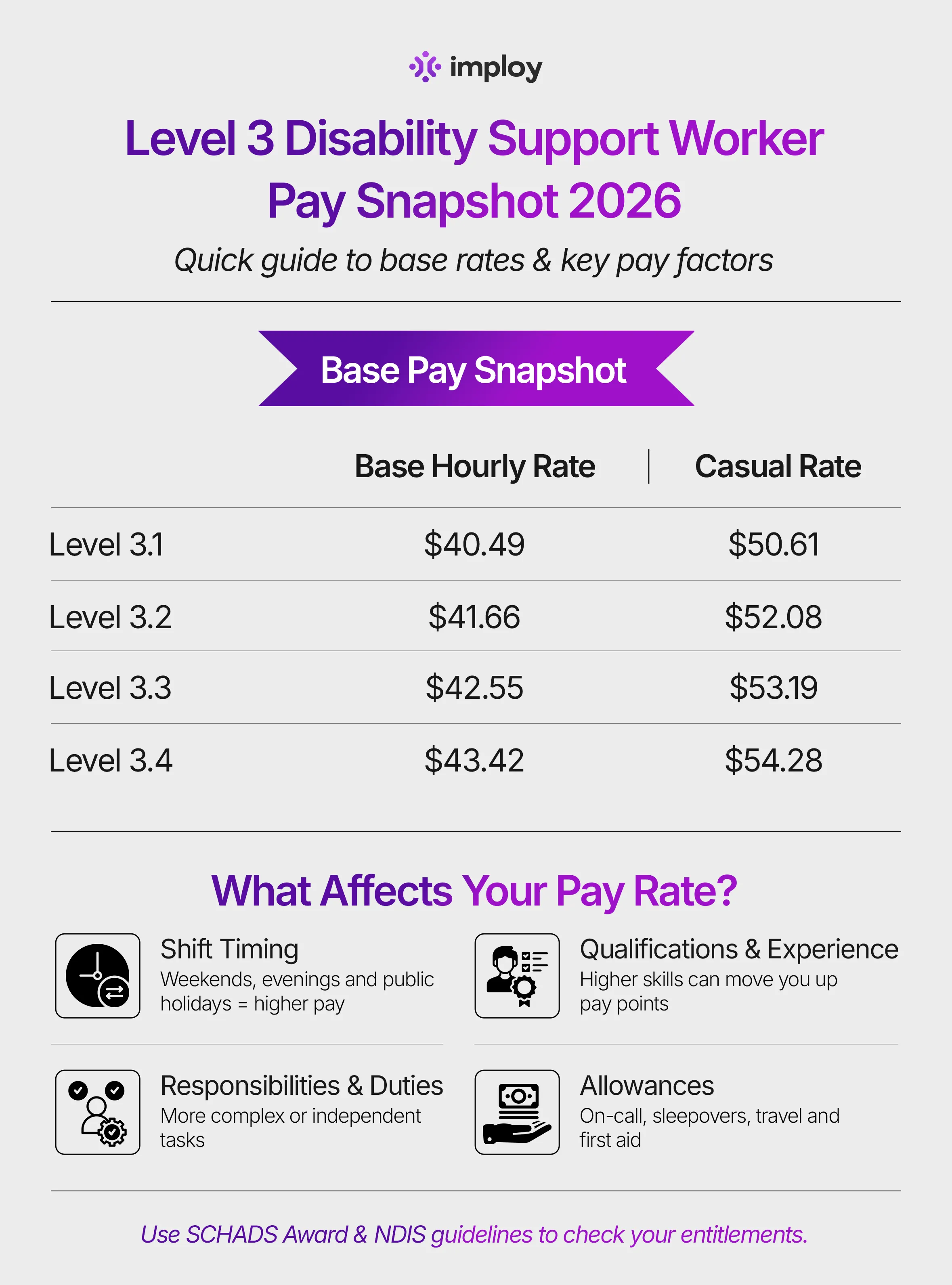
The SCHADS Award sets clear minimum pay rates for Level 3 Disability Support Workers, ensuring fair compensation across full-time, part-time, and casual employment. From 24 June 2026, updated wage rates apply based on classification, pay point, and shift type, with additional penalties for weekends, public holidays, and certain shift hours.
Below is a breakdown of the Level 3 Disability Support Worker pay rates for 2026, including base pay, penalty rates, and casual loadings, to help workers and providers understand how earnings are calculated under the award.
Full‑Time and Part‑Time Pay Rates
Source: Fair Work Ombudsman - SCHADS Award 2026 Pay Guide.
These base rates apply to ordinary hours worked by full‑time and part‑time employees under the SCHADS Award.
Casual Pay and Loadings
Casual employees receive a 25% casual loading on top of the base rate in lieu of paid leave - this increases the hourly rate they’re paid.
Source: Fair Work Ombudsman - SCHADS Award 2026 Pay Guide.
Weekend & Penalty Rates
The SCHADS Award includes penalty rates for weekend, evening, night and public holiday work - which significantly increase hourly pay.
Example Penalty Rates (Estimates Based on SCHADS Multipliers)
Penalty examples for weekend work might look like:
- Saturday: 150% of base rate
- Sunday: 200% of base rate
For instance, a Level 3.1 worker earning $40.49/hour would earn around $60.74 on Saturdays and $80.98 on Sundays.
NOTE: Public holiday penalty rates (often up to 250%) apply on nationally recognised days - giving a significant boost to pay for working on those dates.
What Do These Pay Rates Mean in Practice?
- Base hourly rate: Paid for ordinary weekday hours worked by full-time and part-time Level 3 disability support workers.
- Saturday rate: A higher penalty rate applies for weekend work under the SCHADS Award.
- Sunday rate: Significantly higher than weekday rates due to increased SCHADS penalties.
- Public holiday rate: The highest hourly rate under the award, reflecting the premium for working on nationally recognised public holidays.
- Afternoon shift loading: Applies when a Level 3 worker is rostered during designated afternoon hours.
- Night shift loading: Applies to late-night or overnight shifts, further increasing the hourly rate.
These penalty rates and loadings can substantially increase total earnings for Level 3 disability support workers, particularly those who regularly work weekends, evenings, or public holidays.
Example Pay Calculations
Example 1:
A Level 3 Pay Point 1 casual working a Sunday shift earns $86.96 per hour, reflecting the 200% Sunday penalty rate.
Example 2:
A Level 3 Pay Point 2 part-time worker rostered on a public holiday earns $104.15 per hour, the highest rate under the SCHADS Award.
What Affects a Level 3 Support Worker’s Pay?
Several factors influence how much a Level 3 worker earns, even within the SCHADS framework:
1. Pay Point
Workers progress through pay points (e.g., 3.1, 3.2, 3.3, 3.4) based on experience, additional training, and time in role.
2. Employment Type
- Full‑time and Part‑time wages are based on base rates with leave entitlements.
- Casual workers get higher hourly rates but no paid leave.
3. Shift Timing
Penalty rates for evenings, nights, weekends, and public holidays can dramatically increase earnings on those shifts.
4. Allowances
Additional SCHADS allowances may apply for duties such as:
- Broken shifts
- On‑call work
- Sleepover shifts
- Travel between client homes
Understanding these components helps employers accurately budget and pay staff correctly.
What Does This Mean for Employers and Support Workers?
For Employers
- Ensure correct classification (Level 3) and pay at least the SCHADS Award minimums.
- Include all penalty rates and allowances when calculating wages for shifts.
- Misclassification or underpayment can lead to legal and compliance issues.
For Support Workers
- Know your award level and pay entitlements under SCHADS.
- Understand how penalty rates and loadings boost overall earnings.
- Use tools like the Fair Work Pay and Conditions Tool to double‑check pay rates against your award classification.
Being informed ensures fair pay and compliance with national workplace standards in the disability sector.
How Imploy Supports Disability Support Workers?
At Imploy, we support disability support workers and NDIS providers by simplifying the administrative and compliance side of care - so you can focus on delivering quality support with confidence.
With Imploy, you can:
- Access ready-to-use templates aligned with SCHADS Award and NDIS requirements.
- Create professional invoices, service agreements, and care records quickly and accurately.
- Stay informed about pay rate updates, award changes, and compliance obligations.
- Explore practical blogs, guides, and FAQs designed specifically for disability and NDIS professionals.
Final Thoughts
Level 3 Disability Support Worker pay in 2026 reflects a combination of base rates, penalty rates, and allowances, ensuring workers are fairly compensated for experience, skills, and shift types.
For employers, understanding these rates is crucial for award compliance and staff retention. With tools like Imploy, managing pay, rostering, and compliance becomes simpler, letting you focus on delivering high-quality care.
Frequently Asked Questions (FAQs)
1. What is the hourly pay rate for a Level 3 Disability Support Worker in 2026?
As of 24 June 2026, the SCHADS Award sets the minimum base hourly rate for Level 3 disability support workers between $40.49 and $43.42 per hour, depending on the pay point (3.1 to 3.4).
2. How much are Level 3 workers paid on public holidays?
Public holiday shifts attract the highest penalty rate under the SCHADS Award. In 2026, Level 3 public holiday rates range from approximately $101.23 to $108.55 per hour, depending on the pay point.
3. What affects a Level 3 disability support worker’s pay rate?
Several factors can influence pay, including:
- Pay point progression (experience and skills).
- Shift timing (evenings, nights, weekends, and public holidays).
- Employment type (casual vs permanent).
- Applicable allowances such as sleepovers, on-call work, travel, or first aid duties.
4. Are SCHADS Award rates the same as NDIS pricing?
No. The SCHADS Award sets the legal minimum pay rates for workers, while NDIS price limits determine how much providers can charge for services. Employers must comply with SCHADS Award pay rates regardless of NDIS pricing.
5. Can employers pay above the SCHADS Award rates?
Yes. SCHADS Award rates are minimum standards only. Employers may choose to pay above award rates through enterprise agreements or individual employment contracts.