
Level 1 Disability Support Worker Pay 2025/26
Discover 2026 pay rates for Level 1 Disability Support Workers, including base, casual, penalty rates, and career growth.

Disability support work plays a vital role in helping people with disability live independently and participate in their communities. If you’re starting your career in the sector, or employing entry-level workers, understanding Level 1 Disability Support Worker pay rates in 2026 is essential.
This guide explains exactly how much Level 1 disability support workers are paid in 2026, including base rates, penalty rates, and how pay differs for casual, part-time, and full-time employees under the SCHADS Award.
What is a Level 1 Disability Support Worker?
Under the Social, Community, Home Care and Disability Services Industry Award (SCHADS Award - MA000100), a Level 1 Disability Support Worker is considered an entry-level role. This position is ideal for workers new to the sector, offering hands-on experience while building essential skills and knowledge.
Level 1 workers typically:
- Provide basic personal and community support.
- Work under direct supervision.
- Follow established care plans and procedures.
- Are new to the sector or completing required training.
Most Level 1 workers either hold or are working towards a Certificate III in Individual Support (Disability).
Typical Level 1 duties include:
- Personal Care Assistance
- Household and Domestic Support
- Community Participation and Social Support
- Health and Wellbeing Support
- Documentation and Reporting
Level 1 Disability Support Worker Pay Rates (2026)
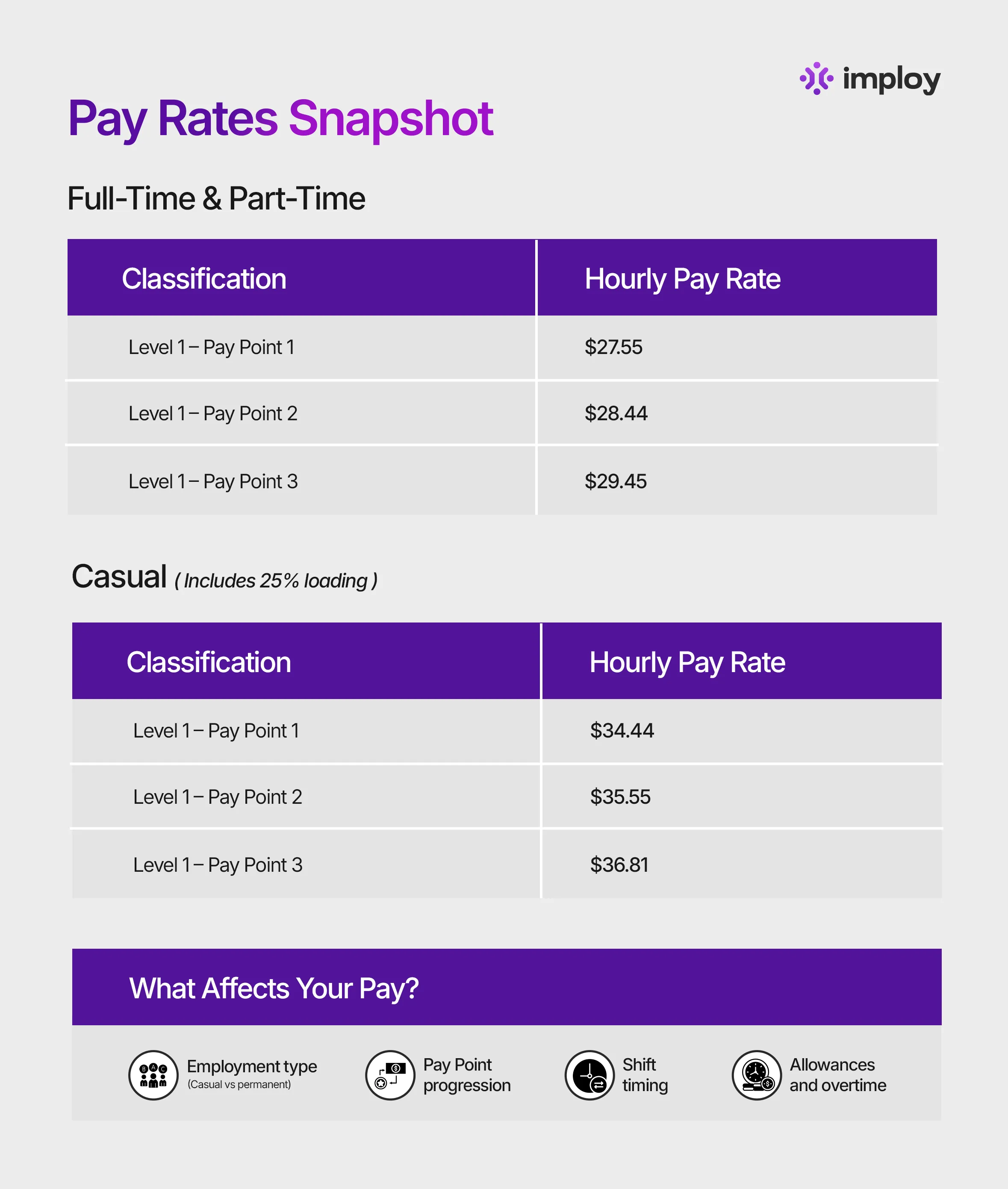
The SCHADS Award sets clear minimum pay rates for Level 1 Disability Support Workers, ensuring fair compensation across full-time, part-time, and casual employment. From 24 June 2026, updated wage rates apply based on classification, pay point, and shift type, with additional penalties for weekends, public holidays, and certain shift hours.
Below is a breakdown of the Level 1 Disability Support Worker pay rates for 2025, including base pay, penalty rates, and casual loadings, to help workers and providers understand how earnings are calculated under the award.
Full-Time and Part-Time Pay Rates
For full-time and part-time employees, the following hourly and weekly rates apply from 24 June 2026.
Source: Fair Work Ombudsman - SCHADS Award 2026 Pay Guide.
Key points:
- Hourly rates apply to ordinary weekday hours.
- Weekend and public holiday rates are paid at higher penalty percentages.
- Shift loadings apply on top of the base rate when eligible.
Casual Level 1 Pay Rates (Including Casual Loading)
Casual employees receive a 25% casual loading, which is already included in the rates below.
Source: Fair Work Ombudsman - SCHADS Award 2026 Pay Guide.
Important: Casual workers do not receive paid leave, which is why their hourly rate is higher than full-time or part-time workers.
What Do These Pay Rates Mean in Practice?
- Base hourly rate: Paid for ordinary weekday hours.
- Saturday rate: Higher penalty for weekend work.
- Sunday rate: Significantly higher due to SCHADS penalties.
- Public holiday rate: The highest rate under the award.
- Afternoon shift loading: Applies when working designated afternoon hours.
- Night shift loading: Applies to late-night or overnight shifts.
These penalties can substantially increase total earnings for Level 1 workers who take on weekend or public holiday shifts.
Example Pay Calculations
Example 1:
A Level 1 Pay Point 1 casual working a Sunday shift earns $61.99 per hour.
Example 2:
A Level 1 Pay Point 2 part-time worker on a public holiday earns $78.21 per hour.
What Affects a Level 1 Support Worker’s Pay?
Several factors influence how much a Level 1 disability support worker earns:
1. Pay Point Progression
Workers move from Pay Point 1 to Pay Point 3 based on experience and time in the role.
2. Employment Type
- Casual workers earn more per hour.
- Full-time and part-time workers receive paid leave and job security.
3. Shift Timing
Working weekends, nights, or public holidays significantly increases hourly pay.
4. Allowances and Overtime
Additional allowances may apply for:
- Broken shifts
- Travel between clients
- Overtime (with higher rates for the first two hours)
Understanding what affects Level 1 support worker pay helps workers make informed choices about shifts, employment type, and career progression.
By moving through pay points, taking on penalty shifts, and understanding applicable allowances, Level 1 workers can maximise their earnings while building experience for future advancement in the disability support sector.
Career Growth Beyond Level 1
Starting as a Level 1 Disability Support Worker gives you a strong foundation in the disability support sector. At this level, you gain hands-on experience supporting participants, learning workplace procedures, and developing core care and communication skills under supervision. For many workers, Level 1 is the first step into a long-term career in disability support.
Level 1 is designed as an entry point - and there are clear pathways to progress. With experience, training, and increased responsibility, you can move into:
- Level 2 Disability Support Worker: Greater independence, higher pay rates, and more complex support tasks. Learn more about Level 2 Disability Support Worker Pay in 2025 on our guide.
- Level 3 and higher classifications: Specialised or higher-intensity support roles.
- Team Leader or Coordinator roles: Supervising staff, mentoring new workers, or managing service delivery.
- Specialist positions: Such as behaviour support, community participation, or complex care.
- Independent support work: Providing services directly to self- or plan-managed NDIS participants.
Completing additional training, such as a Certificate III, Certificate IV, or Diploma in Disability or Community Services, can significantly increase both earning potential and career flexibility.
If you’re considering long-term growth in the sector, including running your own services, explore our guide: How to Set Up an NDIS Business in Australia.
How Imploy Supports Disability Support Workers?
At Imploy, we help disability support workers and providers manage the administrative side of care with confidence and compliance.
With Imploy, you can:
- Access ready-to-use SCHADS- and NDIS-compliant templates.
- Create professional invoices, service agreements, and records quickly.
- Stay updated on pay rate changes and compliance requirements.
- Explore practical blogs, guides, and FAQs designed for NDIS professionals.
Explore our full library of tools and resources here: Imploy’s NDIS Provider Resources.
Final Thoughts
Level 1 Disability Support Worker pay rates in 2026 reflect the importance of entry-level roles in the care sector. While Level 1 is a starting point, penalty rates and progression opportunities mean workers can build a stable and rewarding career in disability support.
Understanding your correct pay rate under the SCHADS Award ensures you are paid fairly for the essential work you do.
Frequently Asked Questions (FAQs)
1. What is a Level 1 Disability Support Worker?
A Level 1 Disability Support Worker is an entry-level role under the SCHADS Award, typically for workers new to the sector. They provide basic personal care, community support, and assistance with daily activities under direct supervision.
2. How much do Level 1 Disability Support Workers earn in 2026?
Pay depends on your employment type, pay point, and shift. Full-time and part-time workers earn between $27.55 and $229.45 per hour, while casual workers earn higher rates between $34.44 and $36.81 per hour due to a 25% casual loading. Weekend, night, and public holiday shifts attract additional penalty rates.
3. What are Pay Points, and how do they affect my pay?
Pay Points 1, 2, and 3 reflect experience and time in the role. Workers start at Pay Point 1 and progress to Pay Point 3, which increases base hourly rates and overall earnings.
4. How do penalty rates work for Level 1 workers?
Penalty rates apply for work on Saturdays, Sundays, public holidays, afternoon, and night shifts. For example, a Level 1 casual working a Sunday shift can earn up to $66.26 per hour depending on their pay point.
5. What is the difference between casual and full-time/part-time pay?
Casual workers receive a higher hourly rate due to casual loading but do not receive paid leave or job security. Full-time and part-time workers earn slightly lower hourly rates but benefit from paid leave and consistent employment.