

Understanding NDIS Client Incident Categorisation
Understand NDIS client incident categorisation, reportable incidents, definitions, and reporting timeframes to stay compliant and protect participants.

Ensuring the safety and wellbeing of NDIS participants is fundamental to delivering high-quality, compliant disability supports. A key part of this responsibility is recognising, categorising, and responding to incidents that occur in connection with the delivery of NDIS services.
Some incidents must be reported to the NDIS Quality and Safeguards Commission within strict legal timeframes. This blog explains NDIS client incident categorisation, with a focus on reportable incidents, their definitions, and notification requirements.
What Is an Incident in the NDIS Context?
An incident under the NDIS refers to any act, omission, event, or circumstance that has happened, or is alleged to have happened in connection with the provision of NDIS supports or services. These events may cause harm or could potentially lead to harm for a person with disability.
Incidents can be actual or alleged, and they may occur:
- During the delivery of supports.
- Due to changes, withdrawal, or alteration of services.
- In environments where supports are provided, such as homes, accommodation settings, or community locations.
There are two main types:
- Reportable incidents: these must be notified to the NDIS Commission within strict timeframes.
- Non-reportable incidents: not always reported to the Commission but still recorded internally for safety and compliance.
Why Incident Categorisation Matters?
Accurate incident categorisation is essential for ensuring safe, compliant, and high-quality NDIS service delivery. When incidents are correctly identified and classified, providers are better able to:
- Take timely and appropriate action to protect the health, safety, and wellbeing of participants.
- Meet legal reporting obligations under the NDIS (Incident Management and Reportable Incidents) Rules 2018.
- Identify patterns and trends to reduce future risks and improve service quality.
- Demonstrate transparency and accountability to the NDIS Quality and Safeguards Commission.
- Reduce regulatory and operational risk by avoiding under-reporting or late reporting.
- Strengthen staff confidence and capability in recognising and responding to incidents.
Registered NDIS providers are required to maintain an effective incident management system that supports the identification, recording, management, and reporting of incidents, including reportable incidents, in line with regulatory requirements.
What Makes an Incident “Reportable”?
A reportable incident is a specific type of incident that registered NDIS providers are legally required to notify to the NDIS Quality and Safeguards Commission within defined timeframes, starting from when the provider becomes aware of the incident.
Reportable incidents include actual or alleged events that cause, or have the potential to cause, serious harm to a person with disability, or involve unauthorised practices. Importantly, these reporting obligations apply regardless of whether the provider was directly responsible for the incident occurring. The focus is on participant safety, transparency, and regulatory oversight - not fault.
Core Categories of Reportable Incidents
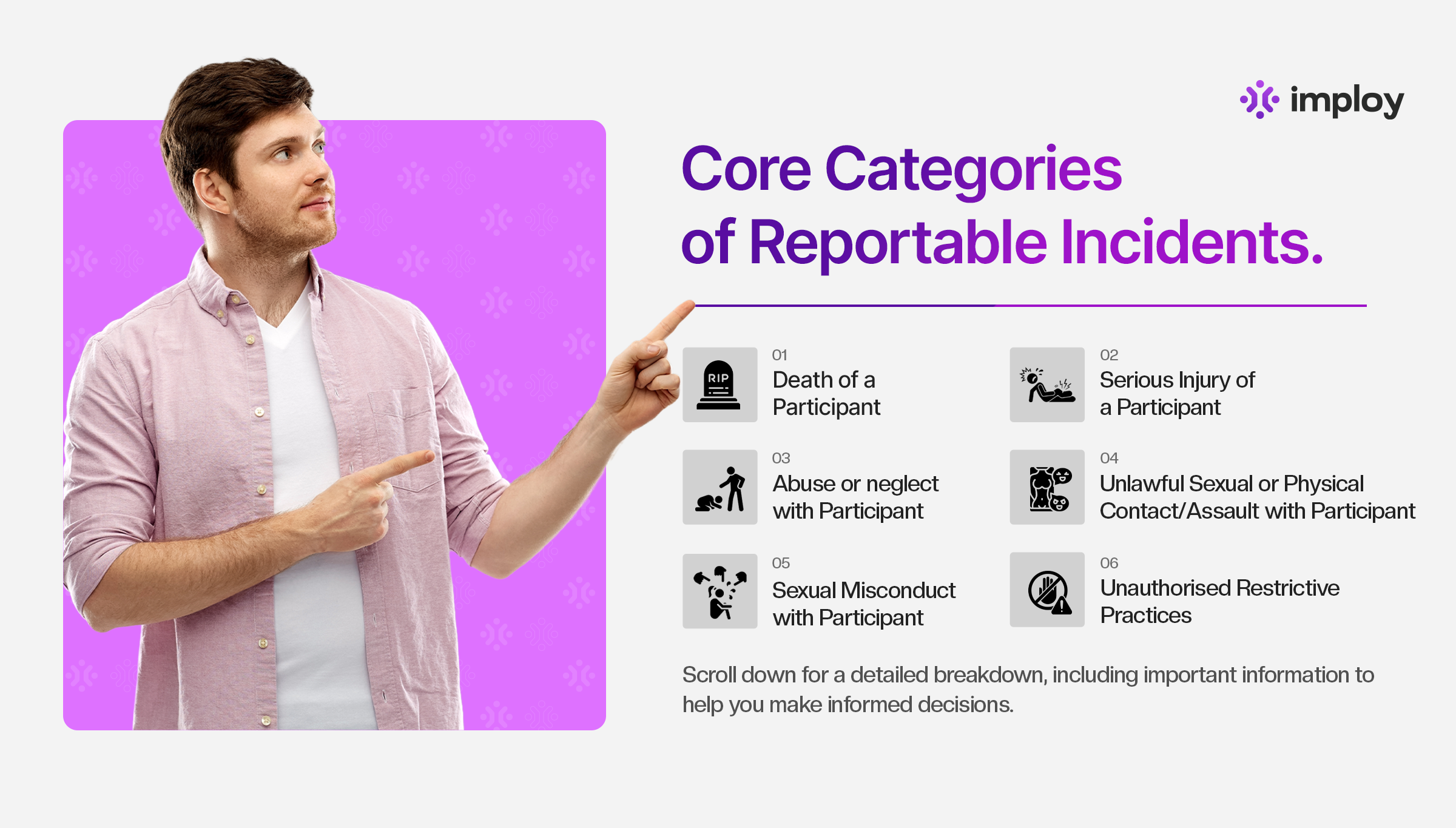
The NDIS Quality and Safeguards Commission identifies six categories of reportable incidents that all registered providers must notify:
- Death of a person with disability
Any death that occurs in connection with the delivery of NDIS supports or services.
Example: A participant passes away while receiving in-home support, during supported accommodation, or while being transported by a provider as part of their NDIS service. - Serious injury of a person with disability
Injuries that require urgent medical treatment, hospitalisation, or pose a significant risk to the person’s health or safety.
Example: A participant sustains a fractured arm after a fall during personal care support and is taken to hospital for treatment. - Abuse or neglect of a person with disability
Acts or omissions that cause harm or place a person at risk of harm, including inadequate care, supervision, or treatment.
Example: A participant is left without essential medication, meals, or personal care for an extended period, resulting in health deterioration. - Unlawful sexual or physical contact with, or assault of, a person with disability
Any non-consensual or unlawful physical or sexual contact, regardless of circumstances.
Example: A support worker physically restrains or hits a participant without lawful authority, or engages in sexual contact without consent. - Sexual misconduct against, or in the presence of, a person with disability (including grooming)
Inappropriate sexual behaviour, exposure, or grooming for sexual activity, whether or not physical contact occurs.
Example: A staff member makes sexually explicit comments, exposes themselves, or attempts to build an inappropriate relationship with a participant for sexual purposes. - Unauthorised use of restrictive practices
The use of restrictive practices that are not authorised by the relevant state or territory or do not follow the participant’s approved behaviour support plan.
Example: A support worker uses physical restraint or locks doors to prevent a participant from leaving, without approval or outside an authorised behaviour support plan.
Correctly identifying and categorising these incidents is essential to ensure timely reporting, protect participants from harm, and maintain compliance with NDIS regulatory requirements.
Reportable Incident Timeframes
Once a registered NDIS provider becomes aware of a reportable incident, they must notify the NDIS Commission within specific timeframes.
NDIS Reportable Incident Notification Table
Important: If the unauthorised use of a restrictive practice results in harm, it must be reported within 24 hours.
Best Practices for Incident Management
To maintain compliance and uphold participant safety, providers should adopt these practices:
- Train staff on identifying and categorising incidents.
- Embed incident reporting protocols into organisational procedures.
- Record all incidents, both reportable and non-reportable, to support continuous quality improvement.
- Review incident trends regularly to identify risk patterns and prevention opportunities.
- Engage participants and families appropriately when incidents occur.
A strong incident management culture not only meets regulatory expectations but also reinforces trust and transparency in service delivery.
Consequences of Late or Non-Reporting
Failing to notify the NDIS Quality and Safeguards Commission within the required timeframes can have serious regulatory and operational consequences for registered NDIS providers. Depending on the nature and severity of the breach, this may include:
- Infringement notices issued by the NDIS Commission.
- Regulatory investigations into the provider’s systems, governance, and service delivery practices.
- Compliance or enforcement actions, including formal warnings, enforceable undertakings, civil penalties, or fines.
- Impacts on provider registration, such as additional conditions, suspension, or cancellation of registration.
- Reputational damage, which can affect participant trust and future referrals.
Beyond regulatory consequences, late or non-reporting can delay critical interventions needed to protect participants from harm and prevent similar incidents from occurring again.
Understanding and consistently meeting incident reporting obligations is therefore essential - not only for regulatory compliance, but also for safeguarding participant wellbeing and maintaining high standards of care across NDIS services.
How Imploy Makes Incident Management Easier?
Imploy helps NDIS providers manage incidents efficiently, reduce compliance risk, and save time through practical, purpose-built tools.
- Structured Incident & Risk Logs
Easily record, track, and resolve incidents in one place. Staff can upload evidence such as photos or documents, while follow-up actions and resolutions are clearly documented from start to finish. - NDIS-Compliant Templates
Ready-made incident reporting templates aligned with NDIS requirements help ensure reports are complete, consistent, and audit-ready - without the need to create forms from scratch. - Real-Time Activity Logs
All actions are time-stamped and tracked, creating a clear digital trail that supports accountability and simplifies audits. - Compliance Alerts & Document Tracking
Automated reminders and compliance dashboards help providers stay on top of certifications, care plans, and key documents, reducing the risk of missed deadlines. - Customisable Reports
Generate and export incident reports in PDF or CSV format to identify trends, support audits, or share insights with stakeholders.
Final Thoughts
NDIS client incident categorisation and reporting are essential responsibilities for registered NDIS providers. By understanding what constitutes a reportable incident, knowing the official categories, and acting within the defined timeframes, providers safeguard participants and maintain high standards of care.
Tools like Imploy can help streamline incident reporting, ensuring records are complete, compliant, and easy to manage, while supporting timely and accurate notifications to the NDIS Commission.
Frequently Asked Questions (FAQs)
1. What is considered an incident under the NDIS?
An NDIS incident is any act, omission, event, or circumstance connected to the delivery of supports or services that causes, or could cause, harm to a person with disability. Incidents may be actual or alleged and must be recorded by the provider.
2. What is the difference between reportable and non-reportable incidents?
Reportable incidents must be notified to the NDIS Quality and Safeguards Commission within strict timeframes due to their seriousness. Non-reportable incidents do not require notification to the Commission but must still be recorded and managed internally as part of the provider’s incident management system.
3. Who is responsible for reporting a reportable incident?
Registered NDIS providers are legally responsible for reporting reportable incidents to the NDIS Quality and Safeguards Commission, even if the provider was not directly responsible for the incident occurring.
4. What are the six categories of NDIS reportable incidents?
The six reportable incident categories are:
- Death of a person with disability
- Serious injury of a person with disability
- Abuse or neglect of a person with disability
- Unlawful sexual or physical contact, or assault
- Sexual misconduct or grooming
- Unauthorised use of restrictive practices
5. How quickly must reportable incidents be notified?
Most reportable incidents must be notified to the NDIS Commission within 24 hours of the provider becoming aware of the incident. Unauthorised use of a restrictive practice must be reported within 5 business days, unless it results in harm, in which case it must be reported within 24 hours.
6. Why is accurate incident categorisation important?
Correct categorisation ensures timely reporting, protects participant safety, supports compliance with legislation, reduces regulatory risk, and helps providers identify trends to improve service quality.


.webp)