
Step-by-Step Guide to Crafting an NDIS Quote
Discover how to craft professional NDIS quotes that support faster approvals, improve compliance, and clearly communicate participant supports.

Creating an accurate and professional NDIS quote is an essential part of delivering services under the National Disability Insurance Scheme (NDIS). Whether you're providing support coordination, personal care, therapy, community participation, or assistive technology, a well-prepared quote helps participants understand the services they will receive while ensuring compliance with NDIS requirements.
A clear NDIS quote not only improves transparency but can also reduce approval delays, minimise administrative back-and-forth, and demonstrate that the proposed supports represent value for money.
In this guide, we'll walk through the key components of an NDIS quote and explain how providers can create quotes efficiently and accurately.
What Is an NDIS Quote?
An NDIS quote is a formal document that outlines the supports a provider intends to deliver to a participant, along with associated costs and service details.
A comprehensive quote typically includes:
- Provider information
- Participant details
- Support descriptions
- NDIS item codes
- Quantities and pricing
- Service delivery arrangements
- Travel or additional costs
- Consent and declarations
The purpose of the quote is to provide a transparent breakdown of services and demonstrate how the proposed supports align with the participant's goals and NDIS funding requirements.
Why a Well-Prepared NDIS Quote Matters?
A professionally prepared quote can:
- Improve participant confidence and transparency
- Help plan managers review supports quickly
- Support NDIA funding approvals
- Reduce errors and compliance risks
- Create a clear record for audits and reporting
Incomplete or inaccurate quotes can lead to delays, funding issues, or additional administrative work for both providers and participants.
8 Steps to Create an NDIS Quote That Gets Approved Faster
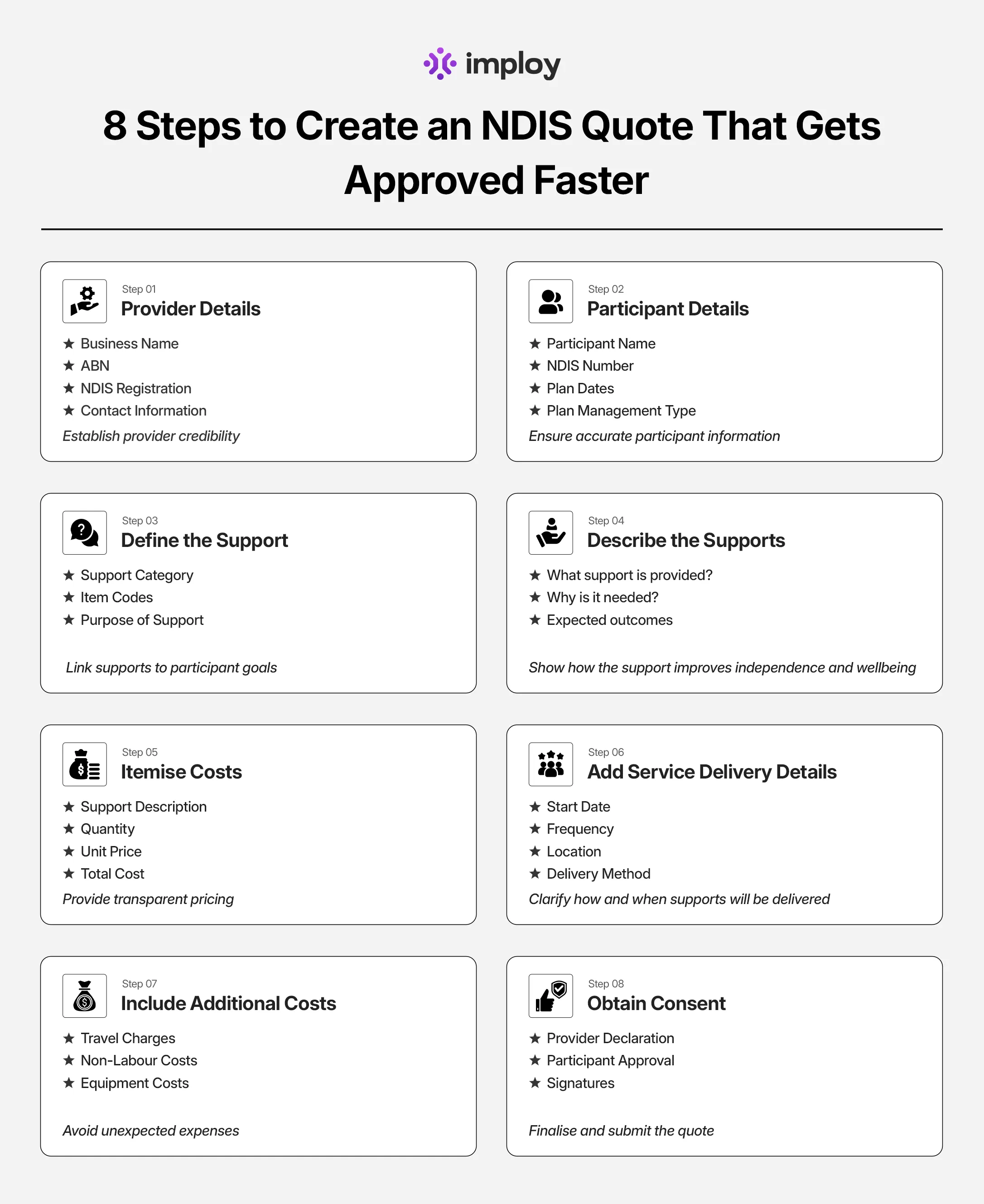
Step 1: Gather Provider Information
Begin by entering your organisation's details.
This section should include:
- Provider name
- Trading name (if applicable)
- ABN
- NDIS registration number (if registered)
- Provider status
- Contact person
- Phone number
- Email address
- Business address
Accurate provider information ensures participants and plan managers can easily verify and contact your organisation.
Best Practice Tip:
Keep provider details standardised across all documentation to maintain professionalism and consistency.
Step 2: Add Participant Details
Next, include information about the participant receiving the supports.
This section generally contains:
- Participant name
- NDIS number
- Date of birth
- Plan start date
- Plan end date
- Plan management type
- Plan manager details (if applicable)
Correct participant information helps ensure supports are billed and managed against the appropriate NDIS plan.
Best Practice Tip:
Always verify participant details against current plan documentation before finalising the quote.
Step 3: Define the Support Being Quoted
This is one of the most important sections of the quote.
Clearly outline:
- Quote number
- Quote date
- Support category
- Support item codes
- Support purpose
- Type of support being provided
The support purpose should explain how the service contributes to the participant's goals and outcomes.
For example:
"Community access support to assist the participant in developing social skills, increasing independence, and participating in community activities."
Best Practice Tip:
Avoid generic descriptions. Clearly connect each support to participant outcomes and goals.
Step 4: Provide a Detailed Description of Supports
The NDIS places significant emphasis on demonstrating why supports are required.
Describe:
1. Type of Support
Explain exactly what service will be delivered.
2. Relationship to Disability
Outline how the support addresses the participant's disability-related needs.
3. Expected Outcomes
Clearly state the intended benefits, such as:
- Increased independence
- Improved daily living skills
- Enhanced community participation
- Greater safety at home
- Improved wellbeing
The more specific and measurable the outcomes, the stronger the justification for the support.
Step 5: Create an Itemised Cost Breakdown
A detailed cost breakdown is essential for transparency and compliance.
For each support, include:
- Support description
- NDIS item code
- Quantity
- Unit
- Unit price
- Total cost
Best Practice Tip:
Always verify pricing against the current NDIS Pricing Arrangements and Price Limits before issuing a quote.
Step 6: Specify Service Delivery Details
Participants and plan managers need to understand how and when supports will be delivered.
Include:
- Service start date
- End date (if applicable)
- Frequency of service
- Location of service
- Delivery method
- Estimated delivery timeframe
- Installation or setup requirements (if applicable)
Examples may include:
- Weekly in-home personal care
- Monthly occupational therapy sessions
- Community-based support delivered twice per week
- Telehealth consultations
Step 7: Include Travel and Additional Costs
If applicable, clearly document:
- Travel time charges
- Travel distance charges
- Non-labour costs
- Equipment delivery costs
- Other associated expenses
Transparency around additional charges helps avoid billing disputes and ensures participants understand the full cost of service delivery.
Best Practice Tip:
Only include travel and additional charges where permitted under current NDIS guidelines.
Step 8: Obtain Declarations and Consent
The final step is ensuring both parties acknowledge the quote.
Provider declarations typically confirm:
- Information is accurate
- Pricing complies with NDIS pricing arrangements
Participant or nominee consent confirms agreement with the proposed supports and costs.
This provides documented evidence that all parties understand and accept the quote.
Common Mistakes to Avoid
Even experienced NDIS providers can make mistakes when preparing quotes, particularly when managing multiple participants and support types. Avoiding these common errors can help improve compliance, reduce approval delays, and create a better experience for participants and plan managers.
1. Using Incorrect Item Codes
NDIS item codes are used to identify the specific supports being funded and delivered. Using outdated, incorrect, or mismatched codes can lead to claim rejections, funding issues, and additional administrative work.
2. Providing Vague Support Descriptions
Support descriptions should clearly explain what service will be delivered and how it will benefit the participant. Generic or unclear descriptions may make it difficult for plan managers or the NDIA to assess the value and purpose of the support.
3. Missing Participant Goals
Every support included in a quote should align with the participant's NDIS goals and intended outcomes. Failing to demonstrate this connection may weaken the justification for funding and delay approval processes.
4. Incorrect Pricing
All quoted rates should comply with the latest NDIS Pricing Arrangements and Price Limits. Errors in pricing can result in compliance risks, billing disputes, or rejected claims.
5. Omitting Additional Costs
Travel charges, non-labour costs, and other approved expenses should be disclosed upfront where applicable. Leaving out these costs can create confusion later and may lead to payment delays or participant disputes.
How Imploy Simplifies NDIS Quote Management?
Creating quotes manually can be time-consuming, particularly for growing providers managing multiple participants and services.
Imploy helps providers streamline administrative tasks by centralising participant information, support records, service delivery data, and billing workflows in one platform.
Instead of creating documents from scratch each time, providers can maintain accurate records, reduce duplication, and improve consistency across quotes, service agreements, invoices, and participant documentation.
This not only saves time but also helps providers maintain compliance and deliver a more professional experience for participants and plan managers.
Final Thoughts
A well-crafted NDIS quote is more than just a pricing document. It demonstrates professionalism, supports compliance, and helps participants understand the value of the services being delivered.
By following a structured approach - capturing accurate participant information, clearly defining supports, providing transparent pricing, and documenting service delivery details - providers can create quotes that are easier to approve, easier to manage, and easier to trust.
As your organisation grows, having the right systems and processes in place can make quote creation faster, more accurate, and far less administrative, allowing your team to focus on what matters most: delivering quality support to participants.
FAQs
1. What is an NDIS quote?
An NDIS quote is a formal document that outlines the supports a provider plans to deliver to a participant, including service descriptions, NDIS item codes, quantities, pricing, and delivery arrangements. It helps participants, plan managers, and the NDIA understand the proposed supports and associated costs.
2. When is an NDIS quote required?
An NDIS quote is typically required when a support or service needs prior approval from the NDIA, particularly for specialised supports, high-value services, assistive technology, or home modifications. Requirements may vary depending on the participant's plan and funding arrangements.
3. What information should be included in an NDIS quote?
A comprehensive NDIS quote should include provider details, participant information, support descriptions, NDIS item codes, quantities, pricing, service delivery details, travel costs (if applicable), and declarations or consent from both parties.
4. How do I find the correct NDIS item code for a service?
Providers can identify the correct item code by referring to the current NDIS Pricing Arrangements and Price Limits. Using the correct code ensures accurate billing and reduces the risk of claim rejections or compliance issues.
5. Can I charge travel costs in an NDIS quote?
Yes, travel costs may be included where permitted under NDIS guidelines. Providers should clearly specify travel time, distance-related expenses, and any other allowable charges to ensure transparency for participants and plan managers.