
NDIS Reforms 2026: A Complete Guide
NDIS 2026 reforms explained simply: functional eligibility, reduced funding, stricter provider rules, and what participants and providers need to do now.


Australia’s National Disability Insurance Scheme (NDIS) is undergoing its most significant transformation since its introduction. Announced in April 2026, these reforms aim to address rising costs, improve fairness, and strengthen system integrity.
With changes rolling out from mid-2026 through to 2028, providers, participants, support coordinators, and plan managers must prepare now to stay compliant and informed.
Why Are NDIS Reforms Happening?
The NDIS has grown rapidly over the past several years, but this growth has also raised serious concerns about long-term affordability, consistency, and system integrity. The reforms introduced in 2026 are designed to bring the scheme back onto a sustainable path while improving fairness and accountability.
1. Rising Costs and Unsustainable Growth
The financial trajectory of the NDIS has been a key driver for reform.
- Projected cost by 2030: $70 billion per year
- Reform target: $55 billion per year
- Expected savings: around $15 billion annually
Without changes, the scheme would continue to expand beyond sustainable levels, placing increasing pressure on federal budgets and future funding commitments.
2. Rapid Participant Growth
Alongside rising costs, participant numbers have increased significantly:
- Current participants: around 760,000
- Projected without reform: over 900,000
- Reform target: approximately 600,000 participants
This gap reflects concerns that eligibility criteria may have become too broad, leading to inconsistent access and uneven distribution of supports.
3. Improving Fairness and Consistency
Beyond financial pressures, the system has also faced criticism for inconsistency in decision-making. Different levels of access and funding have sometimes depended on diagnosis rather than actual support needs.
The reforms aim to shift the system toward a more consistent, evidence-based approach where support is determined by functional impact, not just medical labels.
4. Reducing Fraud and Improving Oversight
Another important factor is the need to strengthen trust and accountability within the system. Increased regulation, tighter provider registration, and digital payment tracking are being introduced to reduce fraud and ensure funding is used appropriately.
The Core Objective
Ultimately, the reforms are designed to achieve a balance between three key goals:
- Financial sustainability of the NDIS
- Fair and consistent access for participants
- Stronger oversight and quality assurance across providers
In simple terms, the government is aiming to ensure the NDIS can continue supporting Australians with disability well into the future - without uncontrolled cost growth or system inefficiencies.
Key NDIS Reforms Explained
1. Shift to Functional Eligibility
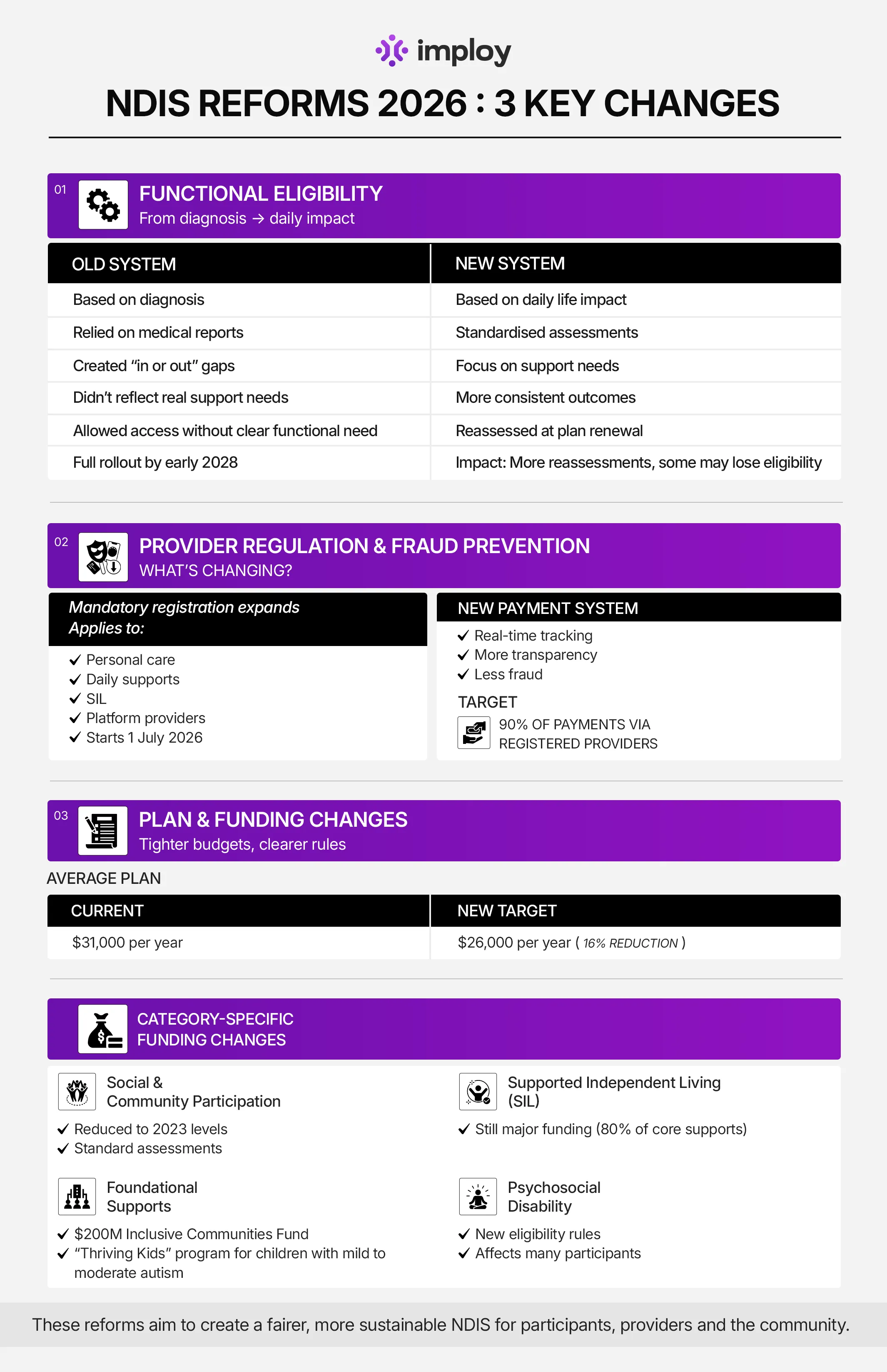
One of the most significant reforms is the shift in how participants qualify for the NDIS. The system is moving away from a diagnosis-driven model to one that focuses on how a disability actually impacts a person’s daily life.
- Old System: Diagnosis-Led
Under the previous model, eligibility was largely based on a participant’s diagnosed disability. While this approach provided a clear entry pathway, it also created several challenges:
- Eligibility primarily based on a medical diagnosis
- Heavy reliance on medical reports and diagnostic labels
- Created sharp and often inequitable “in or out” boundaries
- Diagnosis alone did not always reflect actual support needs
- In some cases, allowed access without clear evidence of functional impact
- New System: Functional Assessment
The reformed model introduces a more consistent and evidence-based approach to determining eligibility.
- Eligibility based on the functional impact of disability on daily life
- Standardised, evidence-based assessments for all applicants
- Focus shifts to actual support needs, not diagnostic labels
- Designed to deliver fairer and more consistent outcomes
- Existing participants will be reassessed at plan renewal
Note: The full rollout of this system is expected by early 2028
What Does This Mean?
This change is intended to create a more equitable system where access to the NDIS is based on how much support a person truly needs, rather than the type of diagnosis they have. However, it also means that many current participants will undergo reassessment, and some may transition to other support systems if they no longer meet the new criteria.
2. Stronger Provider Regulation and Fraud Prevention
The 2026 reforms place a much stronger emphasis on provider accountability, service quality, and safeguarding participant funds. As the NDIS has expanded, gaps in oversight have led to inconsistent service standards and increased instances of overcharging and fraudulent claims. These changes aim to create a more transparent and tightly regulated provider environment.
What’s Changing?
- Mandatory registration expanded across more service types:
Previously, not all providers were required to be registered to deliver NDIS services. Under the new reforms, registration will be mandatory for a broader range of providers, particularly those delivering higher-risk or high-volume supports.
This applies to:
- Personal care
- Daily living supports
- Supported Independent Living (SIL)
- Platform providers (including digital marketplaces and gig-style services)
- Mandatory registration begins 1 July 2026:
From this date, unregistered providers operating in these categories will no longer be able to deliver services to NDIS participants. This is a major shift, especially for smaller or independent providers who previously operated without formal registration.
New Digital Payment System
A key part of the reform is the introduction of a more advanced, centralised payment system designed to improve financial tracking and reduce misuse of funds.
The new system will:
- Track payments in real time, allowing quicker detection of unusual or non-compliant claims
- Increase transparency for participants, providers, and regulators
- Reduce fraudulent claims by introducing tighter validation and monitoring processes
Target outcome: Around 90% of all NDIS payments will be processed through registered providers, significantly reducing the risk of fraud and improving overall system integrity.
3. Changes to Plan and NDIS Funding
The 2026 reforms introduce important changes to how NDIS funding is allocated and managed. The overall goal is to ensure funding is more closely aligned with a participant’s actual support needs, while also improving the long-term sustainability of the scheme.
Average Plan Reduction
- Current average plan: $31,000 per year
- New target average: $26,000 per year
- Reduction: 16%
This reduction reflects stricter guidelines around what is considered “reasonable and necessary” support. Funding will be more targeted, with greater emphasis on evidence-based needs rather than broad or flexible allocations.
Category-Specific Funding Changes:
1. Social & Community Participation
- Funding will be reduced to 2023 levels
- Standardised assessments will be required to justify support needs
This means participants may need to provide clearer evidence of how these supports improve independence and daily functioning.
2. Supported Independent Living (SIL):
- Mandatory provider registration will apply from 1 July, 2026
- Continues to be a major funding category, making up around 80% of core supports
While SIL remains a priority area, there will be stronger oversight to ensure funding is used appropriately and services meet quality standards.
3. Foundational Supports
A new layer of support will be introduced for people who may not need full NDIS plans but still require assistance.
Key initiatives include:
- $200 million Inclusive Communities Fund
- “Thriving Kids” program for children with mild to moderate autism
These supports aim to provide early intervention and community-based assistance outside the core NDIS system.
4. Psychosocial Disability
- Introduction of new functional eligibility criteria
- Will impact a large group of participants with moderate to severe psychological conditions
Access and funding will now depend more on how psychosocial disability affects daily life, rather than diagnosis alone.
Key Dates to Remember
The NDIS reforms will be rolled out in stages over the next two years, with several important milestones that providers, participants, and stakeholders need to be aware of. Understanding these key dates will help you prepare early, stay compliant, and smoothly transition as the new system takes effect.
What Providers, Support Coordinators, and Plan Managers Need to Do Now?
What Providers Need to Do?
- Review and update registration status.
- Align services with evidence-based standards.
- Prepare for increased audits and compliance checks.
- Update pricing and service agreements.
What Support Coordinators Should Focus On?
- Understand the new functional assessment framework.
- Communicate changes clearly to participants.
- Help clients transition to mainstream or foundational supports if needed.
- Review provider networks to ensure compliance.
What Plan Managers Must Prepare For?
- Adapt to the new digital payment system.
- Ensure providers are registered before processing payments.
- Adjust financial planning to reflect lower plan budgets.
- Strengthen compliance processes.
Final Thoughts
The NDIS reforms of 2026 represent a major turning point for the disability sector in Australia. With changes to eligibility, provider regulation, and funding, every stakeholder will be affected.
Preparing early will be key. Providers, coordinators, and plan managers who adapt quickly will be best positioned to navigate the transition and continue delivering high-quality support.
In this evolving landscape, having the right systems in place will make a significant difference. Platforms like Imploy can help providers stay compliant, manage workforce operations efficiently, and adapt to new requirements such as digital payments, stricter registration, and audit readiness.
Ultimately, those who embrace both regulatory changes and smarter technology will be better equipped to succeed in the new NDIS environment.
FAQs
1. When will the NDIS reforms come into effect?
The reforms were announced in April 2026, with changes rolling out from mid-2026. Key milestones include mandatory provider registration from 1 July 2026, participant reassessments starting in late 2026, and full implementation of functional assessments by early 2028.
2. What is the biggest change in the NDIS reforms?
The most significant change is the shift from a diagnosis-based system to a functional eligibility model, where support is based on how a disability impacts daily life rather than the diagnosis itself.
3. Will existing NDIS participants be affected?
Yes. Existing participants will be reassessed during plan renewals under the new functional assessment framework. This may result in changes to eligibility, funding levels, or support categories.
4. Will NDIS funding be reduced?
On average, plan budgets are expected to decrease by around 16%, from $31,000 to $26,000 per year. However, actual funding will depend on individual needs and functional assessments.
5. What is the new NDIS payment system?
The reforms introduce a digital payment system that tracks transactions in real time, improves transparency, and reduces fraud. The goal is for 90% of payments to go through registered providers.
6. How will psychosocial disability be affected?
Participants with psychosocial disabilities will be assessed under the new functional criteria, meaning access and funding will depend more on how their condition impacts daily life rather than diagnosis alone.
7. What should providers do to prepare?
Providers should:
- Update their registration status
- Prepare for stricter compliance and audits
- Align services with evidence-based standards
- Adapt to the new payment system
8. What should participants do to prepare?
Participants should:
- Stay informed about upcoming reassessments
- Gather evidence showing how their disability impacts daily life
- Speak with their support coordinator or provider about potential changes
- Explore alternative or foundational supports if needed