
How to Read and Apply the SCHADS Pay Guide?
Learn how to read and apply the SCHADS Pay Guide, including classifications, allowances, broken shifts, penalties, and common payroll mistakes.


Navigating employee pay in the healthcare and community services sector can be complex, especially with the Social, Community, Home Care and Disability Services (SCHADS) Award and its Pay Guide. Whether you’re an employer, manager, or support worker, understanding how to read and apply the SCHADS Pay Guide ensures fair compensation, compliance with workplace laws, and accurate payroll management.
If you’re new to SCHADS classifications, start with our SCHADS Awards Classification guide to understand how roles are structured within the Award. This guide will help you identify the correct classification for any position, a crucial first step before calculating pay.
Key Components of the SCHADS Pay Guide
To effectively apply the SCHADS Pay Guide, it’s important to understand its main components. Each element plays a critical role in ensuring employees are paid accurately and employers remain compliant.
1. Pay Rates
Pay rates under the SCHADS Award aren’t one-size-fits-all. The amount an employee is paid depends on who they are, what they do, and how they work. The Pay Guide brings all of this together in one place.
What determines an employee’s pay rate?
A. Classification level
SCHADS roles are grouped from Level 1 (entry-level) to Level 8 (senior or specialist roles). The higher the level, the greater the responsibility, skill, and autonomy - and the higher the base pay.
B. Employment type
Pay rates differ depending on whether the employee is:
- Full-time
- Part-time
- Casual (casual employees receive a loading instead of some leave entitlements)
C. Experience and pay points
Some classifications include incremental pay points, meaning an employee’s rate can increase with:
- Years of service
- Experience in the role
- Progression within the classification level
Metrics employers can rely on:
- Actual duties performed (not just the job title)
- Qualifications or certifications
- Level of independence or decision-making
- Supervisory or leadership responsibilities
- Length of service or relevant experience
Using these factors ensures the employee is placed at the correct pay point and helps prevent underpayment risks.
These metrics help determine the correct pay point within each classification level, ensuring fair and compliant remuneration under the SCHADS Award. Examples of current pay rates and penalty loading calculations are available in Imploy’s Level 1 Disability Support Worker Pay guide, Level 2 Disability Support Worker Pay guide, and Level 3 Disability Support Worker Pay guide.
2. Classifications and Levels
Classifications are determined by:
- Complexity of tasks performed in the role.
- Required skills and qualifications, including certifications and licenses.
- Level of responsibility, such as independent decision-making or managing others.
Metrics for employers:
- Detailed job description and actual duties performed.
- Level of decision-making or autonomy required.
- Required training, certifications, or professional experience.
- Supervisory or leadership responsibilities.
Correct classification ensures employees receive the right base pay and prevents compliance issues. For practical guidance and examples, see our SCHADS Awards Classification guide.
3. Allowances
Allowances are additional payments for specific duties, working conditions, or requirements, including:
- Overtime, weekend, or public holiday loadings.
- Travel between client sites or work locations.
- Uniform or equipment needs.
Metrics employers can rely on:
- Actual work location and travel requirements.
- Shift timing and type (e.g., evening, night, weekend).
- Tasks that require special equipment or uniforms.
- Approved overtime or additional duties performed.
Applying the correct allowances ensures payroll accuracy, fair compensation, and higher staff satisfaction while maintaining compliance.
4. Hours of Work and Breaks
The Pay Guide sets out rules for:
- Standard full-time and part-time hours.
- Shift work provisions, including late-night, split, or rotating shifts.
- Minimum paid and unpaid breaks.
Metrics employers can rely on:
- Start and end times of shifts, including gap times for broken shifts.
- Length of unpaid breaks, especially when shifts are split.
- Compliance with minimum meal and rest breaks as required by the Award.
Correctly applying hours and break rules helps prevent disputes, protects employee wellbeing, and keeps your organisation Fair Work compliant.
Considering these elements provides a complete view of total employee remuneration and ensures budgeting and payroll are accurate and compliant.
Together, these elements ensure a comprehensive view of an employee’s total pay package. Employers must consider all components when budgeting, reporting payroll, and reviewing employment contracts.
Step-by-Step: How to Read the SCHADS Pay Guide
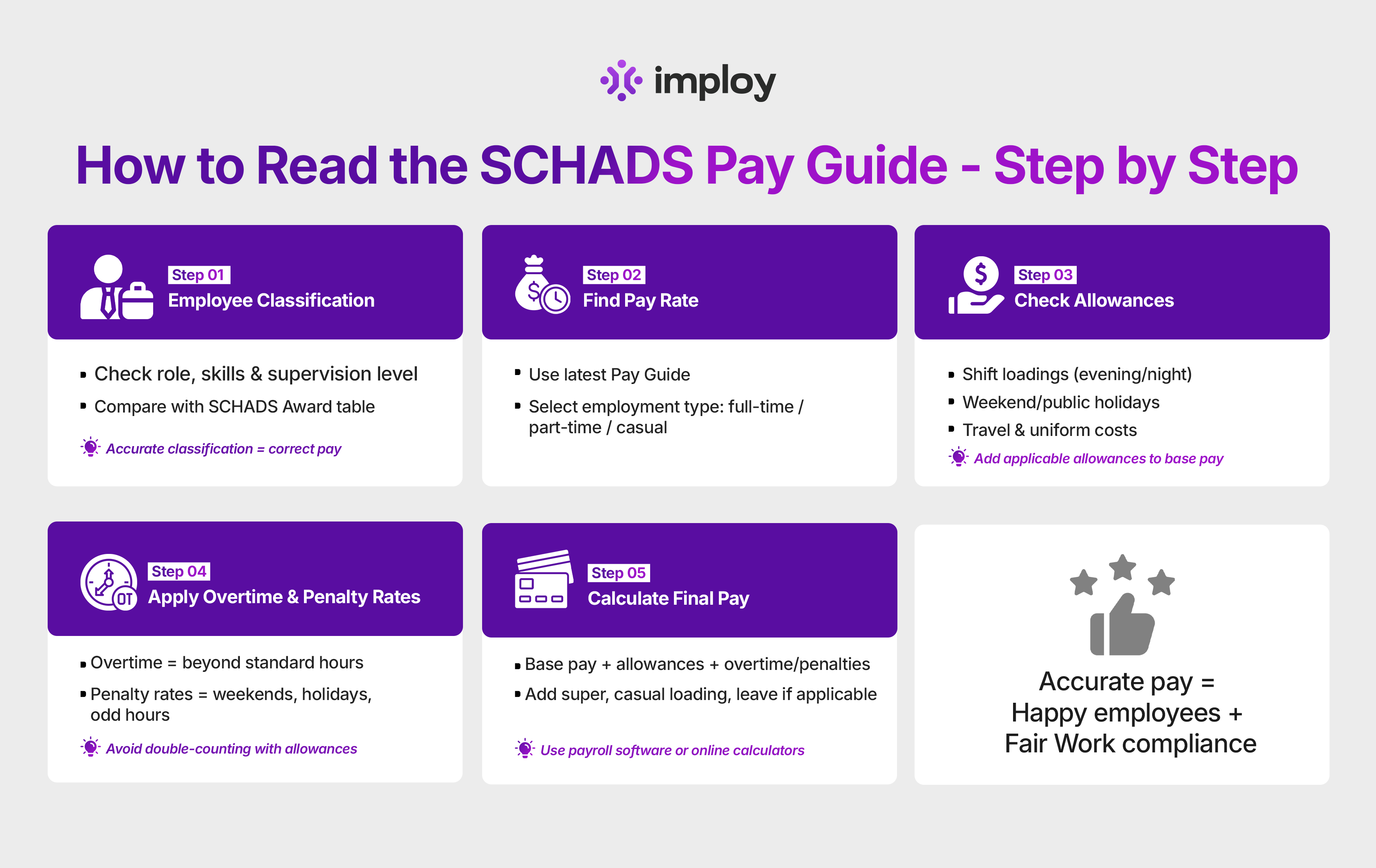
The SCHADS Pay Guide is a comprehensive resource, and at first glance, it can seem overwhelming. However, by following a structured approach, employers, payroll managers, and HR teams can accurately determine employee pay while remaining compliant with the Fair Work Commission requirements. Below is a detailed step-by-step guide.
Step 1: Identify the Employee’s Classification
The first and most critical step is to determine the employee’s classification level under the SCHADS Award. Classifications are based on:
- Role responsibilities: the type and complexity of tasks the employee performs.
- Skills and qualifications: formal training, licenses, or experience required.
- Supervisory or leadership duties: whether the role manages others or requires independent decision-making.
How to do it:
- Review the employee’s job description carefully.
- Compare the role’s responsibilities and requirements against the SCHADS Award classification table.
- Confirm the level using our SCHADS Awards Classification guide for practical examples.
Tip: Misclassifying a role can lead to underpayment or legal disputes, so take the time to ensure accuracy.
Step 2: Find the Relevant Pay Rate
Once the classification is determined, the next step is to identify the correct pay rate.
- Locate the Pay Guide table for the current year. SCHADS pay rates are updated annually, so always use the latest version.
- Choose the correct employment type: full-time, part-time, or casual. Casual employees generally receive a loading on top of base pay in place of some leave entitlements.
- Check incremental steps if the classification has multiple levels depending on experience or tenure.
Step 3: Check Applicable Allowances
Allowances are additional payments for specific duties or working conditions. Not every employee will be entitled to all allowances, but knowing what applies is essential.
Common allowances include:
- Shift loadings: Extra pay for evening or night shifts.
- Weekend or public holiday work: Penalty rates for non-standard days.
- Travel costs: When an employee is required to travel between locations as part of their role.
- Uniform or equipment costs: Compensation for required work clothing or tools.
How to apply allowances:
- Identify the circumstances where the allowance is applicable.
- Check the Pay Guide table for the exact rate.
- Add the allowance to the base pay.
Step 4: Apply Overtime and Penalty Rates
Overtime and penalty rates ensure employees are fairly compensated for additional or irregular work.
- Overtime: Paid when an employee works beyond the standard weekly or daily hours outlined in the Award.
- Penalty rates: Apply for working weekends, public holidays, or outside ordinary hours.
Tips for accurate application:
- Check the Pay Guide for the specific rate percentage (e.g., 1.5* for overtime, 2* for Sunday, 2.5* for public holidays).
- Calculate overtime after all standard hours are worked, including any pre-approved leave adjustments.
- Ensure that overlaps between overtime and allowances are handled correctly to avoid double-counting.
Step 5: Calculate the Final Pay
After determining classification, base rate, allowances, and any overtime or penalty rates, you can calculate total remuneration.
Steps:
- Base pay: Start with the standard hourly or weekly rate.
- Add allowances: Include shift loadings, uniform, or travel allowances.
- Add overtime/penalty pay: Include any relevant overtime hours, broken shifts or penalty rate hours.
- Include other pay elements: Superannuation, casual loading, or leave entitlements if applicable.
Tools to simplify calculations:
- Payroll software: Many systems allow you to input classification and hours worked, automatically calculating penalties and allowances.
- Spreadsheets: Useful for small teams or manual calculations.
- Online calculators: Check the Fair Work website or industry-specific tools.
By following these steps, employers can confidently read and apply the SCHADS Pay Guide, ensuring employees are paid accurately and fairly, and workplaces remain compliant with the Fair Work Act.
Common Mistakes When Applying the SCHADS Pay Guide
Even experienced providers can make mistakes when applying the SCHADS Pay Guide. Understanding these common pitfalls can help you avoid underpayments, compliance issues, and audit risks.
1. Treating the Base Rate as the Final Pay
The base rate is only the starting point for pay. Casual loading, penalties, allowances, and minimum engagement rules often apply on top.
2. Using the Wrong Classification Level
Classification is based on duties performed, not job titles. Failing to reassess roles as responsibilities change can lead to significant underpayments.
3. Ignoring Minimum Shift Lengths
Minimum engagement rules apply for casual and part-time employees. Paying only for the exact time worked can breach the Award.
4. Misunderstanding Broken Shift Rules
Broken shifts are one of the most commonly misapplied conditions under the SCHADS Award.
A broken shift occurs when an employee works two separate periods in the same day with an unpaid gap longer than a standard meal break between them. When this happens, a broken shift allowance applies in addition to ordinary pay.
Common mistakes include:
- Treating long unpaid gaps as normal breaks
- Forgetting to apply the broken shift allowance
- Scheduling multiple short shifts to bypass minimum engagement rules
- Focusing on total daily hours instead of shift structure
Broken shifts have strict definitions and mandatory additional payments. Auditors assess how the shift is structured, not just the hours worked, making this a frequent source of underpayment findings.
Learn more about managing broken shifts under the SCHADS Award on Imploy’s Broken Shift Allowance Guide.
5. Misapplying Casual Loading
Casual loading applies to ordinary hours, not penalties or allowances. Adding it incorrectly or forgetting it entirely is a common mistake.
6. Confusing Penalty Rates with Overtime
Penalty rates depend on when work is performed, while overtime depends on how much is worked. They are not interchangeable and must be applied separately.
7. Failing to Update Pay Rates
SCHADS pay rates and allowances are updated regularly. Using outdated rate tables or updating base rates without adjusting allowances can result in non-compliance.
8. Relying on Manual Payroll Calculations
Spreadsheets and manual checks increase the risk of errors. Missed penalties, incorrect classifications, and inconsistent pay for similar roles can quietly accumulate into significant underpayments, compliance breaches, and costly back-pay claims over time.
How Imploy Helps You Apply the SCHADS Pay Guide?
Reading and understanding the SCHADS Pay Guide is an important first step, but applying it correctly across your workforce can still be challenging. That’s where Imploy steps in as a practical, all-in-one solution built specifically for Australian care providers.
- Automates SCHADS compliance by applying correct pay rates, penalties, overtime, and allowances.
- Integrated payroll system that aligns rosters, timesheets, and SCHADS Award rules.
- Smart rostering tools that factor in breaks, loadings, and compliance requirements.
- Mobile app for workers to clock in/out, view shifts, and submit notes accurately.
- All-in-one platform for payroll, rostering, client management, invoicing, and reporting.
- Built-in compliance alerts to reduce errors and stay audit-ready.
- Designed specifically for Australian care providers, including NDIS, aged care, and community services.
With Imploy, applying the SCHADS Pay Guide becomes simpler, accurate, and audit-ready, giving providers confidence that employees are paid correctly while saving time on payroll and rostering. By combining compliance, efficiency, and ease of use, Imploy ensures your workforce management runs smoothly so you can focus on delivering quality care.
Final Thoughts
Correctly applying the SCHADS Pay Guide is essential for fair pay, compliance, and smooth payroll management. By understanding classification levels, pay points, allowances, overtime, and break entitlements, employers can avoid underpayments and audit issues.
Using clear metrics and tools to track hours, shifts, and allowances not only keeps workplaces compliant but also supports employee wellbeing and trust. Platforms like Imploy can simplify this process by automating pay calculations, rostering, and compliance tracking, making it easier for providers to stay audit-ready.
FAQs
1. How often is the SCHADS Pay Guide updated?
The SCHADS Pay Guide is usually updated annually, following decisions by the Fair Work Commission. Employers should always use the latest version, as pay rates, allowances, and penalty amounts may change.
2. How do I know if an employee is classified correctly?
Classification is based on the duties actually performed, not job titles. To confirm the correct level, review:
- Role responsibilities
- Skills, qualifications, and experience
- Level of autonomy and decision-making
- Any supervisory or leadership duties
Using a SCHADS classification guide can help prevent underpayments and compliance issues.
3. Do casual employees get penalty rates under SCHADS?
Yes. Casual employees receive a casual loading for ordinary hours, but they are still entitled to penalty rates for weekends, public holidays, and certain shifts. Casual loading does not replace penalties or allowances.
4. What is the difference between overtime and penalty rates?
- Overtime applies when an employee works beyond standard daily or weekly hours.
- Penalty rates apply based on when work is performed, such as weekends or public holidays.
These are separate entitlements and must be calculated correctly under the Pay Guide.
5. When does a broken shift allowance apply?
A broken shift occurs when an employee works two separate periods in one day with an unpaid gap longer than a standard meal break. When this happens, a broken shift allowance applies in addition to ordinary pay.
6. Are minimum shift lengths mandatory?
Yes. The SCHADS Award includes minimum engagement periods, especially for casual and part-time employees. Paying only for the exact time worked, without meeting minimum shift requirements, may breach the Award.