

NDIS Mealtime Management Plan Guide for Providers
Learn what an NDIS Mealtime Management Plan includes, who needs one, IDDSI requirements, provider responsibilities, and best practices for safe mealtime support.

Supporting participants during mealtimes involves much more than preparing and serving food. For people with swallowing difficulties (dysphagia), every meal can present risks such as choking, aspiration, malnutrition, and dehydration if appropriate supports are not in place.
For NDIS providers, implementing a participant-specific Mealtime Management Plan is essential for promoting safe, consistent, and person-centred care. In this guide, you'll learn what a Mealtime Management Plan is, who needs one, what it should include, and how your organisation can implement it effectively.
What Is a Mealtime Management Plan?
A Mealtime Management Plan is an individualised document that outlines how a participant can safely eat and drink based on recommendations from a qualified Speech Pathologist. It provides clear instructions that support workers must follow before, during, and after every meal to reduce the risk of choking, aspiration, and other swallowing-related complications.
The plan typically includes recommendations about:
- Food texture and fluid consistency
- Participant positioning
- Feeding assistance and supervision
- Swallowing strategies
- Adaptive equipment
- Emergency procedures
- Monitoring and documentation requirements
Unlike a general care plan, which covers a participant's overall support needs, a Mealtime Management Plan focuses specifically on eating, drinking, and swallowing safety. It translates clinical recommendations into practical instructions that can be consistently followed by support workers.
Every support worker involved in meal preparation or feeding should understand the participant's current Mealtime Management Plan before providing support.
Why Mealtime Management Matters Under the NDIS?
Safe mealtime management is essential for protecting participants from preventable harm while promoting dignity, independence, and quality of life.
Without appropriate mealtime supports, participants may experience:
- Choking incidents
- Aspiration of food or fluids into the lungs
- Chest infections and aspiration pneumonia
- Poor nutrition
- Dehydration
- Weight loss
- Anxiety around eating
- Reduced independence
From a provider perspective, effective mealtime management also supports compliance with the NDIS Practice Standards by demonstrating appropriate risk management, staff competency, and person-centred care. Consistent implementation of clinical recommendations helps reduce incidents while ensuring participants receive the same standard of support regardless of which staff member is providing care.
Who Needs a Mealtime Management Plan?
Not every participant requires a Mealtime Management Plan. These plans are generally recommended for individuals whose disability affects their ability to chew, swallow, or safely consume food and fluids.
Participants who may require a plan include people living with:
- Cerebral palsy
- Stroke
- Acquired brain injury
- Parkinson's disease
- Motor neurone disease
- Multiple sclerosis
- Intellectual disability
- Autism (where clinically indicated)
- Other neurological or degenerative conditions affecting swallowing
Only a qualified Speech Pathologist can determine whether a participant requires a Mealtime Management Plan and recommend appropriate food textures, fluid consistencies, and swallowing strategies. Providers and support workers should never alter these recommendations without clinical advice.
Who Is Responsible for the Plan?
Safe mealtime management requires collaboration between clinicians, providers, support workers, participants, and families.
1. Speech Pathologist
The Speech Pathologist conducts swallowing assessments, identifies risks, determines appropriate IDDSI food and fluid levels, develops the Mealtime Management Plan, and reviews it whenever the participant's needs change.
2. NDIS Provider
Providers are responsible for implementing the recommendations within the plan. This includes ensuring staff receive appropriate training, maintaining current documentation, monitoring compliance, and making sure the latest version of the plan is accessible to everyone supporting the participant.
3. Support Workers
Support workers play the most important role in day-to-day implementation. They must follow the participant's Mealtime Management Plan exactly as written, monitor participants during meals, report any changes in swallowing ability, and accurately document observations or incidents.
4. Participant and Family
Participants and their families provide valuable information about preferences, concerns, and any changes that may affect mealtime safety. Their feedback should be considered during reviews to ensure support remains person-centred.
What Should a Mealtime Management Plan Include?
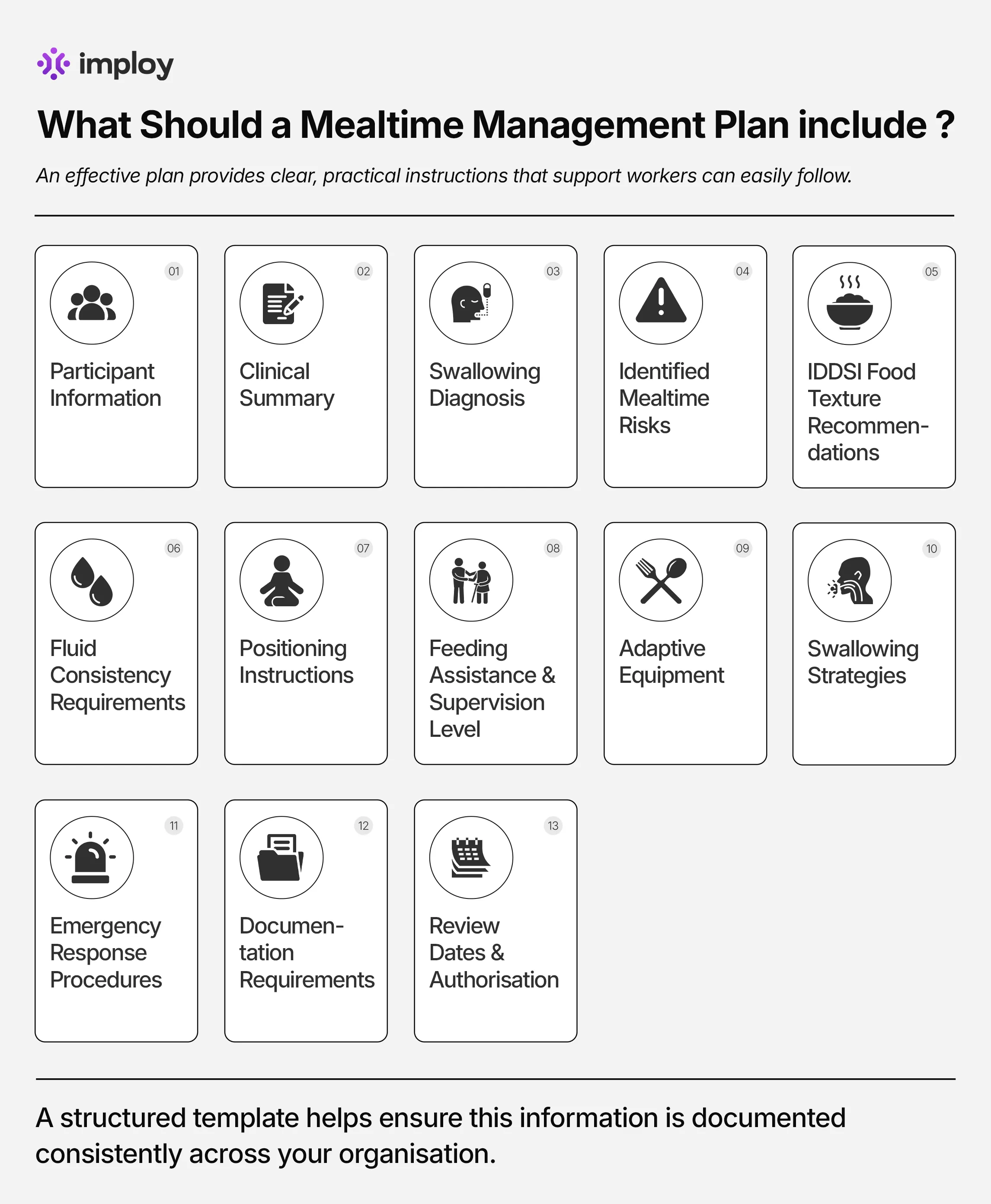
An effective Mealtime Management Plan should provide clear, practical instructions that support workers can easily follow.
1. Participant information: Records essential details such as the participant's name, date of birth, and emergency contacts.
2. Clinical summary: Provides a brief overview of the participant's medical history and conditions that affect eating and drinking.
3. Swallowing diagnosis: Outlines the participant's swallowing difficulties based on assessment by a qualified Speech Pathologist.
4. Identified mealtime risks: Highlights potential risks, such as choking or aspiration, that need to be managed during meals.
5. IDDSI food texture recommendations: Specifies the safe food texture level according to the IDDSI framework.
6. Fluid consistency requirements: Identifies the correct drink thickness to reduce the risk of aspiration.
7. Positioning instructions: Explains how the participant should be positioned before, during, and after meals for safe swallowing.
8. Feeding assistance and supervision level: Describes the level of support or supervision the participant requires while eating and drinking.
9. Adaptive equipment: Lists any specialised utensils, cups, or other equipment needed to support safe mealtimes.
10. Swallowing strategies: Includes techniques recommended by the Speech Pathologist to improve swallowing safety.
11. Emergency response procedures: Provides clear instructions on what staff should do if choking or another mealtime emergency occurs.
12. Documentation requirements: Explains what observations, incidents, or changes should be recorded after each meal.
13. Review dates and authorisation: Confirms when the plan should be reviewed and identifies the clinician who approved it.
Understanding the IDDSI Framework
The International Dysphagia Diet Standardisation Initiative (IDDSI) provides a globally recognised framework for classifying food textures and drink thickness for people with swallowing difficulties.
Using standardised terminology helps ensure everyone involved in the participant's care understands exactly what food and fluids can be safely provided.
Support workers should never guess food textures or fluid thicknesses. If there is any uncertainty, stop and seek clarification before serving the meal.
Following a Mealtime Management Plan
Supporting participants safely requires consistent practice before, during, and after every meal.
1. Before the Meal
- Review the current Mealtime Management Plan.
- Prepare the correct food texture and fluid consistency.
- Position the participant correctly.
- Check adaptive equipment.
- Minimise distractions.
2. During the Meal
- Follow prescribed swallowing strategies.
- Encourage independence where appropriate.
- Offer small mouthfuls.
- Monitor for signs of choking, coughing, fatigue, or distress.
- Never rush the participant.
3. After the Meal
- Ensure the participant remains upright if recommended.
- Record observations.
- Report concerns immediately.
- Clean adaptive equipment.
- Complete progress notes where required.
Consistency is essential. Every support worker should follow the same procedures to minimise risk.
Common Mistakes Providers Should Avoid
Even experienced providers can unintentionally increase risk by making avoidable mistakes.
Common examples include:
- Using outdated Mealtime Management Plans
- Serving incorrect food textures or fluid thicknesses
- Inconsistent practices between staff members
- Poor documentation
- Failing to review plans after health changes
- Not escalating changes in swallowing ability
Establishing clear procedures, regular staff training, and standardised documentation can significantly reduce these risks.
How Imploy Helps NDIS Providers?
Imploy helps NDIS providers streamline mealtime management and improve consistency across their organisation by providing practical tools and resources.
With Imploy, you can:
- Standardise documentation using professionally designed NDIS templates.
- Download a ready-to-use Mealtime Management Plan Template that includes participant information, clinical recommendations, IDDSI requirements, checklists, emergency procedures, and staff sign-off.
- Improve staff consistency with clear, easy-to-follow mealtime support documentation.
- Support compliance by maintaining organised records and documenting participant-specific instructions.
- Reduce administrative workload with practical templates and operational resources.
- Support staff onboarding and training using standardised documentation and best-practice guides.
- Manage your workforce more efficiently with rostering, onboarding, payroll, and compliance tools designed for NDIS providers.
Final Thoughts
Safe mealtime management protects participants from avoidable harm while supporting dignity, independence, and quality of life. Although the Speech Pathologist develops the clinical recommendations, providers are responsible for ensuring those recommendations are implemented consistently through staff training, clear documentation, and regular reviews.
By combining participant-specific clinical guidance with practical tools such as a standardised Mealtime Management Plan Template, providers can improve communication, strengthen compliance, and deliver safer, more confident mealtime support across their organisation.
Frequently Asked Questions (FAQs)
1. What is a Mealtime Management Plan under the NDIS?
A Mealtime Management Plan is an individualised document developed by a qualified Speech Pathologist that outlines how a participant can safely eat and drink. It includes recommendations for food textures, fluid consistencies, positioning, feeding assistance, and swallowing strategies to reduce the risk of choking and aspiration.
2. Who needs a Mealtime Management Plan?
A Mealtime Management Plan is recommended for participants who have swallowing difficulties (dysphagia) or conditions that affect their ability to chew and swallow safely, such as cerebral palsy, stroke, acquired brain injury, Parkinson's disease, motor neurone disease, or multiple sclerosis.
3. Who can create a Mealtime Management Plan?
Only a qualified Speech Pathologist should assess a participant's swallowing ability and develop or update a Mealtime Management Plan. Providers and support workers should never change the recommendations without clinical approval.
4. What is the IDDSI Framework?
The International Dysphagia Diet Standardisation Initiative (IDDSI) Framework is a global standard for classifying food textures and drink thickness levels for people with swallowing difficulties. It helps ensure participants receive food and fluids that are safe for their swallowing ability.
5. What should be included in a Mealtime Management Plan?
A comprehensive plan should include participant information, swallowing diagnosis, identified risks, IDDSI food and fluid recommendations, positioning instructions, feeding assistance requirements, adaptive equipment, swallowing strategies, emergency procedures, documentation requirements, and review dates.
6. How often should a Mealtime Management Plan be reviewed?
The plan should be reviewed whenever there is a change in the participant's swallowing ability, medical condition, nutritional status, or after a choking or aspiration incident. Regular reviews by the Speech Pathologist help ensure the plan remains safe and effective.


.webp)