

Level 4 Disability Support Worker Pay in 2026
Level 4 Disability Support Worker pay rates in 2026 under the SCHADS Award. View hourly, casual, weekend, night and public holiday rates.


If you work in disability support or manage a team of support workers, understanding the pay structure for Level 4 workers is essential. In 2026, the Social, Community, Home Care and Disability Services (SCHADS) Award sets the minimum rates, ensuring fair compensation for the skills and responsibilities required at this level.
This guide breaks down Level 4 pay, including base rates, casual loading, penalty rates, and real-world implications, so both employees and employers can navigate 2026 pay expectations with confidence.
Who Is a Level 4 Disability Support Worker?
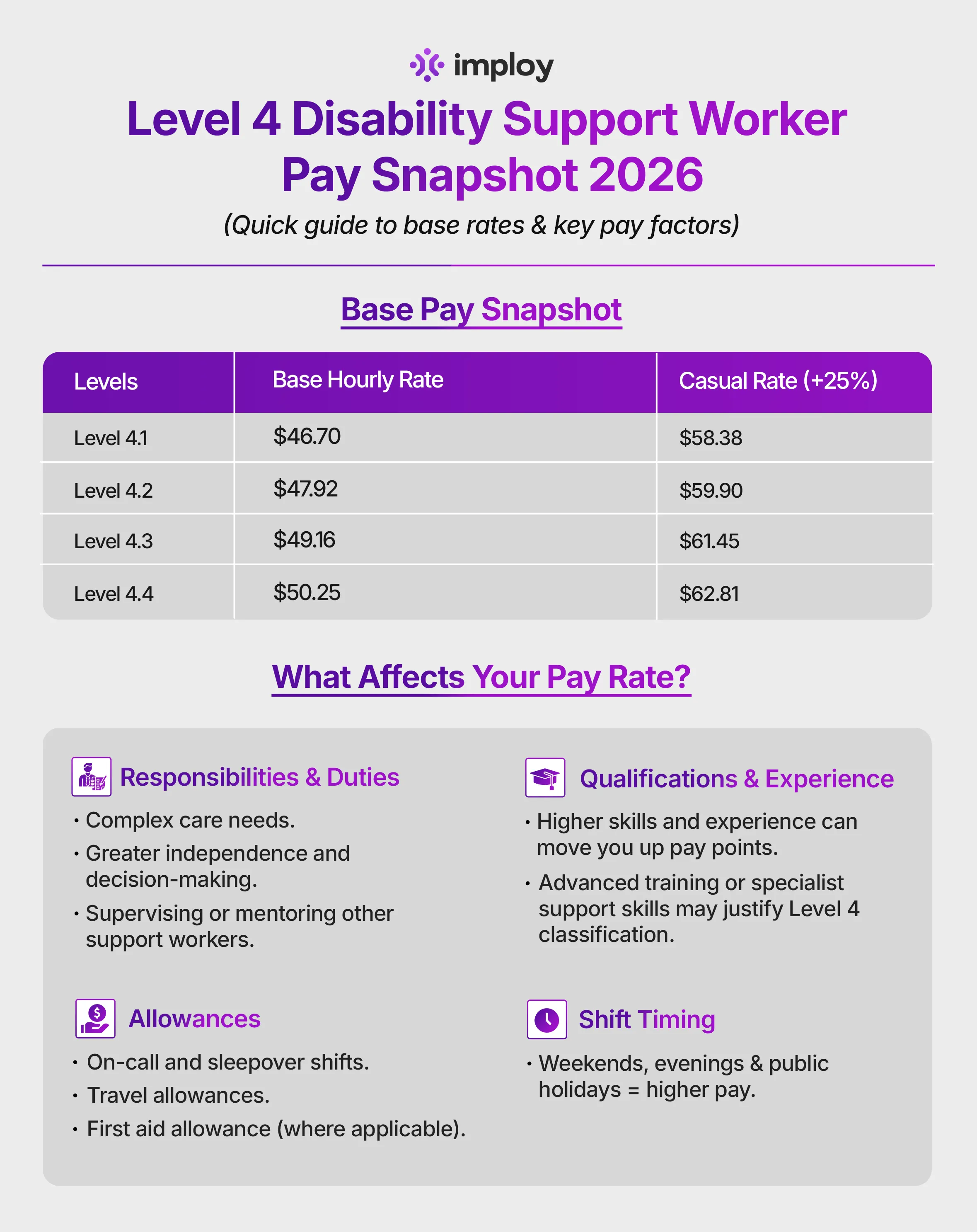
A Level 4 disability support worker is typically an experienced professional responsible for complex care tasks, advanced support, and sometimes leadership within a care team.
Key responsibilities may include:
- Providing high-level assistance with daily living activities.
- Supporting participants with complex or challenging behaviors.
- Supervising or mentoring junior support staff.
- Coordinating care plans with allied health professionals.
Level 4 differs from Level 3 mainly in terms of experience, responsibility, and autonomy. Workers at this level often have additional qualifications or training that justify higher pay. Learn more about Level 1 Disability Support Worker Pay, Level 2 Disability Support Worker Pay and Level 3 Disability Support Worker Pay in detail on our previous blogs.
SCHADS Award Pay Rates for Level 4 Disability Support Workers
Under the Social, Community, Home Care and Disability Services (SCHADS) Award, Level 4 disability support workers are paid according to pay points, reflecting experience, skills, and responsibilities. Below is a detailed breakdown of weekly, hourly, and penalty rates effective in 2026.
Full-Time & Part-Time Pay Rates
Source: Fair Work Ombudsman - SCHADS Award 2025 Pay Guide.
These base rates apply to ordinary hours worked by full‑time and part‑time employees under the SCHADS Award.
Casual Pay Rates (Including 25% Casual Loading)
Casual Level 4 disability support workers receive a 25% loading in lieu of paid leave entitlements.
Source: Fair Work Ombudsman - SCHADS Award 2025 Pay Guide.
Important Compliance Note
These figures represent minimum rates under the SCHADS Award. Some employers may pay above-award rates through enterprise agreements or internal pay structures, but no worker should be paid less than these amounts.
Support workers and providers are encouraged to use the Fair Work Pay and Conditions Tool to confirm classifications, pay points, and penalties.
What Do These Pay Rates Mean in Practice?
- Base hourly rate: Paid for ordinary weekday hours worked by full-time and part-time Level 4 disability support workers.
- Saturday rate: A higher penalty applies for weekend work under the SCHADS Award.
- Sunday rate: Significantly higher than weekday rates due to increased SCHADS penalties.
- Public holiday rate: The highest hourly rate under the Award, reflecting the premium for working on nationally recognised public holidays.
- Afternoon (evening) shift loading: Applies when a Level 4 worker is rostered during designated afternoon or evening hours.
- Night shift loading: Applies to late-night or overnight shifts, further increasing the hourly rate.
These penalty rates and loadings can substantially increase total earnings for Level 4 disability support workers, especially for those who frequently work weekends, evenings, nights, or public holidays.
Example Pay Calculations
Example 1:
A Level 4 - Pay Point 1 casual working a Sunday shift earns approximately $100.31 per hour, reflecting the 200% Sunday penalty rate (inclusive of casual loading).
Example 2:
A Level 4 - Pay Point 2 part-time worker rostered on a public holiday earns approximately $114.38 per hour, the highest rate available for that pay point under the SCHADS Award.
Example 3:
A Level 4 - Pay Point 3 worker completing a night shift earns approximately $53.97 per hour, compared to $46.93 per hour for the same role during standard weekday hours.
Factors That Influence Level 4 Pay
Several factors can influence how much a Level 4 disability support worker earns under the SCHADS Award. While the Award sets minimum rates, actual take-home pay can vary significantly depending on role, experience, and working arrangements.
1. Experience & Skills
Higher pay points within Level 4 are typically linked to years of experience, advanced skills, and additional qualifications. Workers who support participants with complex needs, demonstrate high levels of independence, or take on mentoring or coordination responsibilities are more likely to progress to higher pay points.
2. Employment Type
Whether a worker is employed on a full-time, part-time, or casual basis has a direct impact on pay:
- Full-time and part-time workers receive base rates plus applicable penalties and loadings.
- Casual workers receive a 25% casual loading, which increases the hourly rate but replaces paid leave entitlements.
3. Shift Patterns and Working Hours
The timing of shifts plays a major role in earnings. Weekend, evening, night, and public holiday shifts attract higher rates under the SCHADS Award. Workers who regularly work outside standard weekday hours often earn significantly more than those working only ordinary hours.
4. Enterprise Agreements and Provider Policies
Some disability service providers operate under enterprise agreements or internal pay structures that offer rates above the SCHADS Award minimums. These arrangements are often used to attract and retain experienced Level 4 workers in high-demand areas or specialist roles.
5. Role Complexity and Responsibility
Pay may also be influenced by the level of responsibility involved in the role. Tasks such as supervising other support workers, managing complex behaviours, coordinating supports, or working with high-risk participants can justify higher pay points or above-award rates.
Understanding these factors helps support workers assess whether they are being paid correctly and supports employers in structuring fair, compliant, and competitive pay arrangements under the SCHADS Award.
How Employers Should Calculate & Comply?
Employers have a legal obligation to ensure Level 4 disability support workers are paid correctly in line with the SCHADS Award. Accurate pay calculation is essential not only for compliance, but also for building trust, retaining skilled workers, and avoiding costly disputes.
To remain compliant, employers should:
1. Use Award-Based Pay Tools
The Fair Work Pay & Conditions Tool should be used to calculate correct base rates, penalty rates, and loadings. This helps ensure calculations reflect the worker’s classification, pay point, employment type, and shift timing.
2. Confirm Correct Classification and Pay Point
Misclassification is one of the most common causes of underpayment. Employers must carefully assess each worker’s duties, experience, qualifications, and level of responsibility to confirm they are correctly classified at Level 4 and placed on the appropriate pay point.
3. Apply All Relevant Penalties and Loadings
Payroll systems must correctly apply:
- Weekend and public holiday penalty rates
- Evening and night shift loadings
- Casual loading (where applicable)
- Any applicable allowances, such as on-call or first aid allowances
Employers must apply the highest applicable rate for each shift, in accordance with SCHADS Award rules.
4. Maintain Accurate Records
Keeping detailed records of hours worked, shift types, penalties applied, and pay calculations is essential. Accurate record-keeping supports transparency and provides protection if pay is ever questioned or audited.
5. Regularly Review Award Updates
The SCHADS Award is reviewed periodically, with changes often taking effect from 1 July each year. Employers should regularly review updates to ensure payroll systems and employment contracts remain current.
Failure to comply with SCHADS Award requirements can result in underpayment claims, back-pay obligations, penalties, and reputational damage. Taking a proactive, structured approach to pay calculation helps ensure compliance while supporting a fair and sustainable disability workforce.
How Imploy Supports Disability Support Workers?
At Imploy, we support disability support workers and NDIS providers by simplifying the administrative and compliance side of care - so you can focus on delivering quality support with confidence.
With Imploy, you can:
- Access ready-to-use templates aligned with SCHADS Award and NDIS requirements.
- Create professional invoices, service agreements, and care records quickly and accurately.
- Stay informed about pay rate updates, award changes, and compliance obligations.
- Explore practical blogs, guides, and FAQs designed specifically for disability and NDIS professionals.
Final Thoughts
Level 4 disability support worker pay in 2026 reflects the skills, experience, and responsibilities required at this level. The SCHADS Award sets clear minimum rates, including penalties for weekends, nights, and public holidays, while casual loadings ensure fair compensation.
Understanding these rates helps workers confirm they are paid correctly and enables employers to remain compliant. Tools like the Fair Work Pay & Conditions Tool and platforms like Imploy make managing pay simple, accurate, and transparent, supporting a skilled and motivated disability workforce.
FAQs
1. What qualifications do I need to be classified as a Level 4 disability support worker?
Level 4 typically requires relevant experience, advanced skills, and sometimes additional qualifications such as Certificate IV in Disability or equivalent. Workers must also demonstrate competence in managing complex needs and may supervise or mentor junior staff.
2. How is casual pay different from full-time or part-time pay?
Casual workers receive a 25% casual loading on top of the base rate instead of paid leave entitlements. Casual rates also attract the same weekend, night, and public holiday penalties.
3. How do penalty rates work under the SCHADS Award?
Penalty rates increase pay for shifts outside ordinary hours. Saturdays are typically 150%, Sundays 200%, and public holidays 250% of the base rate. Evening and night shifts also attract loadings, which vary depending on the time rostered.
4. Can I be paid above the SCHADS Award rate?
Yes. Employers may offer above-award rates through enterprise agreements or internal policies to reflect higher responsibility, specialist skills, or to attract experienced staff.
5. Does experience affect Level 4 pay?
Yes. Pay points within Level 4 reflect experience, advanced skills, and role responsibility. Workers with more experience or higher-level responsibilities will progress to higher pay points.
6. How can Imploy help with pay and compliance?
Imploy simplifies pay calculations, provides templates aligned with SCHADS and NDIS requirements, tracks award updates, and ensures documentation for compliance, reducing administrative burden for both employers and workers.