
How Bulk Invoicing Saves Time and Reduces Errors
Learn how bulk invoicing helps care providers save time, reduce billing errors, prevent double-billing and manage invoices more efficiently.

.webp)
Running an NDIS, SIL, aged care, or home care business involves more than delivering quality support. Providers must also manage rostering, payroll, compliance, reporting, and invoicing.
As client numbers grow, creating invoices manually can become time-consuming and increase the risk of billing mistakes, missed charges, duplicate invoices, and payment delays. Bulk invoicing helps solve these challenges by allowing providers to generate and process multiple invoices at once. This reduces administrative workload, improves billing accuracy, and helps payments arrive faster.
In this guide, we'll explain how bulk invoicing works, how it saves time and reduces errors, and how solutions like Imploy simplify the invoicing process for care providers.
What Is Bulk Invoicing?
Bulk invoicing is the process of generating multiple invoices at once using approved billable service records.
Instead of manually creating invoices for each participant, providers can select a billing period and automatically generate invoices from completed shifts, travel claims, reimbursements, and other billable activities.
This approach streamlines financial operations while ensuring that all delivered services are accurately captured and billed.
Manual Invoicing vs Bulk Invoicing
As organisations expand, bulk invoicing becomes essential for maintaining efficiency and financial control.
The Hidden Costs of Manual Invoicing
Many providers underestimate how much time and money is lost through manual billing processes.
1. Time Lost on Administrative Tasks
Manual invoicing often requires staff to:
- Review completed shifts
- Check participant funding allocations
- Calculate billable amounts
- Create invoices individually
- Export information into accounting software
- Reconcile payment records
When multiplied across dozens or hundreds of participants, these tasks can consume many hours every billing cycle.
2. Increased Risk of Billing Errors
Human error is inevitable when data is entered manually.
Common invoicing mistakes include:
- Missed support sessions
- Duplicate charges
- Incorrect pricing
- Wrong participant details
- Missing travel claims
- Outdated service rates
Even small mistakes can lead to delayed payments, claim rejections, participant dissatisfaction, and compliance concerns.
3. Delayed Cash Flow
When invoicing takes longer, payments are often delayed as well.
Slower cash flow can affect:
- Staff payroll
- Operational expenses
- Business growth initiatives
- Financial forecasting
Faster invoicing typically results in faster payment collection.
4. Compliance and Audit Risks
NDIS and aged care providers operate in highly regulated environments.
Incomplete or inaccurate billing records can create challenges during audits and compliance reviews. Maintaining accurate financial documentation is essential for demonstrating accountability and transparency.
How Bulk Invoicing Saves Time?
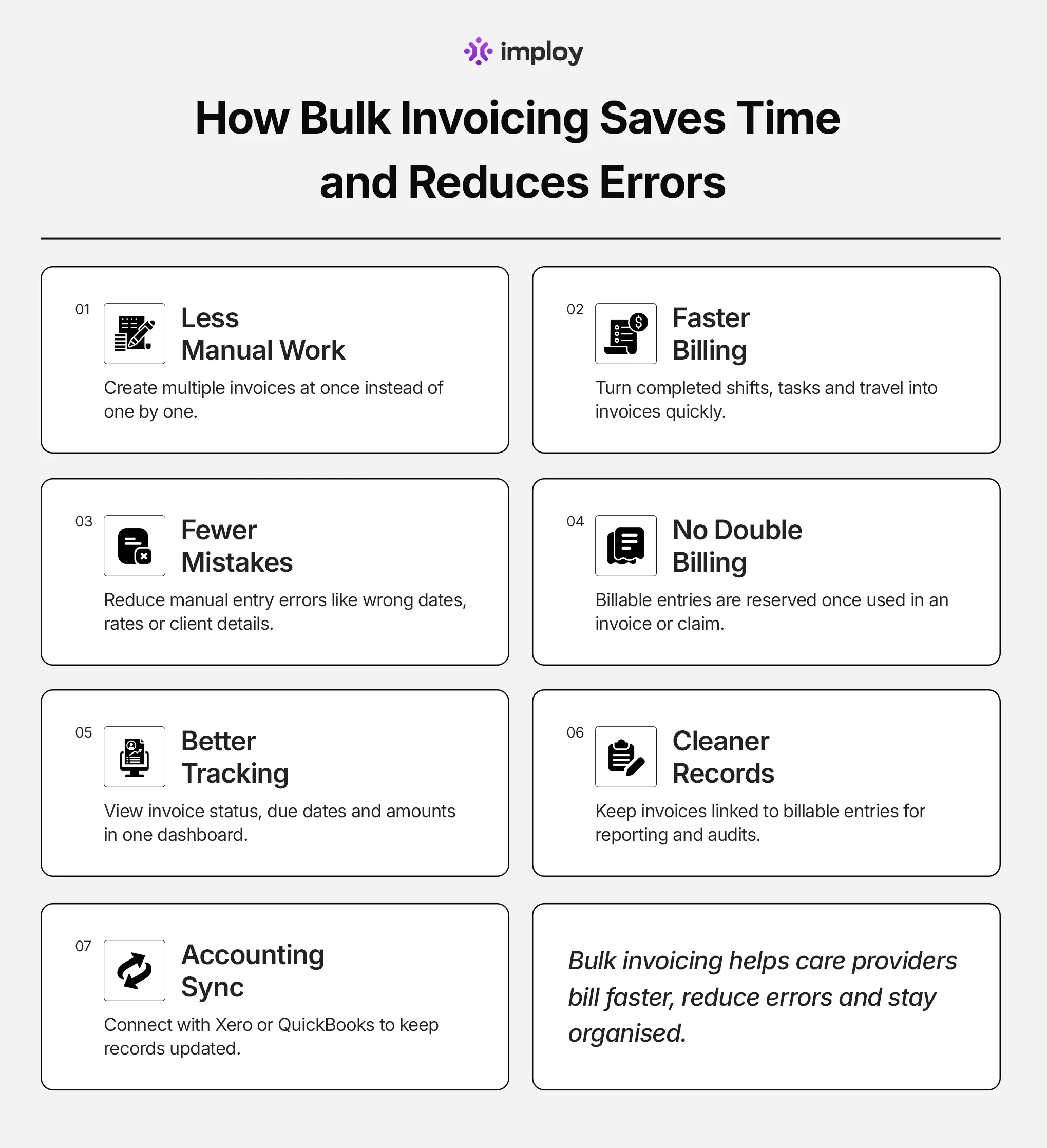
Bulk invoicing significantly reduces the amount of manual work required to generate invoices.
1. Automatically Converts Service Delivery into Invoices
Modern care management software can automatically convert approved billable entries into invoice-ready records.
This means providers no longer need to manually transfer information from timesheets or service records into invoices.
2. Processes Multiple Clients Simultaneously
Rather than creating invoices one participant at a time, providers can generate invoices for an entire billing period in a single workflow.
This dramatically reduces administrative effort and allows finance teams to complete billing tasks much faster.
3. Eliminates Duplicate Data Entry
Many providers use multiple systems for operations and accounting.
Bulk invoicing eliminates repetitive data entry by automatically transferring billing information between systems, reducing workload and improving accuracy.
4. Speeds Up End-of-Month Billing
Month-end invoicing often creates administrative bottlenecks.
Bulk invoicing allows providers to process large invoice volumes in minutes rather than hours, helping finance teams close billing cycles faster.
How Bulk Invoicing Reduces Errors?
Efficiency is only part of the benefit. Bulk invoicing also improves billing accuracy.
1. Uses Approved Billable Records
Invoices are generated directly from approved service records rather than manually entered information.
This creates a single source of truth and reduces discrepancies between service delivery and billing.
2. Prevents Duplicate Billing
One of the most common invoicing issues is accidentally billing the same service more than once.
Modern bulk invoicing systems can reserve billable entries once they are included in an invoice, preventing duplicate claims and duplicate invoices.
3. Standardises Billing Processes
Automation ensures that invoices are created using consistent rules and workflows.
This helps reduce variability across teams and improves financial governance.
4. Improves Invoice Tracking
Providers can easily monitor invoice statuses, helping teams identify unpaid invoices, follow up on outstanding payments, and maintain accurate financial records.
How Imploy Simplifies Bulk Invoicing for Care Providers?
Imploy has been designed specifically for healthcare, disability, and aged care providers, helping organisations automate administrative processes while maintaining compliance and accuracy.
1. Convert Billable Entries into Invoices Faster
Imploy allows providers to generate invoices directly from approved billable entries, reducing manual work and speeding up billing cycles.
2. Process Multiple Invoices Simultaneously
Finance teams can create invoice batches for multiple participants at once, significantly reducing administrative overhead.
3. Prevent Duplicate Billing
Once a billable entry is attached to an invoice, Imploy reserves that entry to help prevent accidental duplicate invoicing.
4. Integrate with Xero and QuickBooks
Imploy synchronises invoice information with leading accounting platforms, helping providers maintain accurate financial records while reducing duplicate data entry.
5. Gain Full Visibility Through a Central Dashboard
The platform provides a centralised invoicing dashboard where teams can track invoice statuses, monitor billing activity, and quickly identify outstanding payments.
6. Scale as Your Organisation Grows
Whether managing a small participant base or hundreds of clients across multiple services, Imploy's bulk invoicing tools support operational growth without increasing administrative complexity.
Best Practices for Successful Bulk Invoicing
To get the most value from bulk invoicing, providers should:
- Keep service records up to date
- Ensure staff submit timesheets promptly
- Review billable entries before processing
- Standardise invoicing procedures
- Integrate accounting systems
- Monitor invoice statuses regularly
- Use automation wherever possible
These practices help maintain accurate billing and improve operational efficiency.
Final Thoughts
As care providers grow, manual invoicing becomes increasingly difficult to manage. The time spent creating invoices individually, correcting mistakes, and reconciling records can quickly impact productivity and profitability.
Bulk invoicing offers a smarter approach by automating invoice generation, reducing human error, improving cash flow, and supporting compliance requirements.
For NDIS, SIL, home care, and aged care providers looking to streamline financial operations, Imploy's bulk invoicing solution helps transform a traditionally time-consuming process into a faster, more accurate, and scalable workflow.
By reducing administrative burden and increasing billing accuracy, providers can spend less time on paperwork and more time delivering exceptional care.
FAQs
1. What is bulk invoicing?
Bulk invoicing is the process of generating multiple invoices simultaneously using approved billable service records rather than creating invoices individually.
2. How does bulk invoicing save time?
It automates invoice generation, eliminates repetitive data entry, and allows providers to process multiple participants in a single workflow.
3. Does bulk invoicing reduce billing errors?
Yes. By generating invoices directly from approved service records, bulk invoicing reduces the risk of duplicate charges, missed services, and manual entry mistakes.
4. Can bulk invoicing integrate with accounting software?
Many modern platforms, including Imploy, integrate with accounting software such as Xero and QuickBooks to streamline financial management.
5. Is bulk invoicing suitable for small providers?
Yes. Even smaller providers can benefit from reduced administration, improved billing accuracy, and faster payment processing.
6. How does Imploy help with bulk invoicing?
Imploy enables providers to generate invoices from billable entries, create invoice batches, sync with accounting software, track invoice statuses, and reduce duplicate billing through automated workflows.