

NDIS Governance & Operational Management Requirements
Understand NDIS governance and operational management requirements, key practice standards, common challenges, and how providers can stay compliant.

Strong governance and operational management are essential for any NDIS provider, not just to meet regulatory requirements, but to ensure participant safety, service quality, and organisational sustainability. Providers who establish robust systems are better positioned for compliance audits, workforce stability, and participant satisfaction.
This guide breaks down the key governance and operational requirements, aligned to the NDIS Practice Standards (Core Module), so providers can clearly understand their obligations and implement practical, compliant systems.
What is Governance and Operational Management under NDIS?
When it comes to the NDIS, governance and operational management might sound like “corporate jargon,” but at their core, they’re about making sure people get safe, high-quality care.
- Governance is like the organisation’s compass. It’s the systems, policies, and leadership structures that guide decisions, keep everyone accountable, and set the direction for the organisation.
- Operational management is the engine that keeps things running day-to-day. It’s about managing staff, delivering services, handling risks, and staying on top of compliance so that participants receive care that’s safe, consistent, and meets their needs.
These two work hand-in-hand. Good governance makes sure operations stay on track and focused on participants, while strong operational management provides the information and processes that leadership needs to make informed decisions. Together, they create a system where care is safe, reliable, and continually improving.
Core Modules of NDIS Governance & Operational Requirements
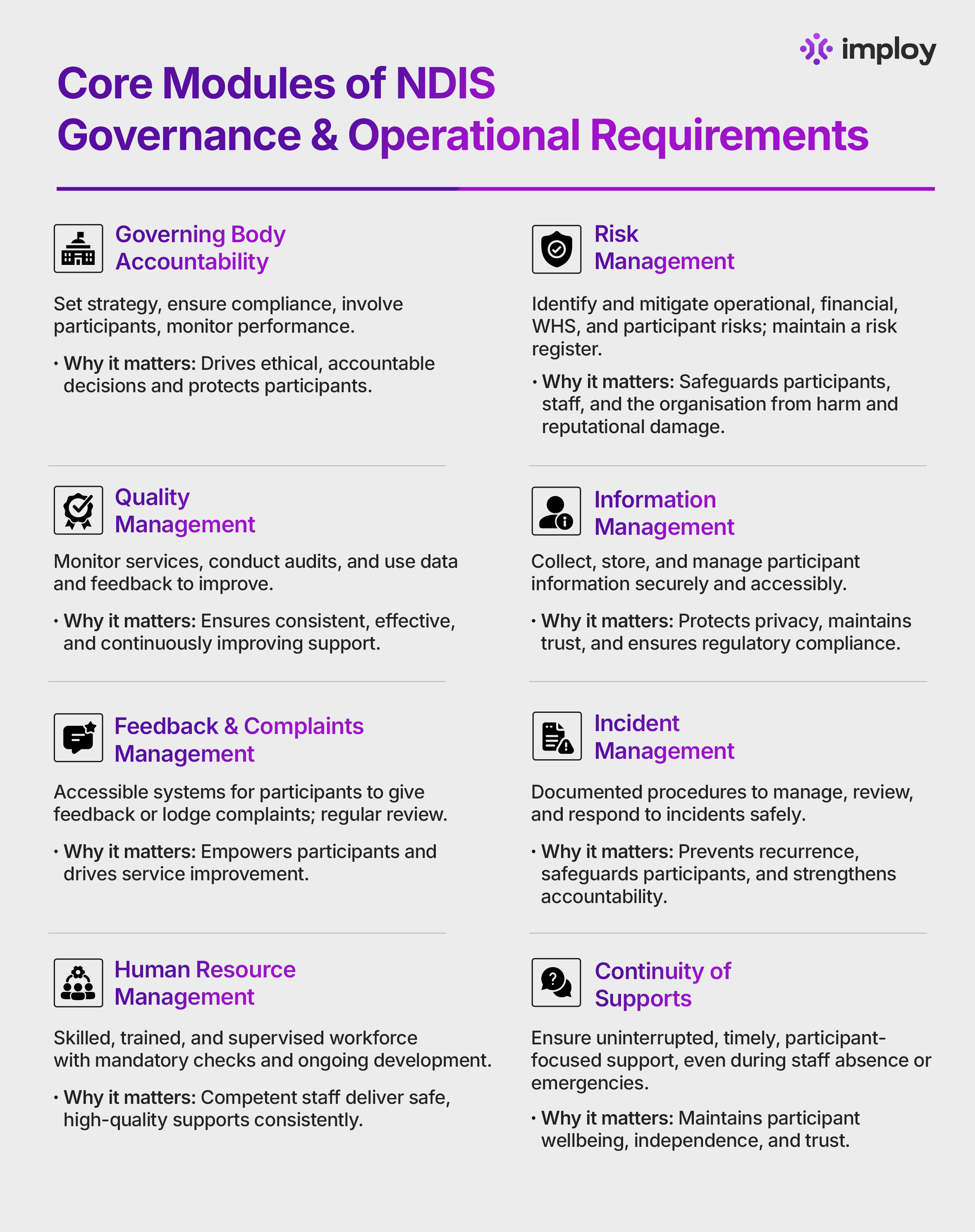
NDIS providers are expected to maintain robust governance and operational management systems proportional to the size and complexity of their services. These systems ensure supports are delivered safely, consistently, and effectively.
1. Governing Body Accountability
Strong governance starts at the top. Clear leadership, defined responsibilities, and informed decision-making ensure the organisation operates ethically, sustainably, and in the best interests of participants.
Outcome: Each participant’s support is overseen by strong governance and operational management systems.
Requirements:
- Involve participants in governance and policy decisions.
- Define structure and roles to meet financial, legal, and contractual obligations.
- Provide training for governing body members to fill skill gaps.
- Conduct strategic and business planning considering risks, participant needs, and organisational requirements.
- Monitor leadership performance to support continuous improvement.
- Manage conflicts of interest proactively and document policies.
Why it matters: Strong governance ensures ethical, accountable, and participant-focused decisions, protecting both participants and the organisation.
2. Risk Management
Every service carries risk, but proactive identification and management help prevent harm and disruption. A structured risk approach supports safer outcomes for participants, workers, and the organisation.
Outcome: Risks to participants, workers, and the provider are identified and managed.
Requirements:
- Identify, assess, and manage operational, financial, and participant risks.
- Maintain a documented risk management system suitable for your service scale.
- Include risk coverage for incidents, complaints, HR, information, financial and emergency planning.
- Implement infection prevention and control measures where relevant.
- Maintain insurance coverage appropriate to services delivered.
Why it matters: Proper risk management protects participants, staff, and your organisation from harm, legal issues, and reputational damage.
You can learn in detail about How to Write an Effective Risk Management Plan for NDIS Clients on our blog.
3. Quality Management
Quality management systems help providers move beyond minimum compliance by continuously reviewing, improving, and strengthening service delivery over time.
Outcome: Participants benefit from a quality management system that promotes continuous improvement.
Requirements:
- Maintain a quality management system proportional to your organisation’s size.
- Conduct internal audits and reviews to enhance service delivery.
- Use data, incident outcomes, and participant feedback to drive improvements.
Why it matters: Quality management ensures services are consistent, effective, and continually improving, which directly benefits participants and supports organisational growth.
4. Information Management
Managing participant information responsibly is essential for privacy, trust, and continuity of care. Clear systems ensure information is accurate, secure, and accessible when needed.
Outcome: Participant information is accurate, secure, and accessible.
Requirements:
- Obtain participant consent for collecting and using information.
- Inform participants about how their information is stored, used, and accessed.
- Maintain an information management system proportional to organisational size.
- Ensure secure storage, access, retention, and disposal of documents.
Why it matters: Proper information management protects participant privacy, maintains trust, and ensures compliance with NDIS and legislative requirements.
5. Feedback and Complaints Management
Accessible feedback and complaints processes give participants a voice and help providers identify issues early, learn from experience, and improve service quality.
Outcome: Participants can easily access complaints systems and feedback is managed effectively.
Requirements:
- Maintain a complaints management policy suited to service complexity.
- Inform participants about feedback and external avenues, including advocacy.
- Review complaints regularly for continuous improvement.
- Train all staff in complaints handling procedures.
Why it matters: Effective feedback and complaints systems empower participants, resolve issues proactively, and improve service quality.
6. Incident Management
Effective incident management systems ensure issues are responded to promptly, transparently, and safely, while reducing the likelihood of similar incidents occurring again.
Outcome: Participants are safeguarded through an effective incident management system.
Requirements:
- Maintain a documented incident management system in line with NDIS rules.
- Inform participants of how incidents affecting them were managed.
- Review incidents regularly and integrate feedback from participants and staff.
- Ensure staff are trained in incident management processes.
Why it matters: Proper incident management prevents recurrence, protects participants, and strengthens organisational accountability.
Learn more on How to Create an NDIS Incident Report on our blog.
7. Human Resource Management
A capable workforce is central to safe, high-quality supports. Clear roles, training, and oversight ensure workers have the skills and support they need to deliver consistent care.
Outcome: Supports are delivered by competent workers with relevant skills, expertise, and qualifications.
Requirements:
- Define skills, responsibilities, and limitations for each role.
- Maintain worker records for pre-employment checks, qualifications, and experience.
- Provide orientation, induction, and mandatory NDIS worker training.
- Ensure ongoing supervision, training, and performance management.
- Prepare workforce continuity plans for emergencies or disasters.
Why it matters: Skilled and supported staff deliver safe, high-quality care, and are critical to maintaining participant trust and service reliability.
8. Continuity of Supports
Participants rely on services being available when they need them. Strong operational planning ensures supports continue with minimal disruption, even during unexpected events.
Outcome: Participants have access to timely and uninterrupted support.
Requirements:
- Manage day-to-day operations efficiently to avoid disruptions.
- Assign qualified personnel if a worker is absent.
- Plan supports with participant input according to their goals and needs.
- Communicate alternative arrangements when unavoidable interruptions occur.
Why it matters: Continuity of supports ensures participants receive consistent care, reducing stress and maintaining their independence and wellbeing.
Strong governance and operational management form the foundation of any successful NDIS service. By putting the right systems, policies, and practices in place, providers can not only stay compliant with the NDIS Practice Standards but also create an environment where participants feel safe, supported, and valued.
Investing in leadership, workforce management, risk oversight, and continuous improvement doesn’t just protect the organisation - it ensures services are reliable, high-quality, and focused on what really matters: improving the lives of those in your care.
Common Challenges Providers Face
Even well-established NDIS providers can find governance and operational management challenging in practice. Some of the most common issues include:
- Unclear governance structures, where roles, responsibilities, and decision-making authority are not clearly defined or documented.
- Policies and procedures that exist only on paper, but aren’t embedded into everyday practice or understood by staff.
- Risk registers that are incomplete, outdated, or rarely reviewed, leaving providers exposed to avoidable operational or compliance risks.
- Limited workforce oversight, including inconsistent training, supervision, or gaps in mandatory checks and records.
- A reactive approach to continuous improvement, where changes are made only after incidents, complaints, or audit findings occur.
These challenges often arise as organisations grow or services become more complex. Addressing them proactively - through clearer governance, practical systems, and regular reviews, helps create a service that is more reliable, audit-ready, and genuinely participant-focused.
Best Practices for Providers
Strong governance and operational management don’t have to be complicated, but they do need to be intentional, practical, and consistently applied. NDIS providers that perform well over time tend to follow these best practices:
- Keep governance simple but thorough
Tailor governance structures, policies, and reporting systems to the size, risk profile, and complexity of your organisation. Clear, fit-for-purpose systems are far more effective than overly complex frameworks that are hard to maintain. - Implement and enforce policies in practice
Policies should guide everyday decision-making, not sit unused in a folder. Ensure staff understand procedures through training, supervision, and real-world application, and hold teams accountable for following them. - Review systems regularly
Conduct internal audits, risk reviews, and policy updates at least annually or more often if services change. Regular reviews help identify gaps early and keep your organisation audit-ready. - Use technology to support compliance
Digital workforce, compliance, and incident management systems can streamline reporting, improve visibility, and reduce human error, especially as your organisation grows. - Keep participants at the centre
Embed participant choice, safety, dignity, and feedback into governance and operational decisions. When participants are actively involved, governance becomes more meaningful and service quality improves.
By adopting these best practices, providers can build governance and operational systems that are sustainable, compliant, and genuinely focused on delivering better outcomes for participants.
How Imploy Helps NDIS Providers?
Meeting NDIS governance and operational management requirements can be complex - especially as services grow and compliance expectations increase. Imploy is purpose-built for Australian care providers, including NDIS organisations, and helps simplify these processes so you can focus more on delivering quality supports.
Imploy supports NDIS providers by:
- Strengthening workforce oversight
Manage worker records, qualifications, screening checks, rosters, and compliance documentation in a central platform that reduces administrative burden and helps maintain audit-ready records. - Supporting policy implementation and compliance
Built-in workflows and tools help ensure operational procedures are consistently followed across teams, improving accountability and day-to-day management. - Improving risk, incident, and compliance visibility
Providers can streamline reporting, incident tracking, and documentation - making it easier to identify trends, respond proactively, and demonstrate compliance during audits. - Enabling continuous improvement
With integrated data and reporting insights, providers can review performance, learn from incidents and feedback, and make informed improvements to operations. - Supporting scalable operations
Imploy tailors governance and operational systems to organisations of all sizes, helping small providers scale without adding complex administrative work. - Enhancing rostering, payroll, and client management
Imploy combines tools for smart rostering, real-time scheduling, payroll automation, client care notes, and financial workflows into one platform - reducing errors and saving time.
By centralising workforce and operational data, Imploy allows providers to shift focus from manual admin tasks to delivering high-quality, participant-centred supports with greater confidence.
Final Thoughts
Strong governance and operational management are not just NDIS compliance requirements - they are the foundation of safe, reliable, and high-quality disability supports. When governance is clear and operational systems are well-managed, providers are better equipped to protect participants, support their workforce, and respond confidently to audits and change.
By embedding best practices, regularly reviewing systems, and using the right tools to support compliance, NDIS providers can move beyond reactive compliance and build sustainable, participant-focused services that stand the test of time.
Frequently Asked Questions
1. What are governance and operational management requirements under the NDIS?
Governance and operational management requirements outline how NDIS providers must lead, manage, and oversee their organisation. They cover areas such as governance structures, risk management, quality systems, workforce management, information handling, incidents, complaints, and continuity of supports to ensure safe and high-quality services.
2. Are governance and operational management requirements mandatory for all NDIS providers?
Yes. All registered NDIS providers must meet the Core Module: Governance and Operational Management Practice Standards. The level of documentation and systems required depends on the size, complexity, and risk profile of the provider.
3. What happens if a provider does not meet governance and operational requirements?
Failure to meet these requirements can result in non-conformities during audits, corrective action requests, sanctions, or in serious cases, registration suspension or revocation. Poor governance can also increase risks to participants and staff.
4. What training should governing body members and leaders receive?
Leaders should be trained in NDIS Practice Standards, governance responsibilities, risk management, financial oversight, and participant rights.
5. How can Imploy support NDIS governance and operational management?
Imploy helps NDIS providers manage workforce compliance, reporting, risk visibility, and operational processes in one platform. This supports stronger governance, simplifies audits, and reduces administrative workload while maintaining participant-focused care.
.webp)

.webp)