
NDIS Complaints Management Policy
Learn how NDIS providers can manage complaints effectively with a robust policy, audit-ready documentation, and Imploy’s compliant management tools.

Handling complaints effectively is a critical responsibility for all NDIS providers. A clear and well-implemented NDIS Complaints Management Policy not only supports compliance with the NDIS Practice Standards, but also builds trust, improves service quality, and safeguards participant rights.
At Imploy, we believe complaints should be viewed as opportunities for learning and improvement - not as risks to avoid. This guide explains what an NDIS complaints management policy is, why it matters, and how providers can implement a compliant and participant-centred approach.
What Is an NDIS Complaints Management Policy?
An NDIS Complaints Management Policy sets out how an organisation receives, manages, investigates, resolves, and records complaints about supports or services delivered to NDIS participants.
Under the NDIS Quality and Safeguards Framework, registered NDIS providers must have a documented complaints management system that is accessible, transparent, and fair.
Complaints may relate to:
- The quality or safety of supports and services.
- Staff behaviour or conduct.
- Communication issues.
- Participant rights, dignity, or choice.
- Administrative or service delivery concerns.
Why Complaints Management Is Important Under the NDIS?
An effective complaints system is essential because it:
- Protects participant rights and safety.
- Ensures compliance with the NDIS Practice Standards and Code of Conduct.
- Promotes accountability and transparency.
- Helps providers identify risks and service gaps.
- Supports continuous improvement and quality assurance.
The NDIS Quality and Safeguards Commission places strong emphasis on how providers manage complaints during audits and compliance reviews.
Legislative and Regulatory Requirements
NDIS complaints management obligations are grounded in Australia’s national disability quality and safeguarding framework. All registered NDIS providers must have a documented and effective system for receiving, managing, and resolving complaints in line with regulatory expectations.
These obligations are supported by:
- NDIS Practice Standards - Core Module, which require providers to have accessible and fair complaints management processes.
- NDIS Code of Conduct, which sets expectations for respectful, ethical, and safe service delivery.
- NDIS (Complaints Management and Resolution) Rules, which outline how complaints must be handled and resolved.
- Oversight by the NDIS Quality and Safeguards Commission, which monitors compliance and investigates complaints where required
To meet these requirements, providers must ensure that:
- Complaints can be made without fear of retribution or negative consequences.
- Participants are supported to understand the complaints process, including access to advocates or support persons.
- Complaints are acknowledged, assessed, and resolved promptly and fairly.
- Accurate records of complaints, actions, and outcomes are maintained and made available for audit or regulatory review.
A strong complaints management system demonstrates a provider’s commitment to participant rights, transparency, and continuous improvement - key expectations under the NDIS regulatory framework.
Purpose and Scope of the Policy
The complaints management policy should clearly outline:
Purpose
- To provide a fair, accessible, and consistent process for managing complaints.
- To ensure complaints are resolved respectfully and efficiently.
- To use feedback to improve service delivery.
Scope
The policy applies to:
- NDIS participants.
- Family members, carers, and advocates.
- Staff, contractors, and volunteers.
- Complaints related to any NDIS support or service provided by the organisation.
Step-by-Step Complaints Management Process
An effective complaints management process ensures concerns are handled consistently, fairly, and in line with NDIS requirements.
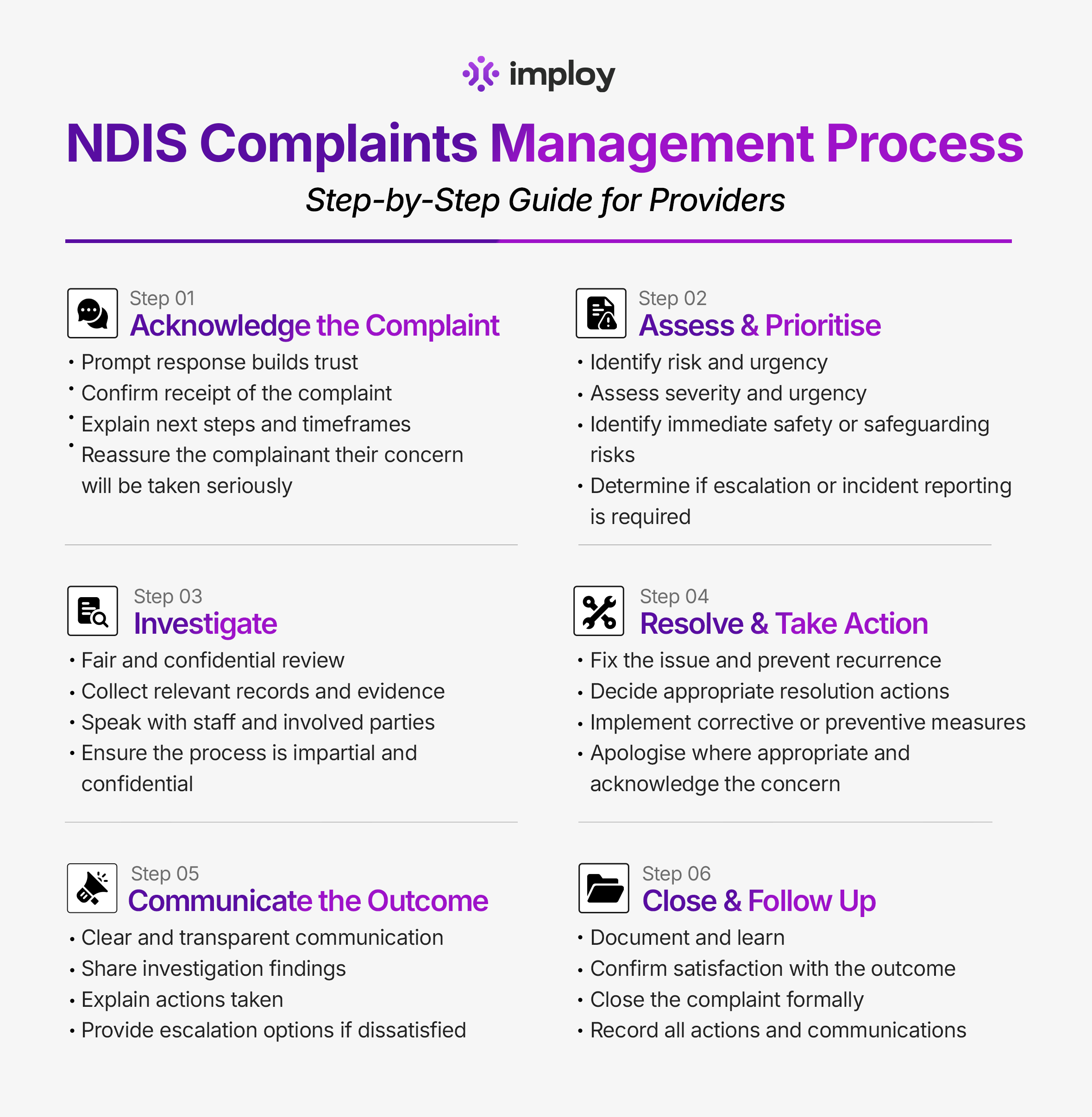
1. Acknowledge the Complaint
All complaints should be acknowledged promptly to reassure the complainant that their concern has been received and will be addressed.
Providers should:
- Confirm receipt of the complaint as soon as possible.
- Explain the complaints handling process and expected timeframes.
- Reassure the complainant that the matter will be taken seriously and handled confidentially.
2. Assess and Prioritise
Each complaint must be assessed to determine its urgency and potential impact.
This includes:
- Assessing the severity and complexity of the complaint.
- Identifying any immediate risks to participant safety or wellbeing.
- Determining whether escalation, incident reporting, or safeguarding action is required.
3. Investigate
Complaints should be investigated in a fair, objective, and timely manner.
Providers should:
- Gather relevant documentation, records, and evidence.
- Speak with staff, participants, or other involved parties as appropriate.
- Ensure the investigation process is impartial, confidential, and respectful.
4. Resolve and Take Action
Once the investigation is complete, appropriate actions must be identified and implemented.
This may include:
- Taking corrective action to address the issue raised.
- Implementing preventive measures to reduce the risk of recurrence.
- Offering an apology where appropriate and acknowledging the concern raised.
5. Communicate the Outcome
Clear communication is essential to maintain transparency and trust.
Providers must:
- Inform the complainant of the investigation findings.
- Explain what actions have been taken or will be taken.
- Advise the complainant of escalation options if they are not satisfied with the outcome.
6. Close and Follow Up
Complaints should only be closed once the process is complete and outcomes are documented.
Providers should:
- Confirm whether the complainant is satisfied with the outcome.
- Formally close the complaint in line with internal procedures.
- Record all actions, decisions, and communications for audit and review purposes.
How Complaints Are Received and Recorded?
NDIS providers must ensure that complaints can be made easily and in a way that suits the needs of participants, families, and advocates. Offering multiple complaint channels helps remove barriers and encourages open feedback.
Providers should allow complaints to be received through:
- Direct verbal feedback, including in person or over the phone.
- Written complaints, such as letters or feedback forms.
- Email or online submission forms.
- Third-party or anonymous complaints, including those made by advocates, carers, or support persons.
All complaints must be taken seriously, regardless of how they are received or who raises them.
When a complaint is received, the provider should accurately record:
- The date and time the complaint was received.
- The name and contact details of the complainant (if provided).
- A clear description of the issue or concern raised.
- The people involved in the complaint.
- Any immediate risks to participant safety or safeguarding concerns.
A designated Complaints Manager or Responsible Person should oversee the complaints process to ensure consistency, confidentiality, timely action, and compliance with NDIS requirements. Clear accountability helps ensure complaints are managed fairly and appropriately.
Key Principles of Effective Complaints Management
A compliant NDIS complaints management policy must be underpinned by clear principles that protect participant rights and support fair, timely resolution. The following principles align with the NDIS Practice Standards and expectations of the NDIS Quality and Safeguards Commission.
1. Accessibility
Complaints processes must be easy to access and understand for all participants, regardless of their communication needs or abilities.
Complaints can be made:
- Verbally or in writing
- In person, by phone, email, or online
- With the assistance of an advocate, family member, nominee, or support person
Providers should offer information in plain language and alternative formats, and make reasonable adjustments to ensure people feel safe and supported to raise concerns.
2. Fairness and Respect
All complaints must be handled impartially and without bias.
This includes ensuring:
- Complaints are taken seriously and acknowledged respectfully
- Participants are treated with dignity, courtesy, and cultural sensitivity
- No adverse consequences or discrimination occur as a result of making a complaint
Staff involved in complaints handling must remain objective and avoid conflicts of interest.
3. Transparency
Transparency builds trust and confidence in the complaints process.
Providers must ensure:
- The complaints process is clearly explained at the outset
- Regular updates are provided throughout the process
- Outcomes, decisions, and any actions taken are communicated clearly, including reasons for those decisions
Participants should understand what will happen, who is responsible, and what options are available if they are dissatisfied with the outcome.
4. Timeliness
Complaints must be managed promptly to prevent escalation and minimise distress.
This means:
- Complaints are acknowledged as soon as possible
- Investigations are conducted without unnecessary delay
- Outcomes are communicated within reasonable and documented timeframes
Delays should be explained, and interim updates provided where resolution takes longer than expected.
Learning From Complaints
Complaints provide valuable insight into participant experiences and highlight areas where services can be improved. Rather than being viewed negatively, complaints should be treated as an important feedback mechanism that supports better outcomes and safer services.
NDIS providers should regularly review complaints data to:
- Identify patterns, trends, or recurring issues across services or locations.
- Improve policies, procedures, and staff training.
- Strengthen service quality, safety, and participant experience.
Outcomes from complaint reviews should be used to inform continuous improvement activities, including risk management, quality improvement plans, and workforce development. This approach supports a strong continuous improvement culture, which is a core expectation under the NDIS Practice Standards.
Escalation Pathways
While many complaints can be resolved at a local level, providers must ensure clear and accessible escalation pathways when a complaint cannot be resolved internally or when the complainant is dissatisfied with the outcome.
Participants must be informed of their right to escalate complaints to:
- Senior management within the organisation, for independent review.
- The NDIS Quality and Safeguards Commission, which has authority to investigate complaints about NDIS supports and services.
- Independent advocacy services, which can assist participants to raise and pursue complaints.
Providers are required to cooperate fully with any external complaints investigations, including providing requested documentation and information. Clear escalation pathways reinforce transparency, accountability, and participant confidence in the complaints process.
How Imploy Helps?
Imploy provides NDIS and aged care providers with a comprehensive platform to simplify care delivery, compliance, and workforce management. Here’s how it supports effective complaints management and quality service:
1. Centralised Care and Client Management
Imploy allows providers to manage care plans, track client progress, and document interactions in one secure system. This ensures complaints and service concerns are captured accurately and can be reviewed quickly.
2. Mobile Workforce Tools
Support workers and carers can access schedules, submit progress notes, and receive real-time updates via the Imploy mobile app. This improves communication and transparency, helping issues to be addressed promptly.
3. Audit-Ready Documentation
All records, including client interactions, care notes, and communications, are securely stored and easily retrievable, ensuring compliance with NDIS Practice Standards and readiness for audits.
4. Streamlined Rostering and Administrative Workflows
By automating rostering, shift allocation, payroll, and invoicing, Imploy reduces administrative burden, allowing staff to focus on care delivery and timely responses to participant concerns.
5. Insights and Reporting for Continuous Improvement
Imploy provides reporting and analytics tools that help providers identify trends or recurring issues, supporting continuous improvement in service delivery and complaint resolution.
6. Support for NDIS Compliance
With PRODA integration, STP-compliant payroll, and secure documentation, Imploy helps providers meet regulatory obligations, maintain accountability, and demonstrate participant-centred care.
Overall, Imploy empowers NDIS and aged care providers to manage complaints with confidence and consistency. By bringing together care management, workforce tools, and compliance-ready documentation in one platform, Imploy helps providers respond to concerns promptly, meet regulatory obligations, and continuously improve service quality - supporting safer, more transparent, and participant-centred care.
Final Thoughts
A strong NDIS Complaints Management Policy is essential for delivering safe, respectful, and high-quality supports. When complaints are handled well, they strengthen trust, improve services, and demonstrate a provider’s commitment to participant rights and continuous improvement.
At Imploy, we support NDIS providers to build compliant, practical, and participant-centred systems that meet regulatory expectations and real-world service needs.
Frequently Asked Questions (FAQs)
1. What is an NDIS complaints management policy?
An NDIS complaints management policy outlines how a provider receives, investigates, resolves, and records complaints about supports or services. It ensures concerns are handled fairly, transparently, and in line with NDIS Practice Standards.
2. Who can make a complaint under the NDIS?
Complaints can be made by NDIS participants, family members, carers, advocates, staff, or any third party. Complaints may also be made anonymously.
3. Can participants make a complaint without fear of consequences?
Yes. Under the NDIS Code of Conduct, complaints must be accepted without fear of retribution, discrimination, or negative impact on a participant’s supports or services.
4. How quickly must a complaint be acknowledged?
Complaints should be acknowledged as soon as possible after receipt. Providers should clearly communicate next steps and expected timeframes for resolution.
5. What happens if a complaint involves safety or safeguarding concerns?
If a complaint identifies immediate risks to participant safety, providers must prioritise the issue, take urgent action, and escalate or report the matter as required under NDIS incident management obligations.