

NDIS Business Continuity Plan: A Complete Guide for Providers
Learn how NDIS providers can ensure safety, workforce continuity, and compliance with a strong Business Continuity Plan.


Delivering consistent, safe, and reliable support is a core obligation of every NDIS provider. When unexpected disruptions occur - such as staff shortages, system failures, natural disasters, or public health emergencies - providers must still ensure participants receive essential support.
This is where a Business Continuity Plan (BCP) becomes critical.
An effective NDIS Business Continuity Plan helps providers prepare for disruption, respond appropriately, and maintain participant safety and service delivery during challenging circumstances. This guide explains what an NDIS BCP is, why it is essential, and what providers need to include to meet compliance and quality expectations.
What Is an NDIS Business Continuity Plan?
An NDIS Business Continuity Plan is a structured document that outlines how a provider will continue delivering critical support and services when normal operations are disrupted.
Unlike an Emergency or Disaster Management Plan which focuses on immediate response to emergencies - a BCP focuses on:
- Sustaining essential services.
- Minimising service interruption.
- Protecting participants, staff, and organisational systems.
- Supporting recovery and return to normal operations.
For NDIS providers, business continuity planning is not optional. It is a key part of governance, risk management, and participant safeguarding.
Why is Business Continuity Planning Essential in the NDIS?
NDIS participants often rely on support for daily living, health, safety, and community participation. Any disruption, no matter how temporary - can have serious consequences.
A strong Business Continuity Plan helps providers to:
- Maintain participant health, safety, and wellbeing.
- Meet obligations under the NDIS Practice Standards.
- Reduce the risk of serious incidents or harm.
- Demonstrate preparedness during audits and assessments.
- Protect organisational reputation and sustainability.
Ultimately, continuity planning ensures that participants are not left without critical support when they need it most.
Objectives of an NDIS Business Continuity Plan
The primary purpose of an NDIS Business Continuity Plan is to ensure participants continue to receive safe and essential support during unexpected disruptions.
A well-designed plan provides clarity, structure, and direction when normal operations are impacted, helping providers respond quickly and effectively. An effective BCP should clearly aim to:
- Maintain delivery of critical supports.
- Protect high-risk and vulnerable participants.
- Ensure workforce availability and capability.
- Maintain access to records, systems, and data.
- Enable clear communication with participants, staff, and stakeholders.
- Support safe and timely recovery after disruption.
By clearly defining these objectives, an NDIS Business Continuity Plan strengthens service reliability, supports compliance with the NDIS Practice Standards, and reinforces a provider’s commitment to participant safety, quality, and continuity of care - regardless of the circumstances.
Common Risks That Can Disrupt NDIS Services
NDIS providers face a wide range of potential disruptions, including:
- Workforce shortages or sudden staff unavailability.
- Natural disasters such as floods, bushfires, or storms.
- Power outages or IT system failures.
- Cyber incidents or data breaches.
- Public health emergencies and pandemics.
- Facility closures or restricted access to service locations.
- Supply chain disruptions affecting equipment or consumables.
A Business Continuity Plan should consider realistic scenarios relevant to the provider’s services and geographic location.
Core Components of an Effective NDIS Business Continuity Plan
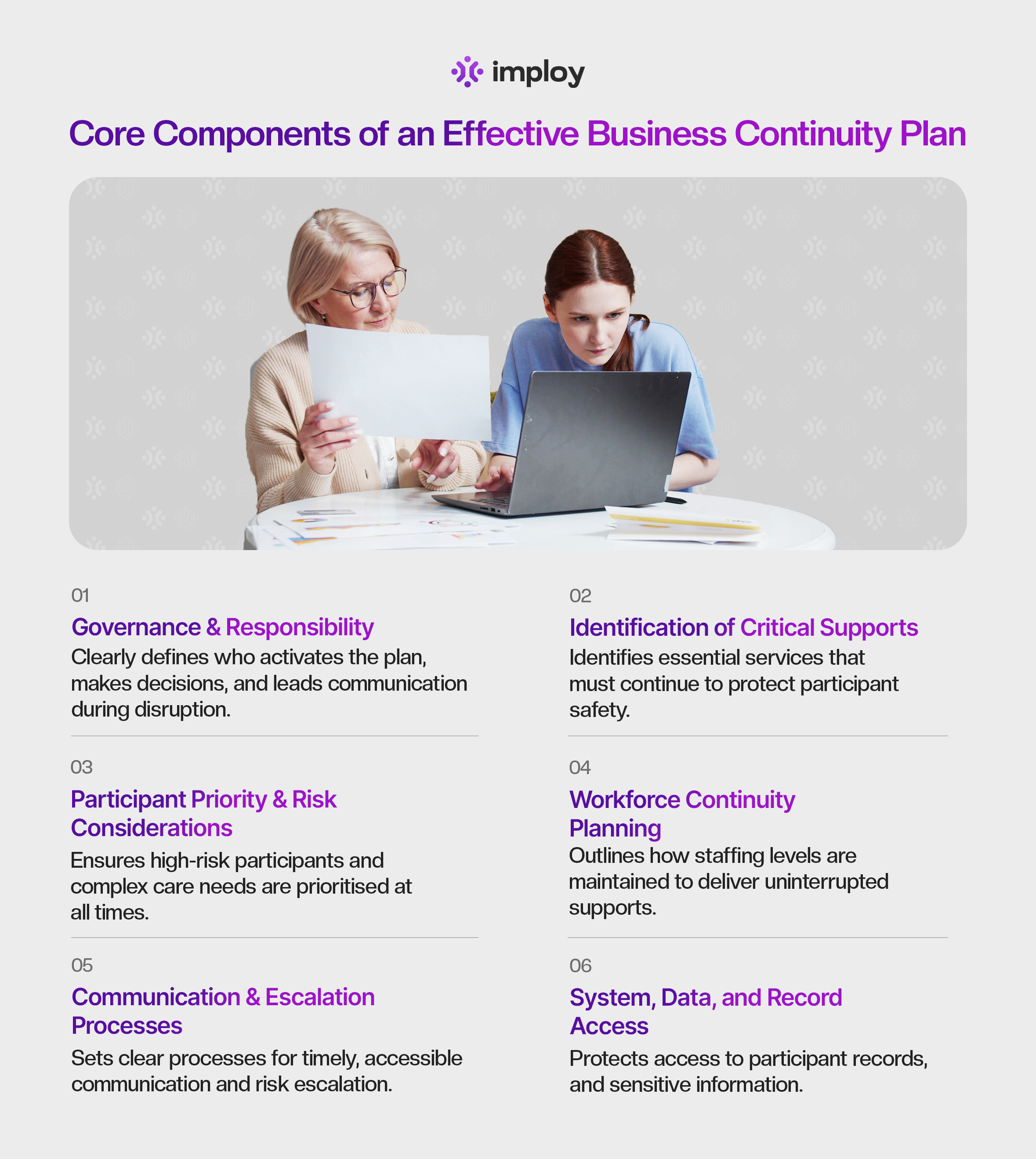
A strong NDIS Business Continuity Plan clearly outlines how a provider will continue delivering safe and essential support during unexpected disruptions. The following core components ensure services remain participant-centred, compliant, and operationally resilient.
1. Governance and Responsibilities
Clear roles and responsibilities must be defined, including:
- Clear authority to activate the Business Continuity Plan.
- Defined roles for operational and strategic decision-making.
- Assigned responsibility for communication with participants and stakeholders.
- Leadership accountability during disruptions and recovery.
2. Identification of Critical Supports
Providers must focus on:
- Identification of essential services that must continue.
- Clear list of supports that cannot be interrupted.
- Defined minimum service levels to maintain participant safety.
- Prioritisation of resources based on service criticality.
This ensures resources are prioritised effectively.
3. Participant Prioritisation and Risk Considerations
The plan should consider:
- Identification of participants with complex or high support needs.
- Consideration of participants requiring medication or clinical supports.
- Assessment of risks associated with service disruption.
- Participant-centred approach to continuity planning.
Continuity planning must always be participant-centred.
4. Workforce Continuity Planning
Workforce arrangements should address:
- Minimum staffing requirements.
- Backup staffing options.
- Role flexibility and cross-training.
- Use of agency staff or partner providers.
- Staff safety and wellbeing.
A service cannot continue without a prepared workforce.
5. Communication and Escalation Processes
Clear communication processes are essential, including:
- Internal communication processes for staff.
- Communication arrangements for participants, families, and carers.
- Stakeholder communication, including support coordinators.
- Clear escalation pathways for serious risks or incidents.
- Use of accessible and timely communication methods.
Information must be timely, accurate, and accessible.
6. Systems, Data, and Record Access
The BCP should ensure:
- Secure access to participant records at all times.
- Backup arrangements for IT systems and communications.
- Data protection and privacy controls.
- Alternative systems to support continuity of care.
Loss of data access can significantly disrupt care delivery.
By addressing each of these components, an NDIS Business Continuity Plan supports safe service delivery, strengthens risk management, and demonstrates compliance with the NDIS Practice Standards. Regular review and testing of these elements help ensure providers are prepared to respond effectively and maintain continuity of supports, even during significant disruption.
Participant-Centred Continuity Planning
NDIS Business Continuity Plans must be grounded in participant needs and safety. This includes:
- Planning for continuity of daily supports such as personal care, meals, mobility assistance, and community access.
- Ensuring ongoing access to medications, clinical care, and health-related supports.
- Identifying participants with complex, high-intensity, or time-critical support needs.
- Prioritising participants who may be at greater risk if services are disrupted.
- Using accessible, timely, and appropriate communication methods.
- Involving families, carers, guardians, or nominees where appropriate.
- Considering individual risk factors, preferences, and cultural needs.
- Ensuring alternative arrangements are in place if usual supports cannot be delivered.
- Ensuring participants do not experience increased risk due to organisational disruption.
Common Mistakes Providers Should Avoid
Gaps in continuity planning often emerge during audits or real disruptions. Provider must avoid making following mistakes:
- Treating the BCP as a compliance “tick-box”.
- Using generic or outdated plans.
- Failing to include participant-specific risks.
- Outdated contact details or escalation pathways.
- Lack of staff awareness or training.
- Never testing or reviewing the plan.
How Imploy Helps NDIS Providers with Business Continuity?
Imploy supports NDIS providers in building resilient, compliant, and participant-centred services, ensuring continuity of care even during disruptions. Key ways Imploy helps include:
- Automated Workforce Management: Schedule, track, and deploy staff efficiently to cover critical supports and minimise service gaps.
- Backup Staffing Solutions: Access trained and pre-vetted casual or agency staff when workforce shortages occur.
- Real-Time Communication Tools: Notify staff, participants, and families quickly about changes, updates, or emergencies.
- Participant Risk & Needs Management: Maintain accurate records of participant preferences, clinical requirements, and high-priority supports.
- Data Security & Accessibility: Secure access to participant records and operational information, even during IT or system disruptions.
- Monitoring & Reporting: Track service delivery, workforce availability, and incident response to improve planning and compliance.
- Continuous Improvement Support: Provides analytics and insights to help providers update and test their Business Continuity Plans effectively.
With Imploy, providers can reduce the risk of service interruptions, ensure participant safety, and demonstrate compliance with NDIS Practice Standards - all while maintaining high-quality, participant-focused care.
Final Thoughts
A robust NDIS Business Continuity Plan is essential for any provider committed to safe, reliable, and participant-centred support. By identifying risks, prioritising participant needs, planning workforce continuity, and implementing clear communication and system safeguards, providers can minimise service disruptions and maintain compliance with NDIS Practice Standards.
Regular testing, review, and continuous improvement of the plan ensures it remains practical, effective, and responsive to changing circumstances. With tools like Imploy, providers can streamline workforce management, maintain participant safety, and build organisational resilience, ensuring high-quality supports even during unexpected disruptions.
FAQs
1. What is an NDIS Business Continuity Plan (BCP)?
A BCP is a structured plan that outlines how an NDIS provider will maintain critical services and support during unexpected disruptions.
2. Why is a BCP important for NDIS providers?
It ensures participant safety, service reliability, and compliance with NDIS Practice Standards, even during staff shortages, natural disasters, or system failures.
3. How often should a BCP be reviewed or tested?
Providers should test the plan regularly through simulations or desktop exercises and review it after incidents, service changes, or identified risks.
4. What are common mistakes providers make in BCPs?
Treating it as a compliance tick-box, failing to consider participant-specific risks, outdated contact or escalation details, lack of staff awareness, and not testing the plan.
5. How does Imploy support NDIS providers with BCP?
Imploy provides workforce management, backup staffing solutions, real-time communication, participant risk management, data security, reporting, and continuous improvement tools to help providers maintain uninterrupted services.
6. Is a BCP mandatory for all NDIS providers?
While not legislatively mandated, having a BCP aligns with NDIS Practice Standards, risk management requirements, and is strongly recommended to ensure participant safety and organisational resilience.