
NDIS Level 2 Support Coordination Explained
Learn what NDIS Level 2 Support Coordination involves, including key responsibilities, required skills, qualifications, and 2025–26 pay rates under the NDIS pricing framework.

The National Disability Insurance Scheme (NDIS) has transformed disability support in Australia, placing strong emphasis on participant choice and control. A key service within this framework is Level 2 Support Coordination (Coordination of Supports), which helps participants implement their plans, connect with suitable providers, and manage multiple supports effectively.
In this blog, we’ll explain what Level 2 Support Coordination involves, the key skills and qualifications required for the role, and how pay rates are structured under the NDIS pricing framework - giving providers and aspiring coordinators a clear, practical understanding of the position.
What Is Level 2 Support Coordination?
Level 2 Support Coordination, also called Coordination of Supports, is a step beyond basic plan guidance. While Level 1 (Support Connection) helps participants understand their plan and make initial provider contacts, Level 2 focuses on coordinating multiple supports and helping participants get the most out of their NDIS plan.
Core Responsibilities
At Level 2 - formally called Coordination of Supports, the focus is on:
- Connecting the participant with service providers
- Developing and strengthening the support network
- Assisting with service agreements and negotiation
- Monitoring quality and progress
- Helping the participant feel confident managing their services
This level is typically suited to participants with multiple support needs, several providers, or those needing extra guidance to build independence across their support needs.
How Does It Differ from Level 1?
Level 1 is introductory: it primarily helps participants understand what’s in their plan and make initial contacts. Level 2 goes further by coordinating services, supporting provider interactions, and addressing barriers as they arise.
Duties of a Level 2 Support Coordinator
A Level 2 Support Coordinator plays a central role in helping NDIS participants to put a mix of supports in place and build the confidence and capability to manage their supports more independently. At this level, coordinators go beyond basic connection and focus on coordinating services, designing support approaches, and helping participants navigate and use their plans effectively.
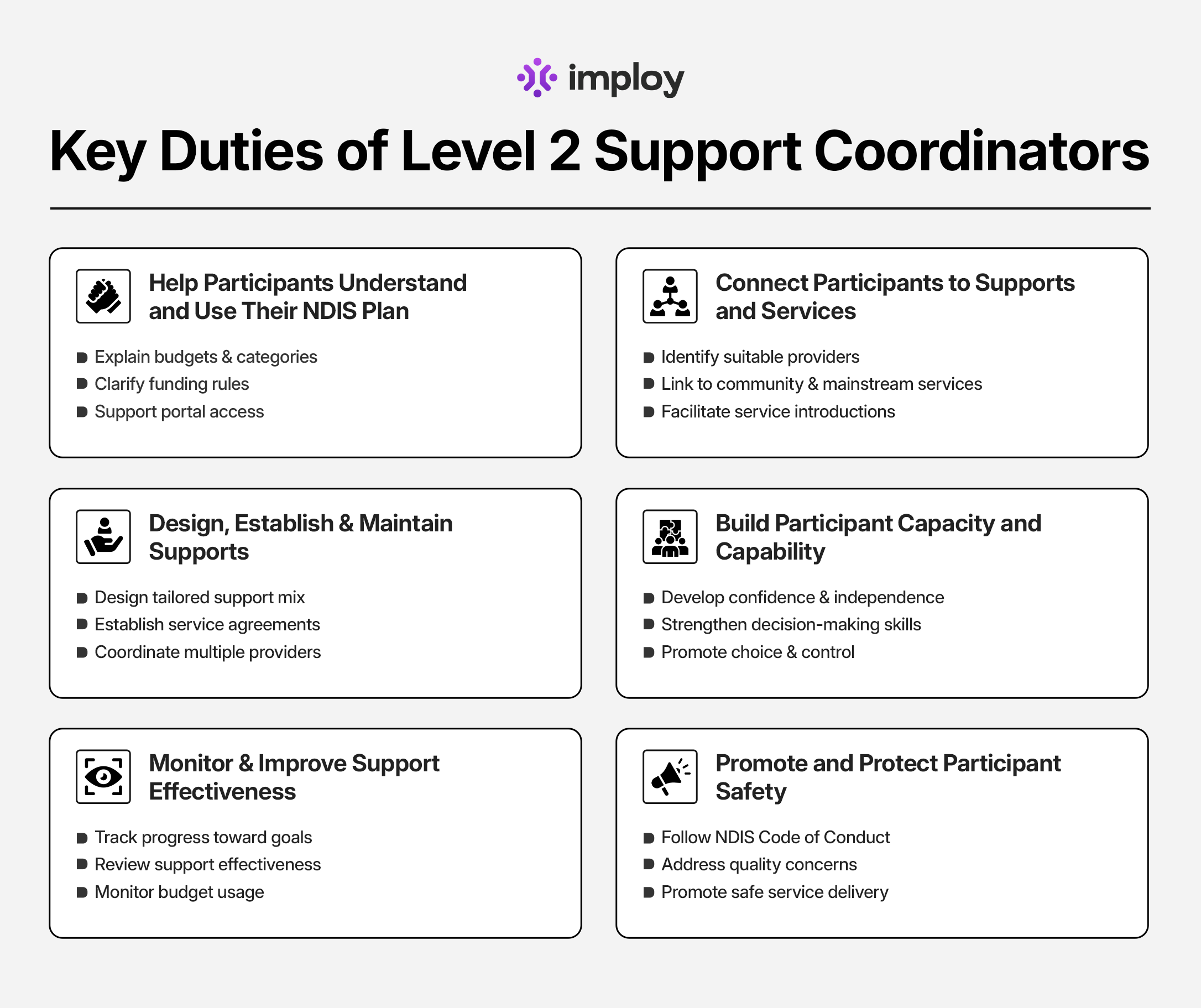
1. Help Participants Understand and Use Their NDIS Plan
- Explain funded supports, budgets, and how the plan works.
- Help participants understand how and when funding can be used.
- Support access to the NDIS portal and plan information.
2. Connect Participants to Supports and Services
- Connect participants with appropriate NDIS funded services, community supports, and mainstream services.
- Help explore a range of choices, including registered and unregistered providers (where appropriate).
3. Design, Establish & Maintain Supports
- Work with participants to design a tailored mix of supports to pursue their goals.
- Assist with service agreements and coordinating with multiple providers.
- Help maintain supports over time and adjust when needed.
4. Build Participant Capacity and Capability
- Support participants to build confidence, skills and independence in using their supports and navigating the NDIS.
- Help participants exercise choice and control.
- Assist planning for unexpected situations and crisis responses.
5. Monitor & Improve Support Effectiveness
- Help monitor how well supports are working against participant goals.
- Coach and reflect on what’s working and what might need changing.
- Report progress to the NDIA when required.
6. Promote and Protect Participant Safety
- Support coordinators are expected to act under the NDIS Code of Conduct to promote safety and wellbeing.
- Raise concerns about poor quality or unsafe supports.
- Encourage participants to raise safety or quality issues.
In short, Level 2 Support Coordinators are expected to help participants put suitable supports in place, build their capacity to manage these supports, and monitor progress over time - all while ensuring safety, choice and control remain central to service delivery.
Key Skills Required for Level 2 Support Coordination
A successful Level 2 Support Coordinator requires a blend of technical capabilities, interpersonal expertise, and sector knowledge.
1. Core Professional Skills
- Participant-centred planning: Ability to centre activities around participant goals.
- Communication & engagement: Clear (written and verbal) communication with participants, families, and providers.
- Critical thinking & problem-solving: Adapting to changing situations and resolving conflicts.
- Time and task management: Coordinating multiple parties across varied activities.
2. Soft and Relational Skills
- Empathy and understanding: Working respectfully with diverse participants and cultural backgrounds.
- Advocacy and negotiation: Supporting participants to articulate needs and negotiate services.
- Collaborative mindset: Building partnerships with providers, community services, and plan managers.
These capabilities help ensure that participants receive effective, responsive supports that align with their goals and NDIS plans.
Qualifications and Professional Requirements
Unlike some therapy roles in the NDIS, there is no single mandatory qualification required to become a Support Coordinator. However, many providers prefer candidates with relevant education or experience in disability, community services, social work, or case management.
1. Relevant Education and Training
While there is no single mandatory qualification for becoming a Support Coordinator, many professionals in this role come from fields related to health, social services, or community support. Educational backgrounds that are commonly valued include:
- Social work
- Community services or disability support
- Psychology or behavioural support
- Case management or care coordination
- Occupational therapy or allied health
- Allied health or human services disciplines
Training related to NDIS processes, participant engagement, and support planning is also highly valued within the sector.
2.Mandatory Checks and Compliance
While formal qualifications are not strictly required, workers must meet several compliance obligations within the NDIS system. These typically include:
- NDIS Worker Screening Check for workers in risk-assessed roles
- Compliance with the NDIS Code of Conduct
- Meeting NDIS Practice Standards if working for a registered provider
Many providers may also require additional onboarding, supervision, and ongoing professional development to maintain service quality.
Level 2 Support Coordination Pay Rates
NDIS Price Guide Rates
The NDIA sets maximum hourly price limits for Support Coordination under the NDIS Pricing Arrangements and Price Limits.
Level 2 Support Coordination (Coordination of Supports) has a higher price limit than Level 1 because it involves more complex service coordination and capacity-building support.
According to the 2025-26 NDIS Pricing Arrangements, the price limit for Level 2 Support Coordination is:
- National: $100.14 per hour
- Remote: $140.19 per hour
- Very Remote: $150.21 per hour
The price limit generally covers:
- Face-to-face coordination support
- Non-face-to-face activities (phone calls, provider coordination, plan implementation tasks)
- Provider travel (subject to NDIS travel rules)
- NDIA-requested reporting and documentation
- Service planning and coordination work
Providers must always refer to the latest NDIS Pricing Arrangements and Price Limits, as price limits may be updated periodically.
Employee Pay Rates (SCHADS Award 2025/26)
While the NDIS sets the maximum amount a provider can charge, employee wages are governed by the SCHADS Award (Social, Community, Home Care and Disability Services Award).
According to the 2025 SCHADS pay guide, Level 2 disability-related roles typically attract the following minimum hourly rates:
Full-Time / Part-Time (Ordinary Hours):
Level 2 - Pay Point 1: approx. $34.58 per hour
Level 2 - Pay Point 2: approx. $35.67 per hour
Level 2 - Pay Point 3: approx. $36.75 per hour
Level 2 - Pay Point 4: approx. $37.73 per hour
Casual (Including 25% Loading):
Level 2 - Pay Point 1: approx. $43.23 per hour
Level 2 - Pay Point 2: approx. $44.59 per hour
Level 2 - Pay Point 3: approx. $45.94 per hour
Level 2 - Pay Point 4: approx. $47.16 per hour
Penalty rates apply for weekends, public holidays, afternoon shifts and night work. For a detailed breakdown of current disability support worker pay rates, you can refer to Imploy’s 2025 guide Level 2 Disability Support Worker Pay Guide.
Challenges and Limitations of Level 2 Support Coordination
While Level 2 Support Coordination plays a crucial role in helping participants implement and manage their NDIS plans, the role also comes with several practical challenges. Support Coordinators often operate in complex environments where they must balance participant needs, service availability, and NDIS funding rules.
1. Managing Complex Participant Needs
Participants who receive Level 2 Support Coordination often have multiple supports, providers, and goals within their NDIS plans. Coordinating these services requires strong organisational and problem-solving skills. Support Coordinators must ensure that services work together effectively while keeping the participant’s goals at the centre of planning.
2. Limited Funding Hours
NDIS plans typically allocate a limited number of Support Coordination hours. This can restrict the amount of time coordinators can spend helping participants with tasks such as provider communication, service troubleshooting, and goal planning. As a result, coordinators must prioritise activities carefully to maximise the impact of available funding.
3. Service Availability Issues
In many regions, particularly rural or remote areas, suitable service providers may be limited or have long waitlists. This can make it difficult for Support Coordinators to connect participants with the right supports quickly, which may delay the implementation of their plans.
4. Administrative and Compliance Requirements
Support Coordinators must maintain accurate records, reports, and communication logs to meet provider and NDIS requirements. Managing documentation, progress reports, and plan reviews can be time-consuming, especially when coordinators are supporting multiple participants simultaneously.
5. Balancing Advocacy and Capacity Building
A key goal of Level 2 Support Coordination is to build the participant’s ability to manage their own supports over time. However, coordinators often need to balance this capacity-building role with providing immediate assistance when challenges arise, which can be difficult within limited plan funding.
Despite these challenges, Level 2 Support Coordination remains an essential support that helps participants navigate the NDIS, connect with services, and work towards greater independence and choice in their supports.
How Imploy Helps?
Managing Support Coordination effectively requires more than just sector knowledge - providers also need efficient systems to handle scheduling, documentation, staff management, and compliance. Imploy provides a complete workforce management solution for providers delivering Level 2 Support Coordination and other NDIS services. Key benefits include:
- SCHADS-compliant payroll: Automatically calculates pay rates, casual loadings, and penalties to ensure compliance with the 2025 award.
- Timesheet and rostering management: Simplifies scheduling and tracking of staff hours for face-to-face and non-face-to-face activities.
- Onboarding and compliance tools: Streamlines worker screening checks, inductions, and documentation requirements.
- Cost-effective operations: Reduces administrative burden, helping providers focus on delivering quality participant outcomes.
- Reporting and insights: Generates easy-to-read reports for funding, service delivery, and audit purposes.
By using Imploy, providers can manage their Level 2 Support Coordination workforce efficiently, stay compliant, and ensure participants receive timely and effective support.
Final Thoughts
Level 2 Support Coordination plays a vital role within the National Disability Insurance Scheme by helping participants turn their plans into practical, real-world supports. By connecting participants with the right providers, coordinating multiple services, and building participants’ confidence to manage their supports, Support Coordinators help ensure that NDIS plans lead to meaningful outcomes.
At the same time, the role requires strong organisational skills, sector knowledge, and efficient systems to manage participants, documentation, and service coordination. Tools like Imploy can support providers by simplifying scheduling, documentation, and workforce management - allowing Support Coordinators to spend more time focusing on participant outcomes rather than administrative tasks.
FAQs
1. Who is eligible for Level 2 Support Coordination?
Level 2 Support Coordination is usually funded for NDIS participants who have multiple supports, complex service arrangements, or need assistance coordinating providers. The NDIA decides whether to include this support during the planning process based on the participant’s circumstances and goals.
2. How many hours of Level 2 Support Coordination do participants usually receive?
The number of hours allocated for Level 2 Support Coordination varies depending on a participant’s needs, plan complexity, and the NDIA planner’s decision. Some participants may receive only a few hours per month, while others with more complex plans may receive a higher allocation to coordinate multiple services.
3. Can Level 2 Support Coordinators work independently or as contractors?
Yes. Support Coordinators can work as employees of NDIS providers or operate as independent contractors or small businesses. However, they must still comply with NDIS requirements, including worker screening checks, the NDIS Code of Conduct, and any applicable provider registration standards.
4. Can a participant choose their own Support Coordinator?
Yes. The NDIS emphasises participant choice and control, meaning participants can choose their preferred Support Coordinator if Support Coordination funding is included in their plan. Participants may also change coordinators if they feel the service is not meeting their needs.
5. Is Support Coordination always included in an NDIS plan?
No. Support Coordination is not automatically included in every NDIS plan. The NDIA typically funds it when a participant has complex support needs, multiple providers, or requires additional assistance to implement their plan effectively.