

NDIS Risk Assessment: A Complete Guide for Providers
Learn what NDIS risk assessment is, why it matters, key risk types, and a step-by-step process to help providers meet NDIS compliance and deliver safe care.

Delivering safe, high-quality support is at the heart of the NDIS. For providers, this responsibility goes beyond day-to-day care - it requires proactive planning, clear documentation, and ongoing monitoring of risks. That’s where NDIS risk assessment plays a critical role.
A well-structured risk assessment process helps protect participants, support workers, and your organisation, while ensuring compliance with the NDIS Practice Standards and the NDIS Quality and Safeguards Commission.
In this guide, we break down what NDIS risk assessment is, why it matters, how to do it properly, and how digital tools like Imploy can simplify risk management for NDIS providers.
What is an NDIS Risk Assessment?
An NDIS risk assessment is a structured process used to identify, analyse, and manage potential risks that may impact:
- NDIS participants
- Support workers and staff
- Service delivery outcomes
- Organisational compliance and reputation
These risks can arise from a participant’s health needs, behaviour, environment, support setting, or operational practices. The goal is not to eliminate all risk - which is often impossible - but to reduce risks to an acceptable and manageable level while respecting participant choice and control.
NDIS risk assessments are closely aligned with:
- Participant care plans
- Behaviour support plans
- Incident management systems
- Workforce training and supervision
Why is Risk Assessment Essential in NDIS?
Risk assessment is a fundamental part of delivering safe, high-quality support under the NDIS. With participants often receiving care in complex and dynamic environments, providers must be able to identify potential risks early and respond proactively.
Effective risk assessment not only supports participant choice and independence, but also ensures that services are delivered safely, consistently, and in line with regulatory expectations. The major importance of Risk Assessment are listed below:
1. Participant Safety and Wellbeing
Risk assessments help identify hazards before they lead to incidents such as falls, injuries, medication errors, or behavioural escalations. Early identification allows providers to put safeguards in place to support participants safely and confidently.
2. Compliance With NDIS Practice Standards
NDIS providers are required to demonstrate effective risk management under the NDIS Practice Standards, particularly in areas such as:
- Safe service delivery
- Incident management
- Governance and operational management
Incomplete or outdated risk assessments are a common issue identified during audits.
3. Protection for Support Workers
Clear risk controls help staff understand potential hazards and how to manage them, reducing workplace injuries, stress, and burnout.
4. Organisational Risk and Reputation
Poor risk management can result in complaints, incidents, non-compliance notices, or reputational damage. A strong risk framework protects your organisation as much as it protects participants.
Ultimately, strong risk assessment practices benefit everyone involved in NDIS service delivery. They create safer outcomes for participants, clearer guidance for support workers, and greater confidence for providers in meeting their compliance obligations. By embedding risk assessment into everyday operations, NDIS providers can reduce incidents, strengthen governance, and build a culture of safety, accountability, and quality care.
Types of Risks in NDIS Service Delivery
1. Participant-Related Risks
Participant-related risks are directly linked to an individual’s health, abilities, and support needs. These risks can change over time, making regular assessment essential to ensure safe, appropriate, and person-centred support. It includes:
- Medical conditions and health complexities
- Mobility limitations and fall risks
- Behavioural or psychosocial risks
- Medication management issues
- Communication barriers
2. Environmental Risks
Environmental risks relate to the physical settings where supports are delivered, including the home and community. Identifying these hazards helps reduce accidents and create safer support environments. It includes:
- Home safety hazards (stairs, wet areas, poor lighting)
- Community access and transport risks
- Emergency and evacuation risks
- Equipment and assistive technology safety
3. Staff and Operational Risks
Staff and operational risks arise from workforce practices and service delivery processes. Managing these risks is essential for protecting staff wellbeing and maintaining consistent, high-quality care. It includes:
- Inadequate training or supervision
- Fatigue, understaffing, or roster gaps
- Poor communication or documentation
- Manual handling risks
- Lack of continuity of care
Understanding the different types of risks in NDIS service delivery is essential for effective risk management. By identifying participant, environmental, and operational risks early, providers can put appropriate controls in place, reduce incidents, and deliver safer, more reliable supports that meet both participant needs and compliance requirements.
The NDIS Risk Assessment Process (Step-by-Step)
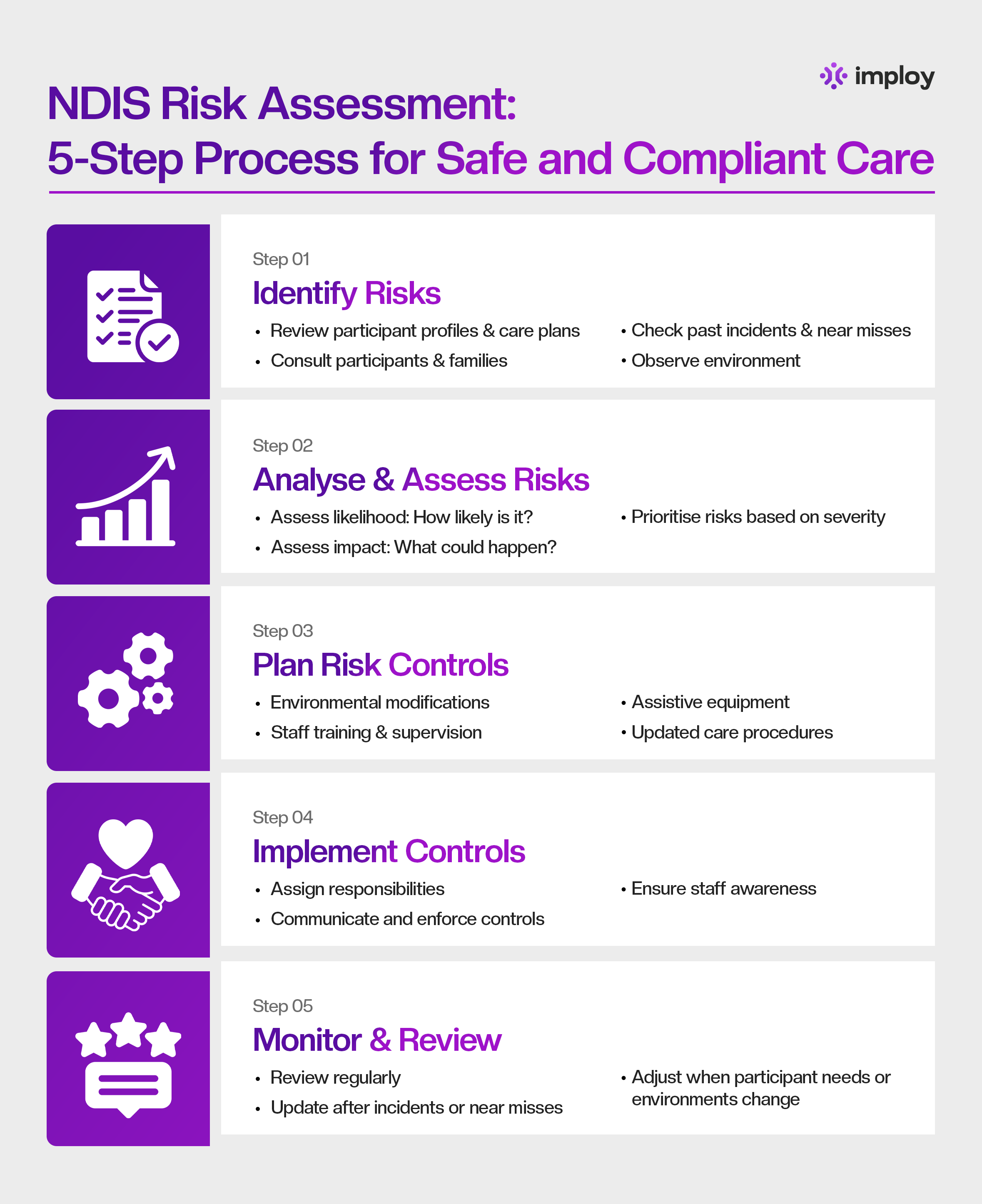
Step 1: Identify Risks
The first step in effective risk assessment is identifying anything that could potentially cause harm to participants, workers, or the organisation, or disrupt the safe delivery of services. Risks can be physical, emotional, behavioural, environmental, or operational in nature.
This process may involve:
- Reviewing participant profiles, support plans, and behaviour support plans
- Consulting directly with participants, families, carers, and support coordinators to understand individual needs and preferences
- Observing the participant’s home, community settings, and work environments for hazards
- Reviewing previous incidents, near misses, complaints, and feedback
- Considering workforce-related risks such as fatigue, lone working, or skill gaps
Identifying risks early allows providers to take proactive steps before harm occurs.
Step 2: Analyse and Assess Risks
Once risks are identified, each risk should be assessed to understand its level of seriousness. This involves evaluating:
- Likelihood: How likely is the risk to occur, based on past incidents or current conditions?
- Impact: What are the potential consequences if the risk does occur (e.g. minor injury, serious harm, service disruption)?
Using a risk matrix or rating scale helps prioritise risks so that high-risk issues are addressed first. This step ensures resources are focused where they are needed most.
Step 3: Plan Risk Controls
After assessing the risks, appropriate control measures should be developed to eliminate or reduce them as much as possible. Controls should be practical, participant-centred, and aligned with the NDIS Practice Standards.
Risk controls may include:
- Environmental modifications such as removing trip hazards or installing safety equipment
- Staff training, competency checks, and increased supervision
- Use of assistive technology or specialised equipment
- Updated care procedures, behaviour support strategies, or communication plans
- Clear escalation and emergency response procedures
Where risks cannot be eliminated entirely, controls should aim to minimise their likelihood and impact.
Step 4: Implement Controls
Planned risk controls must be put into action effectively. This includes assigning clear responsibilities, ensuring staff understand their roles, and integrating controls into everyday service delivery.
Key actions include:
- Communicating risk controls to all relevant staff and stakeholders
- Updating care plans, policies, and procedures
- Providing staff with training or resources required to implement controls
- Ensuring participants are informed and involved where appropriate
Without proper implementation, even well-designed controls will not be effective.
Step 5: Monitor and Review
Risk assessment is an ongoing process. Reviews should occur:
- Regularly
- When participant needs change
- After incidents or near misses
- When services or environments change
Continuous review supports ongoing improvement, strengthens compliance, and helps providers deliver safe, high-quality supports that respect participant choice and dignity.
Common Challenges in NDIS Risk Assessment
NDIS providers often face challenges in managing risk consistently across services. The major challenges for providers are listed below:
1. Ensuring Staff Understand and Follow Controls
Risk controls are only effective if staff understand and apply them. Poor communication, limited training, or staff turnover can lead to controls being missed in daily care.
2. Managing Multiple Participants With Complex Needs
Supporting participants with diverse and complex risks can be difficult to manage, especially when risk information is spread across multiple systems or documents.
3. Linking Risk Assessment to Rostering and Care Delivery
Risk assessments should guide staff allocation and service delivery. When systems are disconnected, staff may be assigned without the right skills or training to manage identified risks.
4. Preparing Evidence for Audits
Audits require clear, up-to-date risk documentation. Collecting evidence from fragmented or manual records can be time-consuming and stressful.
5. Failure to Review and Update Risks
Participant needs and environments change regularly. Without timely reviews, risk assessments can quickly become outdated, increasing safety and compliance risks.
Addressing these common challenges ensures risk assessments remain effective, staff are confident in following controls, and services stay safe and compliant. Using structured processes and the right tools can make risk management proactive rather than reactive.
How Imploy Supports NDIS Risk Assessment
Managing risk effectively is a critical part of NDIS service delivery, and Imploy is designed to make this process simpler, more accurate, and fully compliant. Its features help providers identify, monitor, and act on risks proactively, while also making audit preparation easier.
Key Features and How They Support Risk Assessment
- Incident & Risk Tracking
Record, monitor, and resolve incidents systematically. This ensures risks are documented, actions are assigned, and outcomes are reviewed - the core of an effective risk assessment process. - Centralised Participant & Care Management
Store participant profiles, care plans, progress notes, and documentation in one secure system. Centralisation makes it easier to identify emerging risks and maintain up-to-date risk assessments. - Integrated Rostering & Mobile Access
Staff can access schedules, care notes, and risk information in real-time. This ensures everyone is aware of potential risks and can respond appropriately during service delivery. - Audit-Ready Reporting & Documentation
Generate timestamped, exportable reports and maintain version-controlled records. This demonstrates that risks are actively managed and risk assessments are current, meeting NDIS compliance requirements. - Compliance Alerts & Document Tracking
Automatic reminders for expiring certifications, care plans, or policy updates ensure that staff qualifications and participant documentation are always current, reducing operational and safety risks. - Progress Notes & Trend Analysis
Detailed, searchable documentation allows providers to spot patterns or early warning signs of risk, helping prevent incidents before they occur.
By combining these features, Imploy helps NDIS providers stay proactive in managing risk, reduce administrative burden, and deliver safer, higher-quality care - all while remaining audit-ready and fully compliant with NDIS Practice Standards.
Best Practices for NDIS Risk Assessment
Effective NDIS risk assessment requires more than completing forms - it’s an ongoing process that relies on collaboration, regular reviews, and clear documentation. Following best practices ensures risks are managed proactively, participants are safe, and services remain compliant.
- Involve participants in identifying and managing risks
- Review risk assessments regularly
- Train staff on risk awareness and reporting
- Document all actions and reviews
- Use technology to streamline and standardise processes
Effective risk assessment is not a one-off task - it’s an ongoing commitment to quality and safety.
Final Thoughts
NDIS risk assessment is more than a regulatory requirement - it’s a critical part of delivering safe, high-quality care. By identifying risks early, monitoring them consistently, and taking proactive measures, providers can protect participants, support staff, and their organisation.
Tools like Imploy simplify this process by centralising information, tracking incidents, and maintaining audit-ready documentation, allowing providers to focus on what matters most: safe and reliable care.
Frequently Asked Questions (FAQs)
1. Who is responsible for conducting NDIS risk assessments?
NDIS providers are responsible for conducting risk assessments, with input from participants, families, and support staff as appropriate.
2. How often should risk assessments be reviewed?
Risk assessments should be reviewed regularly and whenever participant needs, environments, or services change, as well as after incidents or near misses.
3. Can risk assessments be done digitally?
Yes. Digital tools like Imploy allow providers to manage risk assessments, incidents, and documentation in one centralised, audit-ready system.
4. What is the difference between a risk assessment and a risk management plan?
A risk assessment identifies and evaluates potential hazards, while a risk management plan outlines the strategies and controls to mitigate those risks.
5. Are risk assessments mandatory under the NDIS?
Yes. Risk management is a core requirement under the NDIS Practice Standards, and providers must demonstrate compliance during audits.