

How to Prepare for the NDIS Practice Standards Gap Assessment
Learn how to prepare for an NDIS Practice Standards gap assessment. Step-by-step guidance to identify gaps, reduce audit risk, and stay compliant.

Operating as an NDIS provider comes with a significant responsibility: delivering safe, high-quality supports while meeting strict regulatory requirements. One of the most effective ways to ensure your organisation is on track is by conducting an NDIS Practice Standards gap assessment.
A well-prepared gap assessment helps you identify compliance weaknesses early, reduce audit risks, and build systems that stand up to scrutiny. In this guide, we’ll explain what an NDIS gap assessment involves, when to conduct one, and how to prepare effectively - without unnecessary stress.
What is an NDIS Practice Standards Gap Assessment?
An NDIS Practice Standards gap assessment is a structured review of your organisation’s policies, procedures, and day-to-day practices against the relevant NDIS Quality Indicators.
It helps answer three critical questions:
- What are we doing well?
- Where do gaps or risks exist?
- What needs to be improved before an audit?
Gap Assessment vs Audit vs Internal Practice Review
- Gap assessment: A preparatory, diagnostic review to identify compliance gaps.
- Certification audit: A formal assessment conducted by an approved certification body.
- Internal Practice Review (IPR): An internal compliance check to ensure ongoing alignment with standards.
Gap assessments are not audits - but they are one of the most effective ways to become audit-ready.
Why NDIS Practice Standards Gap Assessments Matter?
NDIS Practice Standards set the benchmark for how registered providers must deliver supports. Failing to meet these standards can lead to:
- Non-conformities during audits.
- Delays in registration or renewal.
- Increased scrutiny from auditors.
- Reputational and operational risk.
A gap assessment gives you a clear picture of where your organisation currently stands before an audit or registration review. Rather than reacting to issues identified by an auditor, you can address them proactively and with confidence.
When Should You Conduct a Gap Assessment?
While gap assessments are commonly completed before audits, best-practice providers use them strategically throughout the year.
You should consider a gap assessment if you are:
- Applying for initial NDIS registration
- Preparing for mid-term audits
- Expanding registration groups or service offerings
- Responding to compliance incidents or complaints
- Experiencing rapid growth or workforce changes
- Adjusting to updates in NDIS requirements
Regular gap assessments help you move from reactive compliance to a proactive quality culture.
Understanding the NDIS Practice Standards
Your gap assessment will be measured against the applicable NDIS Practice Standards modules, which generally include:
1. Rights and Responsibilities
- Participant rights
- Informed consent
- Privacy and dignity
2. Governance and Operational Management
- Risk management
- Incident management
- Complaints handling
- Continuous improvement
3. Provision of Supports
- Service delivery processes
- Support planning and review
- Documentation of outcomes
4. Environment
- Safe service environments
- Emergency preparedness
- Infection control (where applicable)
Auditors don’t just assess whether policies exist - they look for evidence that policies are implemented consistently in practice.
Step-by-Step Guide to Preparing for an NDIS Gap Assessment (With Examples)
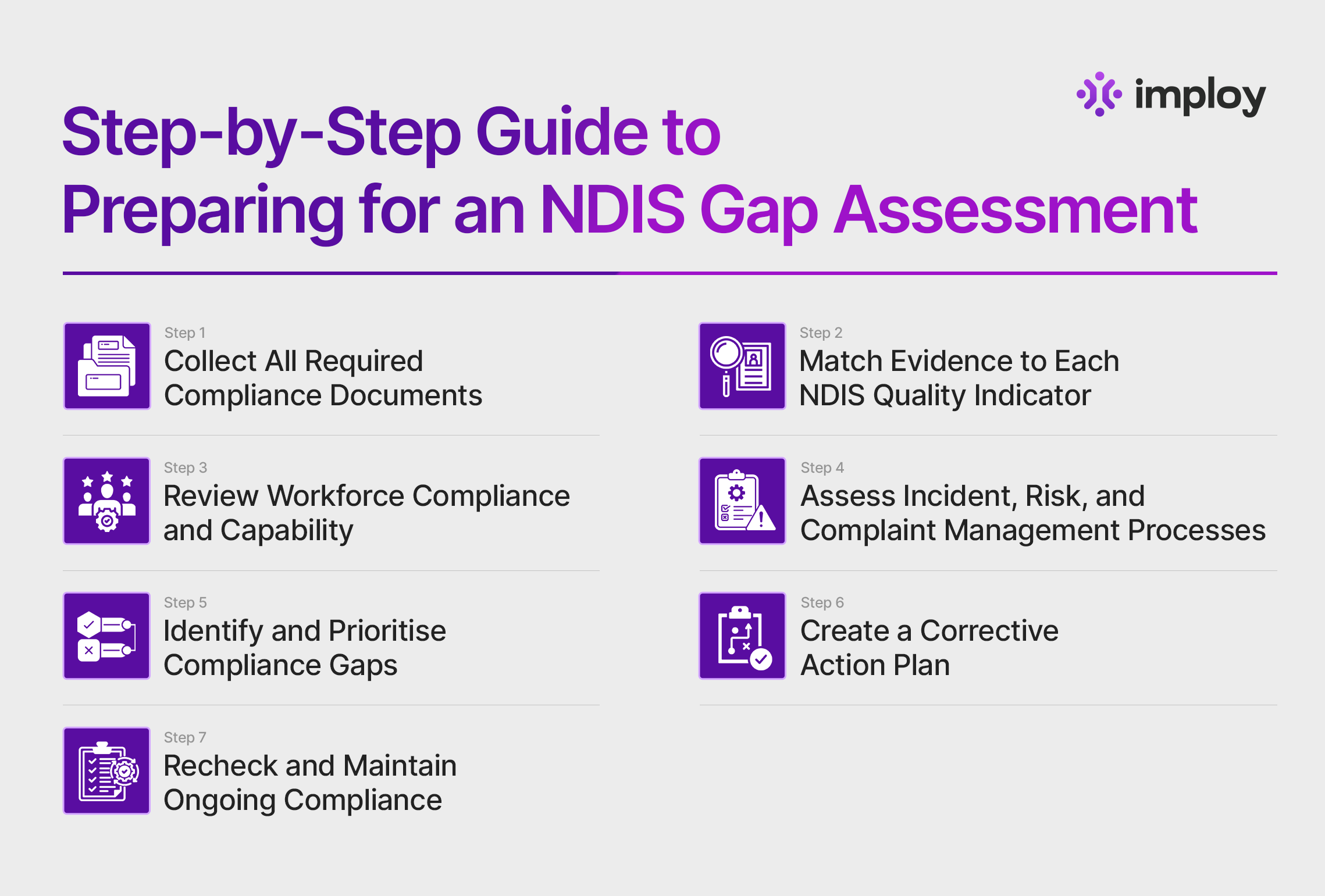
Step 1: Collect All Required Compliance Documents
Begin by gathering the documents your organisation already uses to meet the NDIS Practice Standards.
This typically includes:
- Policies and procedures
- Incident and complaints registers
- Risk assessments and risk registers
- Continuous improvement records
- Staff training and qualification records
Example:
If your incident management policy states incidents must be reported within 24 hours, you should also have incident logs showing actual reports submitted within that timeframe.
Step 2: Match Evidence to Each NDIS Quality Indicator
Each NDIS Quality Indicator requires evidence that shows how your organisation meets the standard in practice.
What to check:
- Do you have evidence for every relevant indicator?
- Does the evidence show real implementation, not just written intent?
Example:
For the Rights and Responsibilities standard, a participant rights policy alone is not enough. You may also need signed service agreements, consent forms, or onboarding records showing participants were informed of their rights.
Step 3: Review Workforce Compliance and Capability
Auditors pay close attention to workforce governance, so your gap assessment should include a thorough staff review.
Check for:
- Valid worker screening checks
- Role-specific training records
- Supervision and performance reviews
- Staff rostered only to supports they are qualified to deliver
Example:
If a support worker delivers behaviour support, your records should show relevant training and supervision - not just a generic induction checklist.
Step 4: Assess Incident, Risk, and Complaint Management Processes
Review whether your systems show a complete compliance cycle - from reporting to resolution and improvement.
Look for:
- Timely incident reporting
- Investigation notes
- Corrective actions taken
- Evidence of learning and improvement
Example:
If a fall incident occurred, the record should show follow-up actions such as environmental changes, staff retraining, or updated risk assessments - not just the incident report itself.
Step 5: Identify and Prioritise Compliance Gaps
Once evidence has been reviewed, clearly document what is missing or inconsistent.
Classify gaps as:
- Low risk: Minor documentation gaps
- Medium risk: Inconsistent practice or incomplete records
- High risk: Safety, governance, or systemic failures
Example:
An outdated policy may be a low-risk gap, while missing incident follow-up records would be considered high risk.
Step 6: Create a Corrective Action Plan
Turn your findings into a structured improvement plan.
Your action plan should include:
- What needs to be fixed
- Who is responsible
- Target completion dates
- How progress will be monitored
Example:
If staff training records are incomplete, the action plan might assign the HR manager to update training logs and schedule refresher sessions within 30 days.
Step 7: Recheck and Maintain Ongoing Compliance
After closing gaps, confirm that changes are embedded into daily operations.
Best practice includes:
- Regular internal practice reviews
- Continuous improvement tracking
- Centralised compliance systems
Example:
Rather than fixing issues only before audits, providers schedule quarterly internal reviews to ensure compliance remains consistent.
Common Mistakes Providers Make
Many providers struggle with gap assessments due to avoidable issues, such as:
- Treating compliance as a paperwork exercise only.
- Using disconnected spreadsheets and folders.
- Failing to link evidence to real practice.
- Outdated policies not reflected in operations.
- Poor visibility across workforce compliance.
These gaps often surface during audits - when it’s too late to fix them easily.
How Imploy Helps You Prepare with Confidence
Imploy is designed to help NDIS providers move beyond manual compliance tracking and become audit-ready at all times.
With Imploy, you can:
- Store all compliance documents in one centralised system.
- Track staff credentials, training, and screening automatically.
- Maintain incident and complaints registers aligned with NDIS standards.
- Monitor compliance risks through real-time dashboards.
- Generate clear, exportable reports to support gap assessments and audits.
- Use NDIS-aligned templates to standardise documentation.
Instead of scrambling for evidence, Imploy helps you maintain continuous compliance every day.
Final Thoughts
Preparing for an NDIS Practice Standards gap assessment doesn’t have to be overwhelming. With the right structure, clear evidence, and supportive systems, it becomes a powerful tool for improving quality - not just meeting minimum requirements.
By identifying gaps early and addressing them proactively, you protect your organisation, your workforce, and most importantly, the people you support.
FAQs
1. Is an NDIS gap assessment mandatory?
No, but it is highly recommended before audits, registration, or service expansion.
2. Who should conduct a gap assessment?
It can be completed internally, by a consultant, or with support from digital compliance tools.
3. How long does a gap assessment take?
Depending on provider size, it may take a few days to several weeks.
4. Can a gap assessment replace an audit?
No. It is a preparatory step, not a formal certification audit.
5. What evidence do auditors expect to see?
Policies, operational records, staff compliance data, incident management logs, and continuous improvement actions.
6. How can software help with gap assessments?
Care management platforms like Imploy centralise compliance data, automate tracking, and make evidence easy to access and report.



.webp)