

NDIS Duty of Care Explained for Providers
NDIS Duty of Care explained for providers. Learn legal obligations, key principles, real-life examples, and how Imploy helps ensure safe, compliant, participant-centred care.

As an NDIS provider, your primary responsibility goes beyond delivering services - it’s about ensuring the safety, wellbeing, and dignity of every participant. This is where Duty of Care comes into play.
Duty of Care is a legal and ethical obligation that requires providers to act in the best interest of participants, protect them from harm, and deliver services competently. Understanding it is essential not only for compliance with the NDIS Act 2013 but also for building trust and maintaining high-quality care standards.
In this blog, we break down Duty of Care for NDIS providers, explore legal obligations, and offer practical tips to integrate it into everyday operations.
What is Duty of Care?
Duty of Care is the legal and ethical obligation placed on individuals and organisations to take reasonable steps to prevent foreseeable harm to others. Within the NDIS context, this responsibility is heightened because providers support people who may be vulnerable due to disability, health conditions, or complex support needs.
For NDIS providers, Duty of Care means:
- Protecting participants from harm: including physical injury, emotional distress, psychological harm, neglect, abuse, or exploitation.
- Delivering services safely and competently: ensuring supports are provided by suitably trained, qualified, and supervised staff.
- Acting professionally and ethically at all times: respecting participant dignity, privacy, consent, and rights in every interaction.
Unlike general workplace responsibilities, Duty of Care in NDIS services is participant-centered, focusing on safeguarding vulnerable individuals while supporting their rights, choice, and independence.
Key Elements of Duty of Care
- Foreseeability: Providers must anticipate potential risks to participants.
- Reasonable Measures: Taking steps that a provider would take in similar circumstances.
- Participant-Centred Approach: Supporting participants while respecting their rights, choices, and independence.
Unlike general workplace safety obligations, Duty of Care in NDIS services is participant-focused, prioritising vulnerable individuals’ wellbeing above operational convenience.
Why Duty of Care Matters?
Meeting Duty of Care obligations is essential for delivering safe, ethical, and compliant NDIS services. When providers actively uphold their Duty of Care, they create an environment where participants are supported, respected, and protected at all times.
Strong Duty of Care practices:
- Protect participants from harm and neglect by ensuring risks are identified early and appropriate safeguards are in place.
- Reduce legal, regulatory, and compliance risks for providers by meeting legislative requirements and NDIS Practice Standards.
- Build trust and confidence with participants, families, carers, and support networks, strengthening long-term service relationships.
- Demonstrate alignment with the NDIS Quality and Safeguards Commission expectations, helping providers meet audit and registration requirements.
Beyond compliance, Duty of Care plays a critical role in service quality and organisational culture. Providers that prioritise Duty of Care foster professionalism, accountability, and continuous improvement across their workforce.
Ultimately, Duty of Care is not just about avoiding penalties, it is the foundation of safe, respectful, and high-quality disability support services that empower participants to live with dignity, choice, and confidence.
Key Principles for NDIS Providers in Upholding Duty of Care
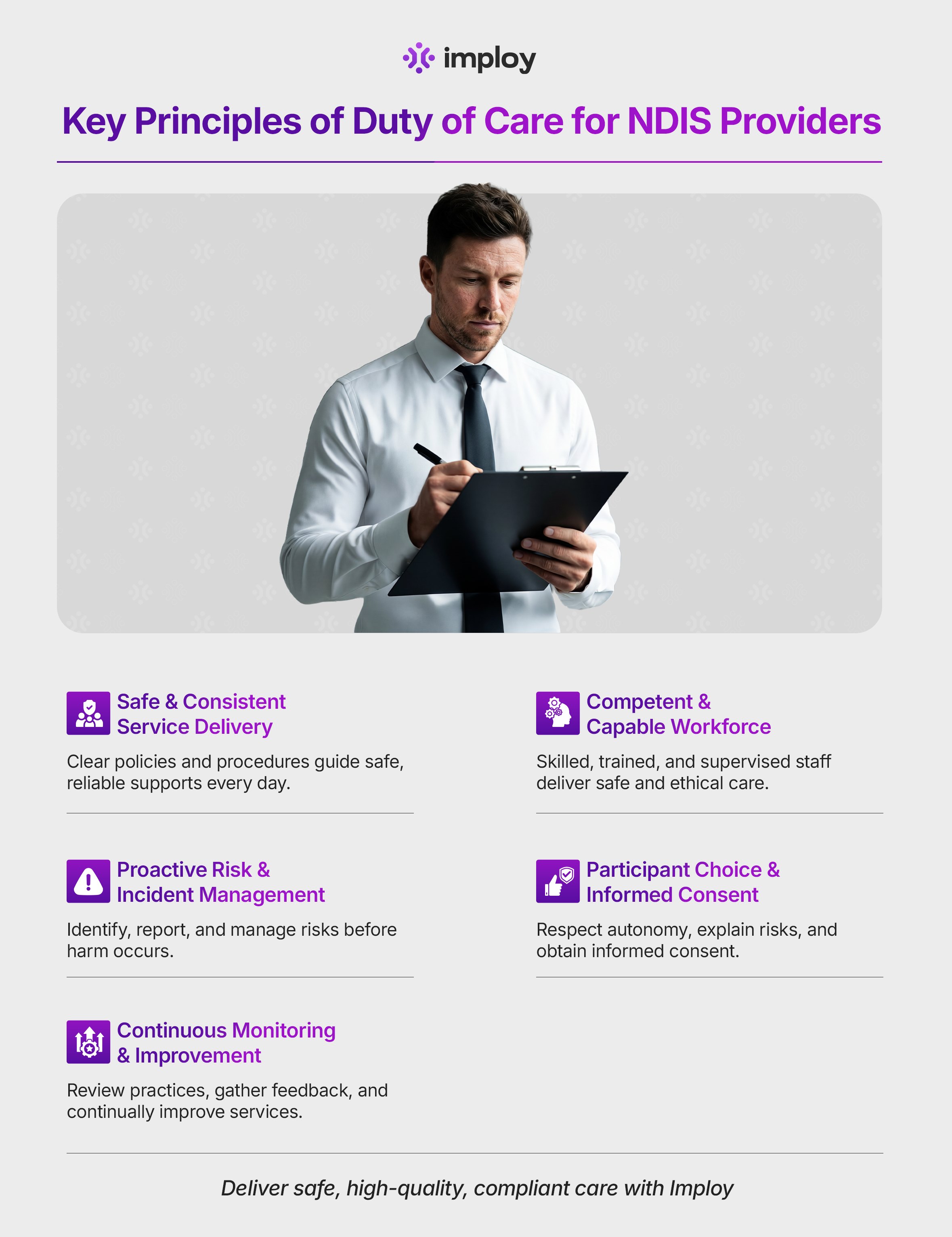
To effectively meet Duty of Care obligations, NDIS providers must embed safety, accountability, and participant wellbeing into every aspect of service delivery. The following key principles guide providers in meeting these responsibilities consistently and compliantly.
1. Safe and Consistent Service Delivery
Providers must establish and maintain clear, documented policies and procedures that guide safe service delivery across all supports. This includes defined processes for:
- Daily care activities
- Medication management
- Incident reporting
- Emergency and crisis response
Well-documented procedures ensure staff understand their responsibilities and can respond appropriately in both routine and high-risk situations.
2. Workforce Competency and Capability
Duty of Care relies heavily on the skills and judgement of the workforce. Providers must ensure:
- Staff are appropriately trained to support complex needs, behaviour support, and safeguarding.
- Workers understand professional boundaries and ethical responsibilities.
- Regular refresher training is delivered in line with NDIS Practice Standards and changing service needs.
A competent workforce reduces risk and supports safe, high-quality care.
3. Proactive Risk and Incident Management
Effective Duty of Care requires providers to actively identify and manage risks before harm occurs. This involves:
- Conducting Risk Assessments prior to service commencement and reviewing them regularly.
- Monitoring changes in participant needs or environments.
- Maintaining accurate incident records and implementing corrective actions to prevent recurrence.
Proactive risk management demonstrates due diligence and strengthens compliance.
4. Respect for Participant Choice and Informed Consent
Providers must balance safety with participant choice and control by:
- Respecting participant autonomy and decision-making.
- Ensuring informed consent is obtained for all supports and interventions.
- Clearly explaining risks, alternatives, and support options in accessible ways.
Supporting informed choice is a core requirement of both Duty of Care and the NDIS framework.
5. Continuous Monitoring and Improvement
Duty of Care is an ongoing obligation, not a one-time activity. Providers should:
- Regularly review policies, procedures, and service outcomes.
- Use audits, incident data, and participant feedback to identify improvement areas.
- Adapt practices to reflect evolving risks, participant needs, and regulatory expectations.
Continuous improvement helps providers maintain safe, responsive, and high-quality services over time.
Together, these principles underpin a strong and effective Duty of Care framework for NDIS providers. By embedding safety, accountability, and participant wellbeing into everyday service delivery, providers can meet their legal and ethical obligations while reducing risk and strengthening compliance.
More importantly, applying these principles in practice supports high-quality, participant-centred care - ensuring individuals are protected from harm, respected in their choices, and empowered to live with dignity, confidence, and control.
Legal Framework for NDIS Providers
NDIS providers operate within a multi-layered legal and regulatory framework that directly shapes their Duty of Care obligations. This framework exists to protect participant safety, uphold rights, and ensure services are delivered ethically, consistently, and to an appropriate standard.
1. NDIS Act 2013
The NDIS Act 2013 forms the foundation of provider obligations under the Scheme. It:
- Establishes the rights of NDIS participants.
- Defines the responsibilities of providers delivering funded supports.
- Sets expectations for quality, safety, and ethical service delivery.
Failure to comply with the Act can result in serious regulatory consequences.
2. NDIS Quality and Safeguards Commission
The NDIS Quality and Safeguards Commission is responsible for monitoring and enforcing provider compliance. It:
- Oversees adherence to the NDIS Practice Standards.
- Manages complaints and investigates incidents.
- Issues compliance actions, including conditions, sanctions, or deregistration.
Providers must be able to demonstrate active governance, risk management, and continuous improvement to meet Commission expectations.
3. Work Health and Safety (WHS) Act 2011
The WHS Act 2011 applies to NDIS providers as employers and service operators. It requires providers to:
- Maintain safe environments for both workers and participants.
- Identify and control hazards associated with service delivery.
- Implement systems to manage physical, psychological, and environmental risks.
WHS obligations directly support Duty of Care by reducing foreseeable harm.
Duty of Care is not optional. It is a legally binding obligation reinforced by legislation, regulators, and the courts. NDIS providers must have clear policies, robust processes, and ongoing staff training in place to demonstrate compliance and protect both participants and their organisation.
Practical Tips for Providers
Meeting Duty of Care goes beyond simply following policies or meeting minimum compliance requirements. It requires providers to embed safety, accountability, and quality into everyday service delivery so that staff consistently act in the best interests of participants.
Key practical steps include:
- Create clear internal procedures:
Staff should have access to well-documented, easy-to-follow procedures that explain how to manage risks, respond to incidents, escalate concerns, and follow emergency protocols. Clear guidance reduces uncertainty and supports consistent decision-making. - Conduct thorough risk assessments:
Providers should identify and assess risks related to environments, mobility support, health needs, and participant behaviour. Risk assessments must be reviewed regularly and updated when participant needs or circumstances change. - Communicate effectively:
Open, transparent communication with participants, families, carers, and allied health professionals helps identify concerns early and ensures supports remain appropriate, coordinated, and safe. - Maintain professional boundaries:
Staff must understand ethical conduct, scope of practice, and role boundaries. Strong boundary awareness protects both participants and workers from harm, misunderstandings, or inappropriate relationships.
- Leverage technology:
Digital tools such as Imploy support providers by streamlining compliance tasks, tracking staff credentials and training, documenting incidents, and monitoring service delivery. Technology helps ensure Duty of Care obligations are met consistently and efficiently.
Duty of Care in Action: Real-Life Examples
Understanding Duty of Care becomes clearer when applied in real-world situations. The following examples highlight how provider actions can significantly impact participant safety and organisational outcomes.
Good Practice Example
A participant with limited mobility begins showing signs of fatigue during a scheduled exercise session. The support worker recognises the risk, modifies the activity, documents the change in the participant’s records, and informs the care coordinator.
Outcome:
- Participant safety is maintained
- Risk of injury is reduced
- Care remains responsive and person-centred
This example demonstrates proactive risk management, clear communication, and adherence to Duty of Care principles.
Breach Example
A participant with complex support needs is left unsupervised during an activity and sustains an injury. An investigation reveals inadequate staffing levels and a failure to conduct appropriate risk assessments.
Outcome:
- Participant harm occurs
- Provider faces complaints, regulatory scrutiny, and potential legal action
- Trust and organisational credibility are damaged
This situation highlights how lapses in planning, supervision, and risk management can result in serious consequences.
How Imploy Supports Duty of Care?
Imploy helps NDIS providers meet Duty of Care obligations by embedding compliance and safety into daily operations:
- Workforce compliance tracking: Monitor staff training, qualifications, and screening checks in one place.
- Incident & risk management: Record incidents, actions, and follow-ups with clear audit trails.
- Policy & procedure access: Give staff real-time access to current policies and guidance.
- Care plan visibility: Ensure workers follow up-to-date participant care plans.
- Audit readiness: Maintain organised records aligned with NDIS Practice Standards.
By improving visibility, consistency, and accountability, Imploy helps providers deliver safer, more compliant, participant-centred care.
Final Thoughts
Duty of Care is a fundamental responsibility for every NDIS provider. It underpins safe service delivery, protects participant wellbeing, and ensures providers meet their legal and ethical obligations. When Duty of Care is embedded into policies, workforce practices, risk management, and daily decision-making, it becomes part of a strong culture of safety and accountability.
By aligning practices with the NDIS Practice Standards and using technology like Imploy to support compliance, providers can confidently deliver high-quality, participant-centred supports while reducing risk, improving governance, and strengthening trust with participants, families, and regulators.
Frequently Asked Questions (FAQs)
1. What does Duty of Care mean for NDIS providers?
Duty of Care refers to a provider’s legal and ethical responsibility to take reasonable steps to protect participants from harm while delivering safe, competent, and respectful supports.
2. Is Duty of Care a legal requirement under the NDIS?
Yes. Duty of Care is supported by the NDIS Act 2013, the NDIS Practice Standards, and general principles of negligence law. Providers must demonstrate they have taken reasonable steps to safeguard participants.
3. What are common breaches of Duty of Care?
Common breaches include inadequate supervision, failure to assess risks, untrained staff delivering supports, poor incident management, and ignoring changes in participant needs.
4. How can providers demonstrate Duty of Care during an audit?
Providers can demonstrate Duty of Care through documented policies, staff training records, risk assessments, incident logs, participant feedback, and continuous improvement activities.
5. How does Imploy help providers meet Duty of Care obligations?
Imploy supports Duty of Care by centralising workforce compliance, incident management, policy access, and care plan visibility—helping providers maintain audit readiness and deliver safer, more consistent supports.
.webp)