

What Makes Level 3 Support Coordinators Unique?
Learn what makes Level 3 (Specialist) Support Coordinators unique under the NDIS, their responsibilities, qualifications, pay, and high-risk support role.


Support coordination is central to helping NDIS participants turn their plans into meaningful, real-world outcomes. But not all support coordination is the same. Within the NDIS framework, Level 3 Support Coordination, also called Specialist Support Coordination, is a distinct role designed for participants with complex or high-risk needs.
This blog explains what makes Level 3 Support Coordinators unique, including their responsibilities, qualifications, pay, and why their role is so vital.
Understanding Support Coordination Levels Under NDIS
The NDIS recognises different levels of support coordination to match participants’ needs, goals, and ability to manage their supports. Each level offers a progressively more intensive service depending on the participant’s complexity and risk.
- Support Connection (Level 1): Helps participants connect with formal and informal services. Ideal for those with lower complexity or new to the NDIS, focusing on building basic skills to use their plan. Learn more about Level 1 Disability Support Worker Pay on our blog.
- Coordination of Supports (Level 2): Provides structured assistance to manage providers and implement plans. Suitable for participants who need moderate support or guidance in coordinating multiple services. Learn more about Level 2 Disability Support Worker Pay
- Specialist Support Coordination (Level 3): Designed for participants with high complexity, risk, or systemic barriers. Level 3 coordinators provide intensive support, including risk management, crisis response, and multi-agency coordination to ensure plans are implemented safely and effectively. Learn more about Level 3 Disability Support Worker Pay on our blog.
What Is a Level 3 (Specialist) Support Coordinator?
Level 3 Support Coordinators, also known as Specialist Support Coordinators, work with NDIS participants who face highly complex or high-risk situations. They provide support where standard coordination is not enough, ensuring participants can use their NDIS plan effectively and safely.
Participants who may require Level 3 support often have:
- Multiple or co-existing disabilities that require integrated care across providers.
- Complex mental health conditions needing specialised interventions.
- High-risk behaviours or safeguarding concerns, such as self-harm or aggression.
- Involvement with multiple systems, including health, housing, justice, or child protection.
- Unstable living environments or homelessness, which can threaten continuity of care.
Unlike Levels 1 or 2, Level 3 Support Coordination is not simply about connecting participants to services. It focuses on:
- Managing complexity across multiple supports and systems.
- Reducing risks to participant safety and wellbeing.
- Stabilising the support environment to prevent crises or service breakdowns.
- Strategic planning, ensuring that all supports work cohesively to meet the participant’s goals.
Level 3 coordinators also often advocate on behalf of participants, liaising with multiple providers, navigating systemic barriers, and ensuring the participant’s rights and preferences are central to every decision.
Key Responsibilities of Level 3 Support Coordinators
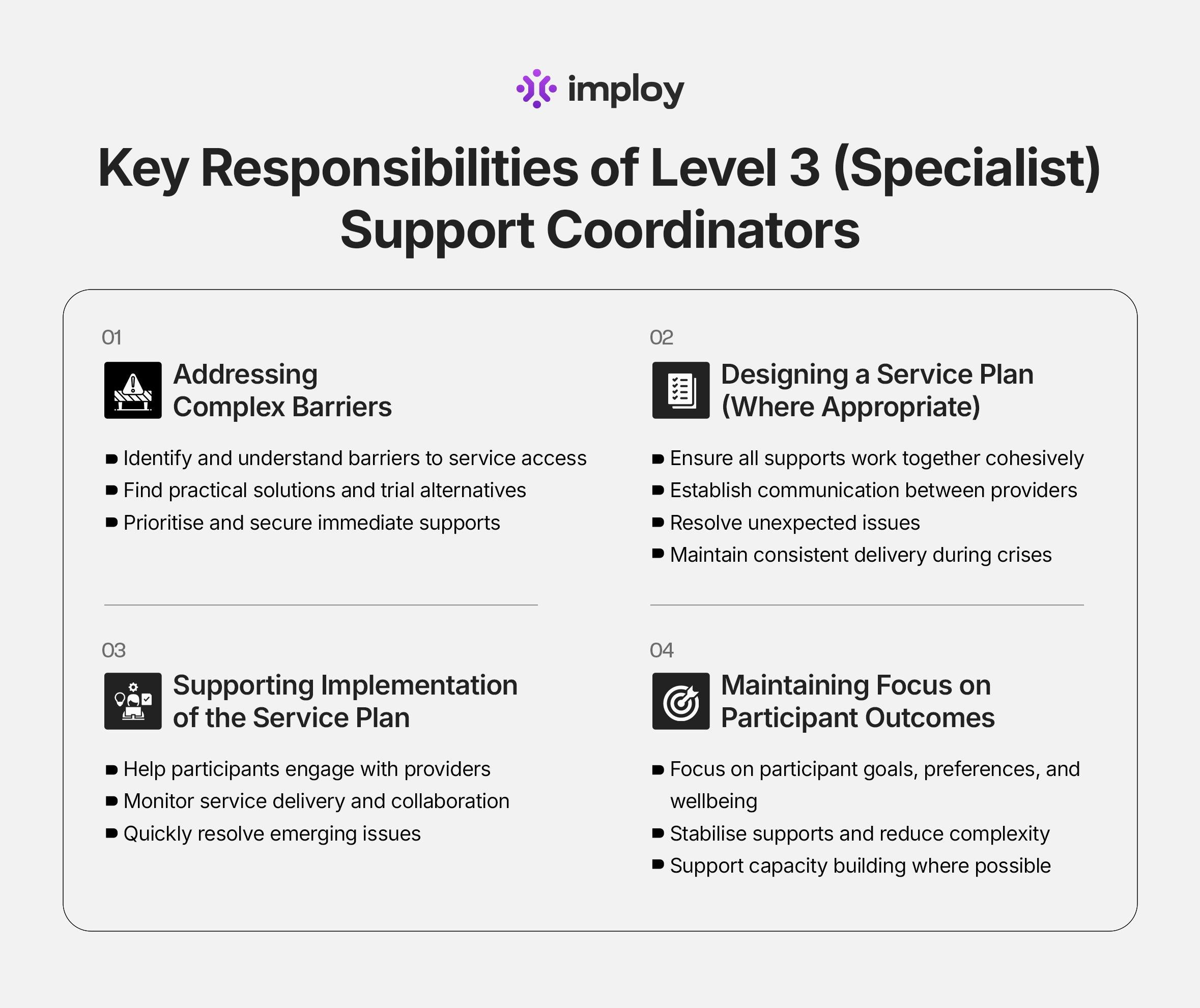
Level 3 Support Coordinators differ from Levels 1 and 2 because they work with participants who have highly complex or high-risk needs. While other levels focus on connecting participants to services or helping manage moderate complexity, Level 3 coordinators provide specialist, intensive support, often in situations where standard coordination is not sufficient.
Their role is strategic, hands-on, and critical to ensuring participants can safely and effectively use their NDIS plan. According to official NDIS guidance, Specialist Support Coordinators are responsible for:
1. Addressing Complex Barriers
A core responsibility of a Level 3 Support Coordinator is to help participants overcome barriers that affect their ability to access and maintain supports. This involves working closely with the participant, and where appropriate their family or carers, to:
- Identify and understand the barriers impacting service access
- Find and trial practical solutions to overcome these barriers
- Establish processes to address barriers, including prioritising what needs to be resolved first
- Identify and secure immediate supports where required
This work is particularly important when participants face multiple challenges that cannot be resolved through standard coordination alone.
Example: A participant struggles to access services due to provider issues and missed appointments. The coordinator identifies the barriers, trials alternative providers, and secures immediate supports to stabilise care.
2. Designing a Service Plan (Where Appropriate)
In situations involving complex needs, the NDIS recognises that participants may require a service plan in addition to their NDIS plan. Level 3 Support Coordinators support the development of this plan to ensure services operate in a coordinated and effective way.
This includes:
- Ensuring supports work together cohesively
- Establishing communication, cooperation, and collaboration between funded and other supports
- Supporting participants and families to resolve unexpected issues
- Helping maintain consistent service delivery and access to supports during crisis or unplanned events
Example: A participant receives support from multiple providers with inconsistent care. The coordinator develops a service plan outlining roles, communication, and contingency steps to ensure services work together effectively.
3. Supporting Implementation of the Service Plan
Once a service plan is developed, Specialist Support Coordinators assist with putting it into action. This involves supporting the participant to engage with services, monitoring how supports are working together, and responding to issues that may arise as circumstances change.
Example: After the service plan is set, the coordinator helps the participant engage with providers, monitors delivery, and quickly resolves issues like unavailable services to maintain continuity.
4. Maintaining Focus on Participant Outcomes
Throughout all activities, Level 3 Support Coordinators maintain a strong focus on the participant’s goals, preferences, and wellbeing. While capacity building may occur where appropriate, the primary aim at this level is to stabilise supports, reduce complexity, and ensure continuity of care for participants with high or complex needs.
Example: As supports stabilise, the coordinator helps the participant understand their plan, make decisions, and build confidence in managing their supports, while providing specialist oversight when needed.
By combining these responsibilities with practical interventions, Level 3 Support Coordinators ensure participants with the most complex needs are supported holistically, safely, and effectively, bridging service gaps, managing risk, and helping participants achieve their goals.
Qualifications and Skills Required for Level 3 Support Coordinators
Level 3 Support Coordinators work with participants who have complex or high-risk needs, so the NDIS requires that they be appropriately qualified and experienced. While there is no single mandated degree or certification, coordinators typically combine education, professional experience, and specialist skills to deliver effective support.
1. Education
Most coordinators have a relevant tertiary qualification, such as:
- Social Work
- Psychology
- Disability Studies or Community Services
- Nursing or Allied Health
Some coordinators also undertake postgraduate study or professional development in areas such as mental health, clinical practice, or advanced case management to strengthen their expertise.
2. Professional Experience
Level 3 coordinators generally have:
- Several years of experience in disability, mental health, or social services
- Demonstrated experience managing complex cases with multiple or high-risk needs
- Experience navigating multi-agency systems, crisis situations, and safeguarding concerns
3. Specialist Skills
While the NDIS does not list formal skills, coordinators are expected to be capable of:
- Identifying and addressing complex barriers that prevent participants from using their NDIS plan effectively
- Developing and implementing service plans where appropriate
- Collaborating with participants, families, and providers to ensure supports work cohesively
- Responding effectively to unexpected issues or crises
Level 3 Support Coordinators combine these qualifications and skills to deliver intensive, specialist support, helping participants navigate challenging circumstances and achieve their goals.
Pay Expectations for Level 3 Support Coordinators
Pay for Support Coordinators varies depending on factors such as employer, experience, qualifications, and location. Due to the complexity and risk involved, Level 3 (Specialist) Support Coordinators typically earn higher salaries than Levels 1 and 2.
Indicative annual salary ranges in Australia include:
- Level 1-2 Support Coordinators:
$65,000 - $85,000 per year - Level 3 / Specialist Support Coordinators:
$85,000 - $110,000+ per year
Coordinators with advanced clinical backgrounds, extensive experience in complex case management, or specialist expertise (such as mental health or safeguarding) may earn more. Salaries also tend to be higher in metropolitan areas, large organisations, or specialist disability and mental health services. Learn more about Level 3 Disability Support Worker Pay on our blog.
Difference between Level 1, 2, and 3 Support Coordinators
How Imploy Helps?
Managing high-complexity NDIS participants requires expert coordination, compliance, and payroll management. Imploy provides tools and services that make this easier for Level 3 Support Coordinators and their organisations:
- Accurate Pay and Compliance - Imploy ensures coordinators are paid correctly according to SCHADS Award classifications, including allowances, penalties, and overtime.
- Simplified Payroll Management - Automates payroll for full-time, part-time, or casual staff, reducing administrative burden and minimizing errors.
- Workforce Oversight - Tracks staff classifications, leave, and entitlements, helping providers remain compliant and audit-ready.
- Time-Saving Tools - Streamlined rostering, pay approvals, and reporting save hours of manual work, allowing coordinators to focus on participants.
- Supports Provider Confidence - Helps organisations manage high-risk or complex participant care efficiently, reducing administrative stress while maintaining compliance.
With Imploy, providers can focus on delivering specialist, high-quality support, while payroll and compliance are handled accurately and efficiently.
Final Thoughts
Level 3 (Specialist) Support Coordinators are unique because they work with participants who have complex or high-risk needs, providing more than just service connections. They reduce complexity, manage risks, and ensure continuity of care, helping participants make the most of their NDIS plans.
By combining specialist skills, experience, and qualifications, these coordinators bring stability and structure to participants’ supports, enabling them to achieve their goals safely and effectively.
Investing in Level 3 Support Coordination is essential for participants facing multiple barriers, ensuring the NDIS delivers meaningful, safe, and high-quality support where it is needed most.
FAQs
Q1: What is a Level 3 Support Coordinator?
A Level 3 Support Coordinator, also known as a Specialist Support Coordinator, works with NDIS participants who have high complexity or high-risk needs. They provide intensive support, manage risks, and ensure participants can effectively use their NDIS plans.
Q2: How is Level 3 different from Level 1 or 2 Support Coordination?
Level 1 focuses on connecting participants to services, Level 2 helps manage and coordinate supports, while Level 3 handles complex cases, high-risk situations, crisis response, and multi-agency coordination.
Q3: Who needs a Level 3 Support Coordinator?
Participants with multiple disabilities, complex mental health needs, high-risk behaviours, involvement with multiple systems, or unstable living environments often require Level 3 support.
Q4: What qualifications do Level 3 Support Coordinators need?
They typically hold tertiary qualifications in social work, psychology, nursing, allied health, or disability studies, combined with extensive professional experience in complex case management and multi-agency collaboration.
Q5: What tasks do Level 3 Support Coordinators perform?
Key tasks include addressing complex barriers, developing and implementing service plans, monitoring support delivery, stabilising high-risk situations, and maintaining a strong focus on participant outcomes.
Q6: How much do Level 3 Support Coordinators earn?
In Australia, Level 3 coordinators typically earn between $85,000 and $110,000+ per year, with variations depending on experience, qualifications, and location.
Q7: How can tools like Imploy support Level 3 Support Coordinators?
Imploy helps with accurate pay, compliance, payroll automation, workforce tracking, and rostering, allowing coordinators to focus on providing safe, high-quality support to complex participants.